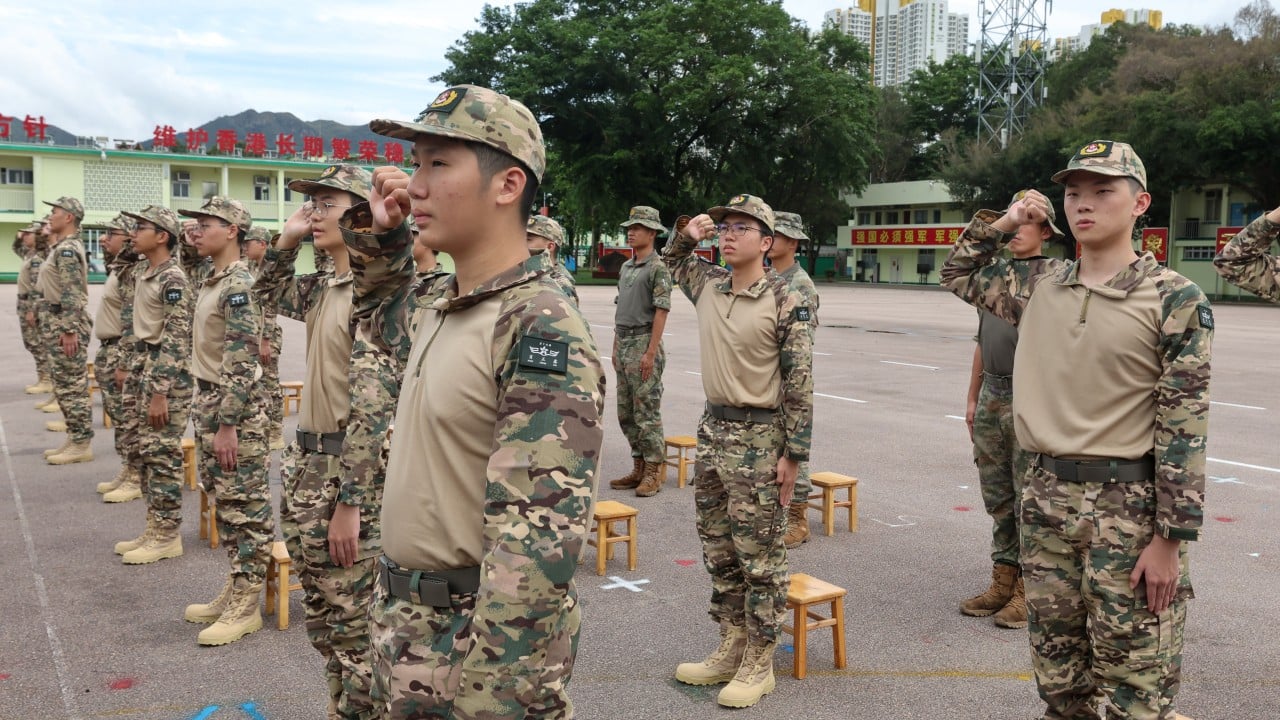
Mass youth programs deployed by state actors operate through precise institutional vectors rather than accidental cultural exchanges. The annual initiative hosted by the People's Liberation Army Hong Kong Garrison, which brings roughly five hundred secondary and tertiary students into the San Wai Barracks for a multi-week immersive program, functions as an operational mechanism for civic alignment and behavioral conditioning. Deconstructing this initiative requires moving past surface-level descriptions of uniforms and drills to analyze the underlying structural incentives, pedagogical mechanisms, and long-term socio-political returns.
The Tripartite Pedagogical Framework
The operational design of the garrison's youth camp relies on three distinct instructional pillars. Each pillar addresses a specific component of behavioral modification, transforming civilian adolescents into disciplined units through structured repetition and environment control.
Physical Compliance and Habituation
The first mechanism is the imposition of strict environmental constraints through military routines. Participants are removed from domestic comfort and placed inside a hyper-regulated military base where schedules, spatial movements, and personal appearance are heavily monitored.
- Spatial Confinement: Operating within the San Wai Barracks restricts external inputs, reducing cognitive distractions.
- Temporal Synchronization: Strict reveille, drill formations, and lights-out schedules enforce a uniform circadian rhythm across all participants.
- Kinesthetic Discipline: Extended standing, synchronized marching, and basic combat drills condition physical obedience and reduce individual variance in favor of collective motion.
This physical friction serves an operational purpose. By stripping away personal autonomy over daily logistics, the program establishes an environment where compliance becomes the default behavioral baseline.
Ideological Alignment and Civic Framing
Alongside physical training, the curriculum integrates structured intellectual inputs focused on national defense, state history, and patriotism. Lectures and garrison exhibitions are curated to frame individual identity within a collective national narrative.
- Contextualizing Authority: Presenting military hardware and history establishes the institutional capability of the state.
- Normative Reinforcement: Flag-raising ceremonies and formal addresses anchor national symbols directly to daily operational routines.
The objective is the internalization of external authority figures as protectors and moral guides, shifting the adolescent frame of reference from local civil identity to a broader national framework.
Team Coercion and Peer Pressure
The structural design leverages peer dynamics to enforce conformity. Group activities, collective evaluations, and shared living quarters create a closed feedback loop where individual failure impacts the collective unit.
- Collective Accountability: Squad performance metrics supersede individual achievements.
- Peer Surveillance: Self-policing emerges naturally within small groups to avoid negative evaluation from garrison instructors.
This social architecture accelerates group cohesion, replacing individualistic friction with cooperative compliance.
The Institutional Cost Function
Evaluating the viability and return on investment of such a program requires analyzing the resource allocation made by the garrison versus the quantifiable output returned to the state apparatus.
The garrison commits substantial capital, personnel, and infrastructure. Active-duty service members act as instructors, barracks space is temporarily reallocated, and administrative overhead is managed directly by military command. The direct cost function includes logistical strain, security management, and opportunity costs associated with diverted military personnel.
The return on investment, however, is measured through qualitative and long-term accumulation of social capital.
- Elite Pipeline Mapping: By targeting secondary and tertiary students, the program touches demographics with higher-than-average societal influence potential.
- Narrative Control: Direct exposure to the military garrison neutralizes adversarial framing, replacing abstract skepticism with personal, highly choreographed lived experience.
- Alumni Network Formation: Graduates form a cohort bonded by shared institutional memory, creating a latent network sympathetic to state objectives within civilian sectors.
The Mechanics of Selection Bias
Participation in the initiative is neither entirely random nor universally accessible. The filtering process introduces a specific selection bias that maximizes the program's efficiency.
Applicants typically originate from institutions where school leadership actively encourages participation, or they represent students already pre-disposed toward civic compliance and national alignment. Consequently, the program rarely converts hostile actors; instead, it reinforces, refines, and deepens the loyalty of marginal or neutral subjects.
This creates a high-efficiency conversion funnel. Resources are not wasted on resistance neutralization. Instead, they are concentrated on high-probability subjects who can act as stabilizing nodes within their respective school networks upon return.
Systemic Limitations and Friction Points
Despite the meticulous design, the program faces intrinsic operational limitations that constrain its long-term scaling capacity.
The first bottleneck is capacity scaling. Housing, feeding, and training cohorts safely within a secure military installation imposes strict upper bounds on participant volume. Processing five hundred students annually represents a tiny fraction of the broader student demographic across the region.
The second limitation is durability decay. The behavioral conditioning achieved during a multi-week immersion is subjected to immediate dilution upon the student's return to regular civilian life, digital ecosystems, and peer groups outside the barracks. Without continuous reinforcement loops, the intensity of the initial alignment degrades over time.
Institutional interventions of this scale rely heavily on controlled environments to manufacture behavioral outcomes. When the physical boundaries of the barracks dissolve, the permanence of the internal shift depends entirely on the ongoing resonance of the narrative introduced during the training window. Future expansions will depend on whether the garrison can bridge the post-camp engagement gap through digital or community-level reinforcement mechanisms. Prioritize digital touchpoints to maintain institutional gravity after participants reintegrate into civilian environments.