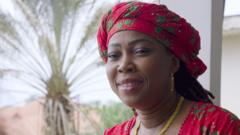
The air inside the registry office smelled of damp paper and cheap cologne. She was fourteen. The man standing next to her, the one buying her childhood with a handful of promises made to her family, was old enough to be her father. Older, even. His hands were thick, his breath heavy with the quiet arrogance of a man who knew the law would take his side. In rural Paraguay, in the closing years of the twentieth century, this was not a crime. It was a transaction.
Her name was Leticia Ocampos.
Most stories about women who escape the gravitational pull of forced marriages follow a predictable script. They run. They hide. They rebuild a quiet, invisible life in the shadows of a world that tried to crush them. But Leticia did not choose invisibility. Decades after she slipped away from the man she would later publicly describe as a perverted predator, she walked into the presidential palace in Asunción. Not as a guest. Not as an activist.
She entered as the First Lady of Paraguay.
Power is a strange, liquid thing. It fills whatever vessel it is poured into, shaping itself to the contours of the container. When her husband, Santiago Peña, assumed the presidency, the nation expected a traditional figurehead. They expected a smiling prop for state dinners, a polite patron of safe charities, a woman who knew how to wave from balconies and stay silent during the debates that actually mattered. Instead, they got an architect. Literally. Leticia had spent her years of freedom earning a degree, learning how to measure stress points, calculate load-bearing capacities, and build structures meant to withstand tectonic shifts.
Now, she is applying those exact principles to the highest levels of governance, and it is tearing the country’s political consensus apart.
To understand the fury she currently provokes, you have to look at the landscape she emerged from. Latin America’s history with first ladies is complicated, often split between the tragic martyrdom of Evita Perón and the quiet, background domesticity of traditional political wives. Leticia refused both archetypes. She did not ask for permission to reshape her office. She simply began dismantling the old infrastructure.
Her critics call her divisive. They claim she is overstepping the unwritten boundaries of an unelected position. In the cafes of Asunción and the toxic echo chambers of social media, the whispers are relentless. Who does she think she is? Why is she driving policy? Who voted for the architect?
The backlash is not actually about constitutional boundaries. It is about discomfort. A woman who survived the absolute bottom of patriarchal vulnerability—a child bride sold into the custody of an abusive older man—is now sitting at the table where the laws of the land are negotiated. Her very presence is an uncomfortable mirror to a society that still struggles with rampant rates of domestic violence and underage exploitation. When she speaks about child protection, it is not the practiced, sanitized rhetoric of a politician's spouse reading a teleprompter. It is the cold, sharp precision of someone who knows exactly what the monsters look like because she used to live with one.
Consider the mechanics of a typical state initiative. Most social programs are designed to be temporary bandages. They offer a meal, a photo opportunity, a ribbon-cutting ceremony, and then the caravan moves on. Leticia’s office began treating social policy like an engineering blueprint. She focused on the Oficina de la Primera Dama (OPD) not as a charity wing, but as a parallel engine for structural reform, targeting early childhood development and women’s economic independence with aggressive, metrics-driven intensity.
This is where the friction turns into open political warfare. In a country where traditional political machismo is woven into the fabric of daily life, an assertive First Lady with her own agenda is viewed as a threat to the administration's stability. Her husband, Santiago Peña, is a US-educated economist, a technocrat who speaks the language of global markets and fiscal discipline. He represents the smooth, polished exterior of modern Paraguay. Leticia represents its raw, unresolved history.
Every time she pushes a policy forward, she exposes the divide between the country’s aspirations and its realities. The political establishment prefers their victims quiet, grateful, and safely tucked away in the past tense. They do not know how to handle a survivor who uses her trauma as a source of leverage rather than a plea for sympathy.
The debate around her role raises a fundamental question that stretches far beyond the borders of Paraguay: What do we actually want from the spouses of our leaders? We demand they be flawless symbols of family values, yet we penalize them if they display the actual grit required to keep a family alive under extraordinary circumstances. We love the narrative of the underdog who beats the odds, right up until the moment that underdog demands a vote on the budget.
Leticia’s allies argue that her critics are operating on double standards rooted in deep-seated misogyny. Her detractors insist their concerns are purely institutional, arguing that an unelected individual should never possess the leverage to influence state resources. The truth, as it usually does, lives in the messy, high-stakes space between those two positions. She is redefining the office through sheer force of will, and in doing so, she has made herself a lightning rod for every anxiety the country harbors about gender, power, and class.
Her life is a masterclass in structural integrity. When an architect designs a building, they must account for the invisible forces that will test it over time—the wind, the shifting soil, the weight of everything inside. You do not build to prevent the storm; you build so that when the storm arrives, the foundation holds.
She survived the first, most brutal storm of her life before she was even old enough to drive. The political theater of Asunción, with all its venom, its media campaigns, and its backroom betrayals, is just another tempest.
On a recent evening in the capital, the lights of the Palacio de López reflected off the dark, slow-moving waters of the Paraguay River. Inside, the receptions carried on, a dizzying display of protocol, fine wine, and diplomatic smiles. Leticia stood amidst the crowd, poised, watchful, and entirely unbothered by the murmurs circulating through the room. She has already been through the worst world anyone could build for her. Now, she is busy building her own.