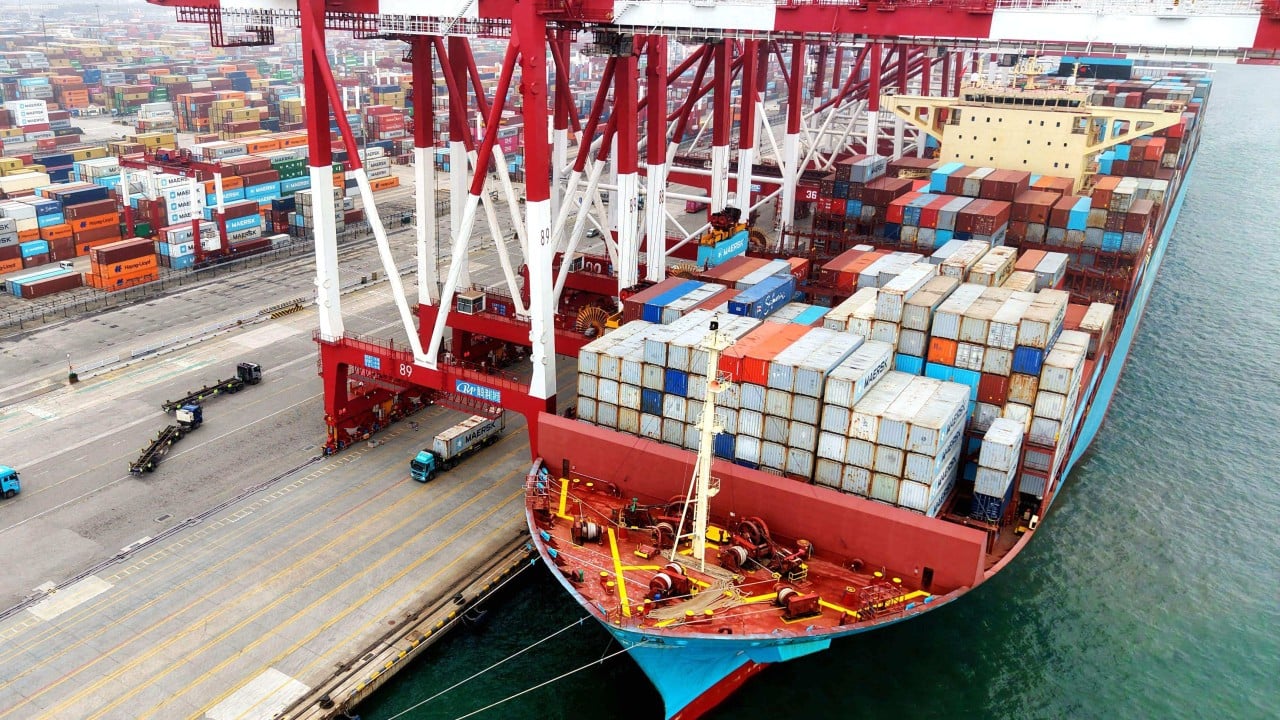
The federal executive branch operates within an institutional frontier defined by statutory delegation. When a constitutional court invalides a specific delegation mechanism, executive agencies do not abandon their policy objectives; instead, they engage in legal arbitrage, identifying parallel statutory authorities to achieve identical macroeconomic outcomes. The Office of the United States Trade Representative (USTR) notice proposing 10% to 12.5% tariffs on 60 trading partners exemplifies this optimization loop. By shifting the formal justification from emergency economic powers to systemic labor standards enforcement under Section 301 of the Trade Act of 1974, the administration seeks to reconstruct a invalidated global trade wall while insulating its protectionist agenda from judicial review.
To evaluate the operational resilience of this trade strategy, one must analyze the institutional bottlenecks, structural cost shifts, and retaliatory dynamics driving this regulatory pivot.
The Statutory Transition Matrix
The administration’s trade policy transformation is a direct response to serial judicial defeats in early 2026. The executive branch has cycled through three distinct statutory frameworks to maintain its targeted tariff revenue and domestic protection margins. The mechanics of these legal levers dictate the speed, scope, and durability of the current trade restrictions.
+---------------------------------------------------------------------------------------+
|                       STATUTORY EVOLUTION OF EXEC TARIFF LEVERS                       |
+---------------------------------------------------------------------------------------+
|  1. IEEPA (International Emergency Economic Powers Act of 1977)                       |
|     - Mechanism: Global blanket duties via national emergency declaration              |
|     - Status: Struck down by US Supreme Court (Feb 2026); exceeded statutory intent   |
|                                                                                       |
|  2. Section 122 (Trade Act of 1974)                                                   |
|     - Mechanism: Short-term stopgap 10% universal tariff                              |
|     - Status: Invalidated by US Court of International Trade (May 2026); 150-day cap  |
|                                                                                       |
|  3. Section 301 (Trade Act of 1974)                                                   |
|     - Mechanism: Country-by-country variable levies targeting "unreasonable" practices |
|     - Status: Active proposal phase; high historical resilience to judicial review    |
+---------------------------------------------------------------------------------------+
The pivot to Section 301 explicitly addresses the structural vulnerabilities exposed by the invalidation of the International Emergency Economic Powers Act (IEEPA) and Section 122 frameworks. While IEEPA granted sweeping authority under national emergency declarations, the Supreme Court ruled that its application to global, indefinite revenue generation unconstitutionally usurped Congress's core taxation powers. Similarly, Section 122 limits emergency balance-of-payments interventions to a strict 150-day window, creating an operational shelf-life that expires on July 24, 2026.
Section 301 alters the legal battleground by shifting the core argument from broad executive privilege to a specific, evidence-backed investigation into "unreasonable, unjustifiable, or discriminatory" foreign state actions. By anchoring the new 10% to 12.5% tariffs to a comprehensive, 100-page forced labor enforcement report, the USTR creates a substantial evidentiary record. This record triggers a highly deferential standard of judicial review, significantly raising the legal bar for importing industries trying to challenge the actions in court.
The Microeconomics of the Forced Labor Pretext
The USTR’s economic rationale relies on a cost-externalization framework. The administration argues that trading partners who fail to enforce strict domestic prohibitions on forced labor effectively subsidize their export sectors. This failure creates an unlevel playing field through an asymmetric regulatory advantage.
The cost function of a domestic manufacturing firm subject to compliance standards is expressed as:
$$C_{domestic} = f(W_{market}, R_{compliance}, K)$$
Where $W_{market}$ represents market-clearing wages, $R_{compliance}$ represents domestic regulatory compliance costs, and $K$ represents capital expenditures. Conversely, an economy that tolerates forced labor inputs alters its cost structure to:
$$C_{distorted} = f(W_{coerced}, R_{null}, K)$$
Because $W_{coerced} \ll W_{market}$ and $R_{null} \rightarrow 0$, the foreign entity can export goods at a price point below the marginal cost of compliant domestic producers.
The USTR uses this cost differential to justify its two-tiered tariff structure:
- Tier 1 (10% Levy): Applied to 16 highly integrated trading partners—including Canada, Mexico, the United Kingdom, Taiwan, and the European Union. These economies possess robust domestic labor laws but are penalized for failing to prevent the transshipment of upstream inputs produced via forced labor.
- Tier 2 (12.5% Levy): Applied to 44 nations—including China, India, Japan, and South Korea—where systemic domestic enforcement gaps or direct supply chain exposures are explicitly documented.
By structuring the tariffs around regulatory omissions rather than direct state actions, the USTR addresses a key administrative challenge: it establishes a uniform mechanism to penalize both adversarial supply chains (e.g., cotton from the Xinjiang region) and allied economies that serve as transshipment hubs.
Supply Chain Reconfiguration and the Inflationary Bottleneck
The operational reality of managing multi-tiered global supply chains makes the USTR’s explicit exemptions necessary. To prevent acute consumer price spikes just ahead of the midterm elections, the administration has carved out an exempt annex of critical goods. These exclusions illuminate the structural dependencies of the domestic economy.
Strategic Exemptions and Critical Dependencies
The exclusion list isolates specific industrial inputs from the tariff wall:
- Aerospace Components: Commercial aircraft parts are exempted due to highly concentrated global duopolies and long certification cycles, where switching suppliers takes years.
- Agricultural and Consumer Foodstuffs: Commodities ranging from coffee to beef are excluded to minimize direct, highly visible inflation at the grocery store.
- Rare Earth Elements and Critical Minerals: Minerals necessary for domestic defense and technology manufacturing remain untariffed, acknowledging that the United States lacks immediate domestic extraction and processing capacity.
The De Minimis Loopholes and Transshipment Risk
For non-exempt industrial and consumer goods, the double-digit Section 301 tariffs introduce severe structural compliance risks. The immediate corporate risk centers on supply chain transparency. Organizations operating in countries like the UK or Mexico face a complex tracking burden to prove their intermediate inputs contain zero components from the 44 higher-tariff Tier 2 nations.
Furthermore, the administration's parallel enforcement actions to close the de minimis shipping exemption mean that low-value direct-to-consumer shipments can no longer bypass customs audits. The intersection of Section 301 enforcement with broader customs sweeps will create significant bottlenecks at major US ports of entry. This will drive up administrative costs and increase delivery lead times for mid-market retail and manufacturing supply chains.
Macro Financial Objectives and Revenue Matching
Beyond the stated labor-compliance objectives, this regulatory shift serves an underlying fiscal purpose: replacing lost federal revenue. The invalidation of the initial global tariffs left a significant multi-billion-dollar hole in the executive branch’s fiscal planning, which was intended to offset the revenue losses from the 2025 corporate tax cuts.
+---------------------------------------------------------------------------------------+
|                        FISCAL DYNAMICS OF EXEC TARIFF WALLS                           |
+---------------------------------------------------------------------------------------+
|  [Tariff Invalidation (IEEPA/Sec 122)] ---> [Multi-Billion Dollar Revenue Deficit]    |
|                                                         |                             |
|                                                         v                             |
|  [Proposed Sec 301 Forced Labor Levies] <--- [Offsets 2025 Corporate Tax Cuts]        |
|                                                         |                             |
|                                                         v                             |
|  [Macroeconomic Consequences] --------------------------------------------------------+
|     * Sustained high consumer prices due to cost pass-through                         |
|     * Sharp reduction in overall international trade volumes                          |
|     * Corporate profit compression across import-dependent sectors                     |
|     * Elevation of sovereign debt volatility in exposed emerging markets              |
+---------------------------------------------------------------------------------------+
Tariffs function as consumption taxes collected at ports of entry, paid directly by domestic importing entities. When these revenues are eliminated by judicial order, the federal deficit widens unless government spending decreases or alternative revenue is generated.
By designing a country-by-country Section 301 framework that avoids a single global declaration, the administration can adjust individual country rates to maintain its revenue targets. However, this fiscal strategy faces a structural trade-off. To the extent that these double-digit tariffs successfully force companies to reshore production or switch suppliers, the overall volume of taxable imports will fall, ultimately shrinking the tariff tax base over time.
In the short to medium term, this policy shifts the tax burden onto import-dependent sectors, compressing corporate margins and sustaining elevated consumer prices.
Strategic Countermeasures and Retaliatory Scenarios
The assumption that trading partners will passively absorb Section 301 tariffs to maintain access to the US market ignores established geopolitical patterns. The European Commission’s rapid pushback underscores that US allies intend to challenge the legal basis of these labor-pretext tariffs, pointing to their own domestic Forced Labour Regulations as proof of compliance.
As the mandatory public comment period proceeds, international trade ministries are preparing multi-track defensive playbooks.
Track 1: WTO Dispute Settlement and Legal Retaliation
Affected nations will file formal complaints with the World Trade Organization (WTO). While the US has previously limited the WTO's enforcement power by blocking judicial appointments to its Appellate Body, European and Asian trade blocs will likely bypass the deadlocked formal system. They can leverage the Multi-Party Interim Appeal Arbitration Arrangement (MPIA) to establish international legal consensus and justify coordinated retaliatory tariffs.
Track 2: Asymmetric Targeted Counter-Tariffs
Foreign governments will likely target their retaliatory measures to maximize political pressure ahead of the upcoming US midterm elections. Rather than applying broad across-the-board tariffs, trading partners historically choose politically sensitive US export sectors, including:
- Agricultural Exports: Concentrating tariffs on Midwest soybeans, pork, and corn to directly affect agricultural regions.
- High-Value Manufacturing: Targeting specific industrial products, such as aerospace exports or specialized machinery, to create localized economic pressure.
- Capital Mobility Barriers: Restricting market access for US services firms and tightening regulatory scrutiny on American digital platforms operating abroad.
Track 3: The Threat of Secondary Oversupply Investigations
The USTR is already preparing its next protectionist step: a parallel Section 301 investigation into industrial overcapacity across 16 major trading partners. This double-track approach—combining labor compliance penalties with potential overcapacity duties—signals that the administration views these investigations as flexible tools to manage trade volumes. This creates a challenging environment of continuous regulatory uncertainty for global supply chain managers.
Tactical Playbook for Supply Chain Executives
Firms cannot afford to wait for the conclusion of the USTR’s public comment period or the subsequent legal challenges. Navigating this environment requires immediate changes to supply chain and financial operations.
- Execute a Tiered Input Audit: Companies must immediately trace their supply chains down to the raw material level. If a Tier 1 country (e.g., Mexico or the UK) processes inputs sourced from a Tier 2 nation (e.g., China or India), the final product faces high customs scrutiny and potential tariff penalties based on transshipment rules.
- Re-index Supply Chain Contracts: All future international supply and purchase agreements should move away from fixed-price structures. Contracts must include explicit "Tariff Alteration Clauses" that automatically reallocate customs liabilities and allow for volume adjustments if import duties rise above a specified baseline.
- Establish Tariff-Advantaged Legal Hubs: Organizations should explore moving their final assembly or significant transformation processes to countries that maintain active bilateral exemptions or have demonstrated strong compliance records that shield them from Section 301 actions.
- Optimize Financial Cash Reserves: Given that the Court of International Trade has shown a willingness to strike down executive trade overreach, companies should track all tariff payments under protest. Setting up clear accounting structures for these payments will streamline the process of claiming federal refunds if these Section 301 labor tariffs face future legal or judicial rollbacks.