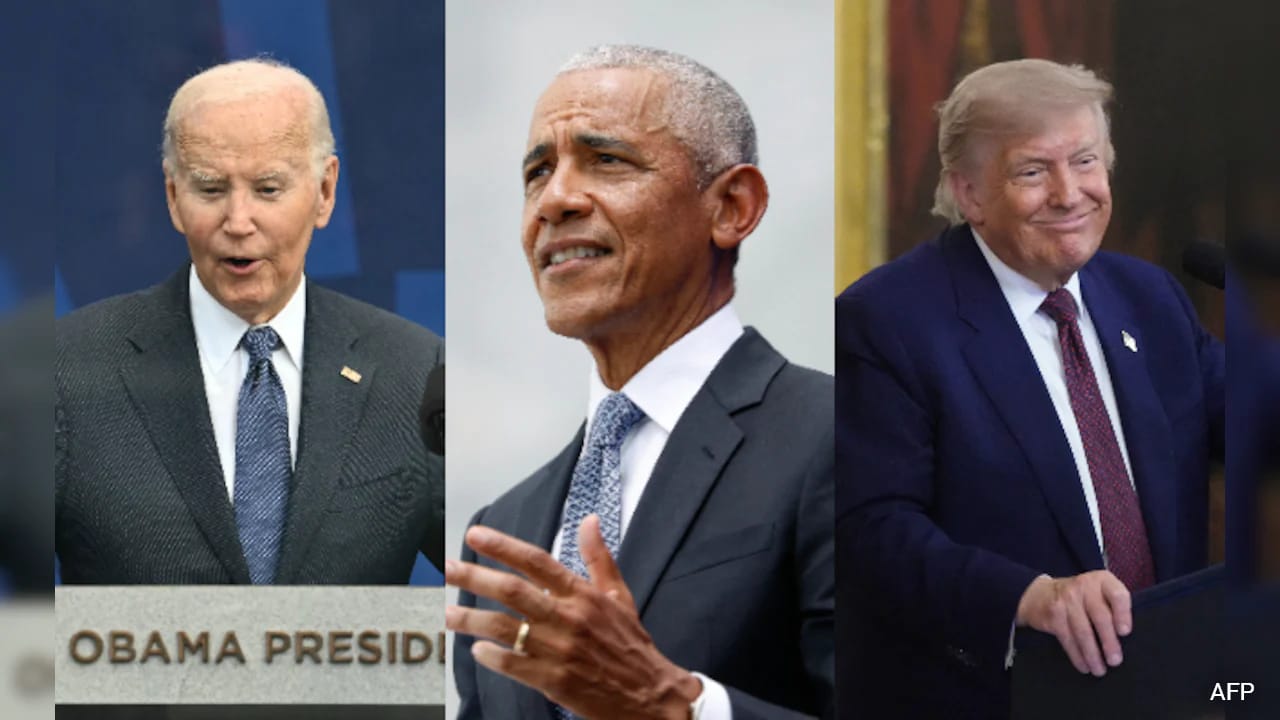
The divergent trajectories of public favorability ratings for Barack Obama, Donald Trump, and Joe Biden are not random fluctuations of public sentiment. They are the direct output of structural mechanisms in contemporary political sociology. Data from recent national polling demonstrates a stark equilibrium: Barack Obama maintains a 57% favorability rating, significantly outperforming Donald Trump at 34% and Joe Biden at 30%.
Understanding this disparity requires moving past surface-level media narratives about personal charisma or partisan grievance. Instead, the data must be analyzed through structural frameworks that isolate the variables governing public opinion decay, active governance liabilities, and coalition design.
The Ex-Presidential Insulation Premium
The primary driver of the statistical gap between a former two-term executive and active or recently active executives is the structural transition from policy actor to cultural symbol. When a president leaves office and clears the immediate legislative theater, their public profile undergoes a functional transformation.
- Decoupling from Hyper-Partisan Churn: An active president must make binary choices on highly controversial subjects—such as executive orders, fiscal budgets, and international conflicts. Every choice creates a hard policy footprint that alienates moderate or opposing voters. A former president is freed from this legislative requirement, halting the continuous accumulation of policy-driven disapproval.
- The Nostalgia Deflator: Public memory operates with a high rate of decay regarding specific systemic frustrations. Over time, negative historical externalities—such as the gridlock of mid-term sessions or localized economic downturns—recede from immediate public consciousness, leaving behind a generalized ideological or symbolic memory.
- The Out-of-Theater Strategic Siting: By focusing on civic infrastructure, structural archiving, and non-legislative public appearances, a former executive can control the context of their public exposure, minimizing the risk of unforced rhetorical errors.
This insulation explains why Obama holds a near-universal 94% backing within his own party and maintains a substantial lead among political independents. For an independent voter, a retired executive represents a historical baseline rather than an immediate threat to their tax rate, judicial preferences, or regulatory philosophy.
The Polarization Floor and the Elasticity Bottleneck
To evaluate why Donald Trump and Joe Biden exhibit significantly lower favorability ceilings, we must analyze the structural mechanics of their core voting coalitions. This requires separating public support into two distinct categories: rigid partisan loyalty and elastic independent alignment.
The Asymmetric Mechanics of the Trump Coalition
Trump’s public standing defies traditional presidential popularity models due to its extreme inelasticity. His favorability occupies a narrow, highly predictable band, anchored by an unyielding base but capped by an equally unyielding opposition.
- High Intensity, Restricted Breadth: While 53% of Republicans name Trump as the historical president they most admire, his appeal fails to convert independent or cross-party voters. His favorability among independents is less than half of Obama's.
- The Constant Campaign Friction: Unlike traditional former executives who retreat from the daily news cycle, Trump remains an active legislative and electoral actor. Because he continuously drives the contemporary political debate, he does not benefit from the ex-presidential insulation premium. He faces the same immediate, daily disapproval penalties as an active incumbent.
- The Anti-Alignment Core: The polarization surrounding his political brand ensures that opposition is not merely passive disagreement but active resistance. Data shows that 90% of opposing partisans strongly disapprove of his performance, creating an absolute mathematical ceiling on his national favorability expansion.
The Structural Collapse of the Biden Coalition
Joe Biden's drop to a 30% favorability rating—lower than his lowest marker during his actual presidency—highlights a different structural problem: coalition deflation without an ideological floor.
- The Transactional Nature of the Coalition: Biden's 2020 and 2024 voting blocs were assembled as defensive, anti-Trump coalitions rather than deeply ideological alignments. When a coalition is built primarily on opposition to an alternative, it lacks the intrinsic loyalty required to withstand long-term economic and geopolitical stress.
- The Depressed Remnant Effect: Once out of direct contention, a transactional leader loses their strategic utility to the voter base. Democratic voters looking for future executive leadership quickly migrate their attention elsewhere, leaving the former incumbent exposed to retrospective criticism from both the left flank and the political center.
- The Loss of Party Unity: Unlike Obama's near-total retention of Democratic loyalty, Biden's intra-party support has eroded as different factions assign him responsibility for recent electoral setbacks and unresolved systemic challenges.
Active Governance Liabilities and Economic Attribution Bias
The metric that most severely suppresses both Trump and Biden's contemporary standing is the direct political penalty of active or recent governance during macroeconomic instability. The public applies a harsh attribution bias to sitting executives, holding them fully responsible for complex global market movements.
[Macroeconomic Pressures: Fuel/Food Inflation]
                   │
                   ▼
[Direct Executive Attribution Bias]
                   │
                   ▼
[Erosion of the Moderate/Independent Voting Base]
                   │
                   ▼
[Sinking of the Favorability Ceiling to the Hard Partisan Floor]
The ongoing economic friction caused by high energy costs, grocery inflation, and international conflict impacts active leaders directly. A dominant majority of the public connects affordability challenges directly to current executive decision-making.
This reality exposes the core vulnerability of any active leader's popularity model. When food and energy costs spike, independent voters—who prioritize kitchen-table economics over ideological loyalty—abandon their support. This causes an executive's favorability ceiling to drop rapidly toward their hard partisan floor. Obama's current numbers are preserved precisely because his record is decoupled from these immediate economic anxieties, transforming his era into a retrospective benchmark for affordability and stability.
The Retrospective Reassessment Matrix
The differences in how these three figures are viewed can be mapped across two distinct dimensions: the intensity of partisan loyalty and the level of structural insulation from daily political conflict.
- High Insulation, High Elasticity (The Obama Model): Maximizes favorability by combining a unified partisan base with a broad appeal to independents. This approach works by keeping the leader out of the daily legislative crossfire, allowing their public image to soften into a positive historical symbol.
- Low Insulation, High Inelasticity (The Trump Model): Maintains a solid popularity floor through intense partisan loyalty, but faces an absolute ceiling because of continuous involvement in daily political battles. This ongoing friction alienates moderate voters and prevents any retrospective boost.
- Low Insulation, Low Inelasticity (The Biden Model): Represents the most vulnerable position, where a leader faces the fallout of current economic or political crises without a deeply loyal ideological base to cushion the decline.
Strategic Forecast for Political Formations
The structural stability of Barack Obama's favorability numbers suggests that his position as the most popular living president will remain secure through the current electoral cycle. His numbers are protected from immediate political shifts, making him an incredibly valuable asset for party fundraising, candidate endorsement, and voter mobilization.
For modern political strategists, this data offers a clear lesson for future presidential campaigns. Relying on an intense but narrow base provides a reliable floor, but it introduces a structural bottleneck that prevents a candidate from winning over a broader national majority. Conversely, building a loose, purely transactional coalition might win a single election, but it leaves a leader highly vulnerable to rapid deflation when economic or global crises hit.
The smart play for parties preparing for the next national alignment is to focus on candidates who can build deep ideological loyalty while also maintaining broad appeal among independent voters. Achieving long-term political viability requires cultivating a brand that can survive the transition from the active legislative arena to historical memory without getting trapped by the rigid ceilings of deep partisan polarization.


