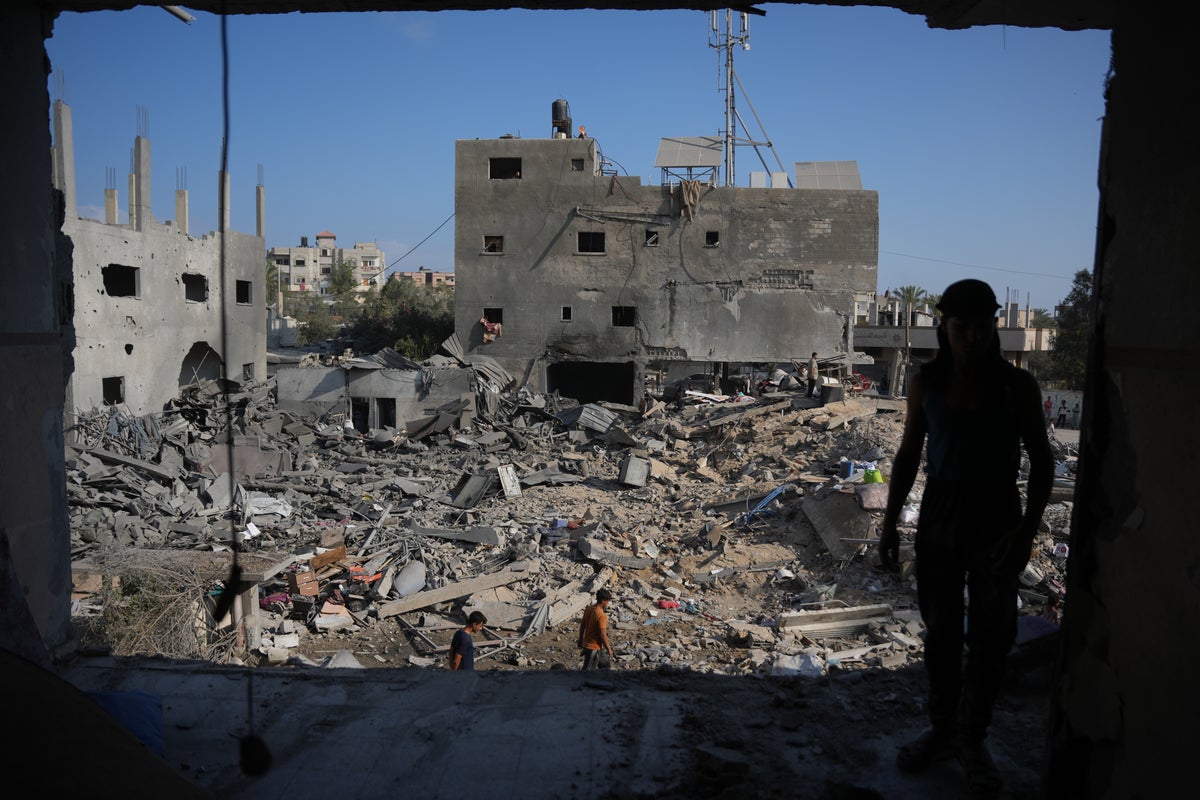
Post-conflict infrastructure initiatives collapse when capital allocation strategies ignore physical operational bottlenecks, political risk, and sovereignty constraints. The Trump administration’s Board of Peace (BoP) model for Gaza—which initially proposed a $25 billion to $112 billion overhaul featuring 180 coastal skyscrapers, high-tech industrial zones, and autonomous deep-sea ports—represents a textbook structural failure in high-risk project management. By scaling back its macro-reconstruction blueprint to a localized pilot camp in southern Gaza near Rafah, the entity has acknowledged an inescapable economic reality: physical capital cannot bypass the fundamental legal, material, and security mechanics of the territory.
Understanding why a multi-billion-dollar metropolis proposal degenerates into a temporary displaced-persons facility requires analyzing the structural friction points that govern post-conflict civil engineering.
The Three Bottlenecks of Post-Conflict Capital Deployment
Capital commitments in war-torn regions do not translate into physical structures without passing through three sequential gates. Failure at any single stage halts downstream operations.
1. The Capital Disbursemnt Friction Metric
Declarative financial pledges from international summits rarely convert into operational liquidity. Out of an initial $7 billion pledged across nine partner nations at the inauguration of the Board of Peace, actual cash transfers stood at approximately $123 million—consisting of $23 million for administrative overhead and $100 million earmarked for security force training. This yields a capital conversion rate of roughly 1.75%. Sovereign balance sheets withhold funding when governance mechanisms lack regulatory clarity, oversight protocols, or a legally defined property rights framework.
2. Physical Material Ingress Constraints
Civil engineering projects require high-volume material throughput. Under existing security frameworks, the entry of basic structural inputs—reinforced steel, concrete aggregates, water piping, and heavy earth-moving equipment—is constrained by strict dual-use material regulations. When material flows are capped at a fraction of baseline construction needs, supply chains stall indefinitely. A high-rise urban development strategy requires tens of thousands of metric tons of structural inputs per month; limiting these inputs degrades large-scale development plans into localized, low-density logistics staging.
3. The Security Risk Premium
Institutional investors require predictable risk profiles. Commercial real estate development, hospitality infrastructure, and industrial zones rely on long-term debt financing that cannot be underwritten in an environment characterized by unresolved kinetic risk, unverified demilitarization, and unclear legal jurisdiction. Sovereign risk models classify sovereign debt and municipal guarantees in un-demarcated zones as non-investment grade, preventing non-state equity participation.
Structural Breakdown of the Reconstruction Framework
[ Macro Renderings: Skyscrapers / Ports ]
                    │
                    ▼  (Blocked by dual-use material restrictions)
[ Capital Friction: 1.75% Conversion Rate ]
                    │
                    ▼  (Blocked by high security risk premium)
[ De-escalated Scope: Localized Staging Camps ]
The pivot from full-scale urban master planning to a micro-pilot camp near Kerem Shalom highlights a severe structural miscalculation. The original proposition treated post-conflict reconstruction as a greenfield real estate exercise, attempting to superimpose modern commercial infrastructure over unresolved geopolitical and municipal conditions.
The Operational Reality of the Pilot Project
The scaled-down initiative focuses on a heavily monitored, low-density installation near Rafah. Instead of permanent residential towers, the operational focus has shifted to establishing basic survival infrastructure:
- Logistical Security Outposts: Establishing operational nodes at entry points such as Kerem Shalom to store basic vehicles and material assets.
- Targeted Auxiliary Forces: Deploying small, international stabilization contingents to manage localized perimeter security rather than broad urban policing.
- Technocratic Municipal Function: Relying on the National Committee for the Administration of Gaza (NCAG)—a 15-member body of appointed technocrats—to administer essential municipal functions (water, waste, basic power) without broader sovereign policy authority.
Governance Mechanisms and Property Rights Arbitrage
A primary vulnerability of top-down developmental models is the failure to resolve internal economic ownership. Transforming densely populated, highly fragmented urban ruins into commercial corridors requires clear land titles and eminent domain frameworks.
- Land Title Obscurity: Multi-decade conflict cycles erase land registries. Establishing high-density commercial assets over contested residential plots invites perpetual litigation, expropriation claims, and social friction.
- External Administrative Control vs. Local Ownership: Establishing external oversight through non-local entities creates an institutional principal-agent problem. Local populations view externally imposed master plans as extractive rather than generative, driving non-compliance, legal resistance, and administrative paralysis.
- The Infrastructure Sequence Paradox: Advanced civic infrastructure (airports, automated logistics nodes, luxury seafront developments) requires foundational stability: working sewage treatment, uninterrupted power grids, functioning primary healthcare, and uninhibited transit. Attempting to build tier-one commercial assets atop broken municipal utilities guarantees capital destruction.
Strategic Requirements for Realizable Reconstruction
To move past theoretical master plans and achieve physical execution, any reconstruction authority must implement a phased, operationally grounded framework:
- Phase I: Basic Utility Stabilization. Priority capital allocation must target water desalination, electrical grid restoration, and rubble clearance before civil structures are designed.
- Phase II: Dual-Use Material Protocol Standardization. Establishing verified, transparent supply chain auditing mechanisms with regional partners to clear fundamental construction materials through border checkpoints.
- Phase III: Property Rights and Municipal Verification. Rebuilding local civic registries to legally codify property ownership, ensuring displaced residents retain economic equity in rehabilitated zones.
- Phase IV: Tiered Commercial Capital Integration. Introducing private debt and foreign direct investment only after baseline security, legal title clarity, and municipal utility performance reach verifiable thresholds.
Without executing these sequential groundwork steps, ambitious development proposals remain confined to digital renderings, while ground realities default to emergency containment structures.