The morning air in Ramallah smells of dry limestone dust, roasting coffee beans, and the acrid tang of diesel exhaust drifting from a nearby transit station. Before the sun clears the Judean hills, the city is already awake. It does not wake gently. It stirs with a familiar, low-grade anxiety, a collective holding of breath that has persisted for generations. Minarets call out the dawn prayer, their echoes bouncing off concrete apartment blocks built too close together, under a sky that is rarely quiet. Overhead, a surveillance drone hums with the steady, invisible persistence of a hornet.
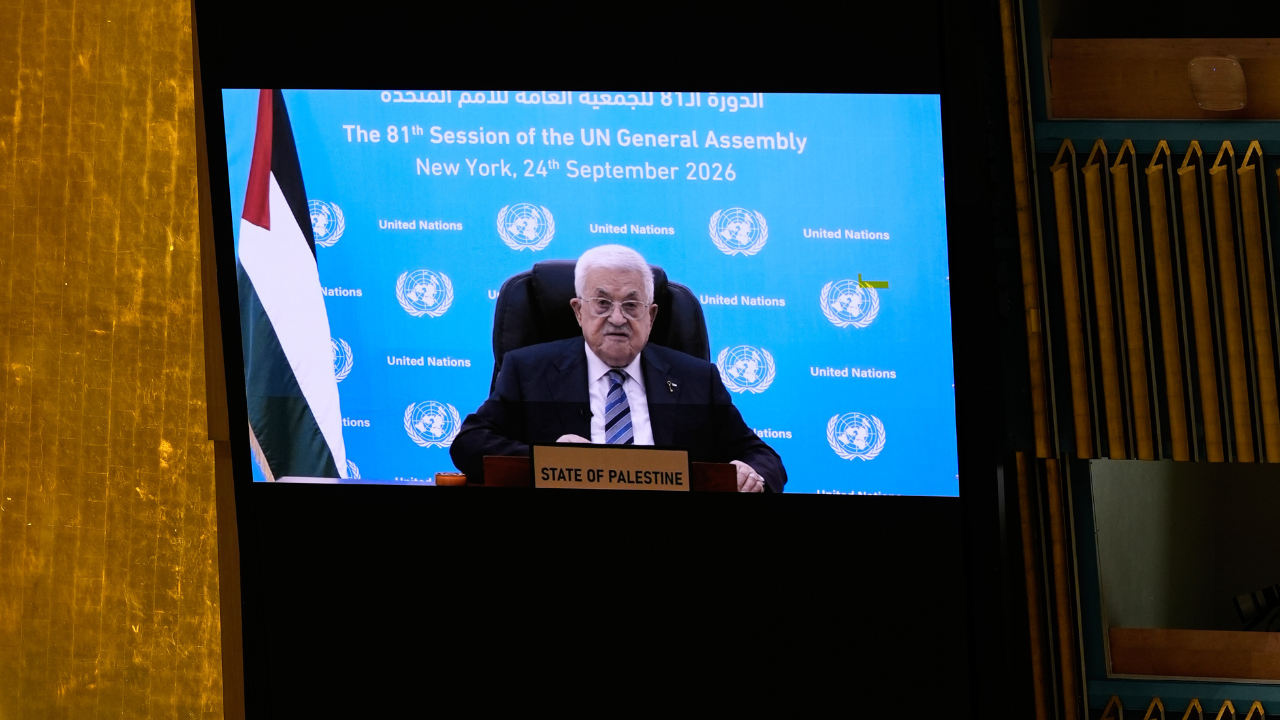
Thousands of miles away, inside the vaulted, marble-lined halls of the United Nations headquarters in New York, microphones catch the rustle of paper and the murmur of translators shifting in their glass booths. Mahmoud Abbas steps up to the mahogany podium. His voice is measured, tired, carrying the weight of octogenarian longevity spent inside a conflict that refuses to resolve. He speaks of red lines, of international law, of an occupying power systematically dismantling the physical and political fabric of Palestinian life. He uses terms like "existential threat" and "systemic erasure." Meanwhile, you can find similar events here: When Seven Hundred and Eighty One Souls Touch the Shingle.
To the casual observer scrolling through a news feed in a quiet suburb halfway across the globe, these are familiar diplomatic cadences. They are words that wash over television screens like weather reports—predictable, recurring, easily muted.
But words spoken in New York possess a strange, distorted echo when they land in the alleys of the West Bank or the scarred landscape of Gaza. They are abstractions trying to capture an earthquake. To understand what a threat to "life and existence" actually means, you have to look past the podium and down into the soil, where policy is measured not in resolutions, but in meters of concrete, hours lost at checkpoints, and trees pulled from the earth by their roots. To explore the complete picture, check out the detailed article by TIME.
Consider what happens when a map is redrawn without your consent.
For decades, the West Bank has not been a unified territory on a geographical map; it is an archipelago. Imagine your own country chopped into twenty separate islands, each surrounded by a different jurisdiction, connected only by winding dirt tracks and guarded intersections where your right to pass depends entirely on the mood of an eighteen-year-old soldier holding a rifle. This is the reality of Area A, B, and C—a bureaucratic jigsaw puzzle designed to make self-determination an impossibility.
To visualize this, picture a house where you are allowed to sleep in your bedroom, but the hallway belongs to someone else. You need a permit to walk to the kitchen. You need a different permit to visit your parents in the next room. Eventually, the corridor narrows. A locked gate appears. Then a concrete wall is poured overnight, slicing your courtyard in half.
This is not a metaphor for policy; it is the policy itself.
Every morning at four o'clock, thousands of men from villages near Bethlehem and Jenin join a silent pilgrimage toward the checkpoints. At Qalandiya, the concrete barriers form a snaking maze reminiscent of an industrial slaughterhouse. People press shoulder-to-shoulder in the pre-dawn chill. There are no grand political speeches here. There is only the shuffle of worn shoes on asphalt, the glow of cheap smartphone screens illuminating anxious faces, and the looming threat of the iron turnstile.
If a soldier's computer glitches, if a permit is deemed expired by three days, if a security alert closes the crossing without warning, the journey ends. A day laborer loses his daily wage. A university student misses an exam. A cancer patient misses an oncology appointment in East Jerusalem. These are small tragedies, seemingly invisible against the grand canvas of geopolitical headlines. Yet, multiplied by millions and repeated every single day for decades, they form an invisible machinery of attrition. Life is not extinguished in a single dramatic explosion; it is drained slowly, drop by drop, through a thousand administrative paper cuts.
Then there are the olive trees.
In the Mediterranean basin, an olive tree is not merely agricultural property. It is an ancestor. Trees planted during the Ottoman era or under British mandate stand with gnarled, sculptural trunks, bearing fruit that has fed families for centuries. To touch their bark is to touch history.
Under the expanding network of settlements and security zones, these orchards have become front lines. By legal definitions established through military orders and zoning laws, thousands of acres of Palestinian-owned land are periodically designated as state land, closed military zones, or areas slated for bypass roads.
Imagine spending your entire life tending an orchard—pruning the branches in winter, plowing the rocky soil in spring, harvesting the green and purple drupes in autumn—only to wake up one October morning and find a row of orange bulldozers parked at the edge of your property line. An administrative demolition order, written in a language you cannot read, is taped to a boulder. You have forty-eight hours to appeal to a military court where the deck is stacked before the gavel even falls.
When the chain saws start, they do not just cut wood. They cut the economic lifeline of a village. They sever the tether connecting a people to their own geography. When an old man watches a two-hundred-year-old tree crash into the dust, he is witnessing the deliberate erasure of his family's footprint on the earth. This is what Abbas meant when he spoke at the UN about existence under siege. Existence is not just breathing; it is belonging to a place that recognizes your right to be there.
The political stagnation compounds this daily erosion. For thirty years, the peace process has functioned as a diplomatic ghost ship—ghostly sails billowing in the wind of endless conferences, bilateral talks, and international communiques, while the hull sits firmly grounded on the reefs of reality.
On the ground, facts are being established with concrete and asphalt. Settlement outposts—illegal even under domestic law—sprout on hilltops overlooking Palestinian valleys. Roads are paved to connect these communities to Tel Aviv, complete with lighting and high-speed lanes, while adjacent Palestinian villages remain unpaved, disconnected from water grids, and denied permits to build a single additional room for a growing family.
When young people grow up in this environment, their psychological horizon is bounded by walls. They inherit a world where their grandparents talk of a time when you could drive from Gaza to Haifa without seeing a single soldier, while they themselves cannot travel thirty miles north without passing three military bases and a dozen watchtowers.
Despair is a quiet pollutant. It seeps into the water table of a society. It creates a vacuum where extremism finds fertile ground, not because people are born radical, but because peaceful avenues of redress have been systematically bricked up. When the law offers no protection, when diplomacy produces only communiques, and when international bodies offer eloquent speeches followed by complete inaction, the human mind begins to look for alternatives born of sheer frustration.
Yet, beneath the surface of this manufactured hopelessness, an astonishing stubbornness persists.
It is visible in the baker in Nablus who fires up his stone oven at midnight regardless of whether there is a curfew looming. It is visible in the university students who set up makeshift desks in the rubble of a demolished community center. It is visible in the women who embroider traditional motifs onto dresses, preserving patterns that map out villages that no longer exist on modern maps.
This resistance is not cinematic. It does not look like a Hollywood war movie. It looks like endurance. It looks like planting a sapling where an old tree was cut down, knowing full well that the seedlings may not bear fruit in your lifetime.
When world leaders gather in New York to debate resolutions, they operate in a realm of diplomatic geometry where countries are colored blocks on a map and populations are demographic statistics. But nations are made of flesh, blood, memory, and soil.
The speech at the UN was not just a diplomatic maneuver. It was a flare sent up from a sinking ship, a final attempt to pierce the insulation of international indifference. It reminded the world that a people cannot be kept indefinitely in a state of suspended animation—neither sovereign nor citizens, neither free nor formally enslaved, suspended in the administrative purgatory of a permanent occupation.
History suggests that systems built on containment and the slow suffocation of a population carry their own inevitable reckoning. Walls do not just keep people out; they trap those inside in a shared destiny. They create a pressure cooker with no safety valve.
As the sun sets over the hills of the West Bank, turning the limestone dust a bruised shade of violet, the minarets call out the evening prayer. The surveillance drones continue their rhythmic hum against the emerging stars. Down in the valley, an old farmer walks back from his half-demolished grove, carrying a basket of bruised olives. He stops at the edge of the path, runs his calloused hand over the rough bark of a surviving tree, and looks out toward the darkening horizon, where the lights of a settlement twinkle brightly against the quiet, stubborn dark.