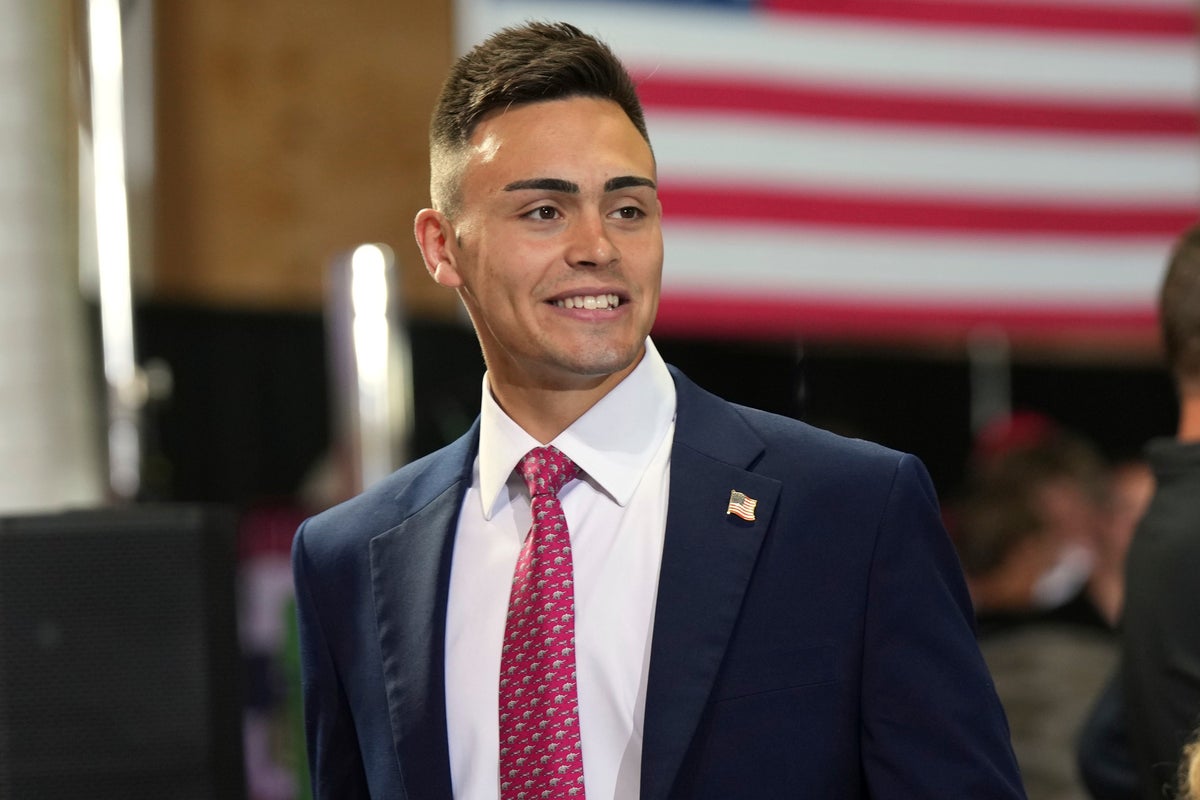
The Republican primary for Wisconsin’s 7th Congressional District serves as a definitive case study in the structural limits of national endorsements when mapped against entrenched local political infrastructure. The candidacy of 26-year-old Michael Alfonso, son-in-law of U.S. Transportation Secretary Sean Duffy, presents a clear structural paradox: the combination of an explicit endorsement from President Donald Trump and a major capital advantage is facing deep friction from the district's organic party leadership. This dynamics reveals a widening systemic gap between centralized executive influence and localized grassroots power structures.
To evaluate whether top-down signaling can overcome institutional resistance, the electoral environment must be disconstructed into clear component variables: capital volume, institutional legacy, and voter alignment matrices.
The Capital Allocation Framework and Transport Interest Asymmetry
In modern primary mechanics, financial capital functions as the primary mechanism to compensate for a deficit in local name recognition. The financial architecture of Alfonso’s campaign relies on concentrated, high-volume transfers rather than a broad base of small-dollar grassroots contributions within northwestern Wisconsin.
Three specific capital injections define this resource base:
- The Campaign Committee Conduit: A $1 million transfer from the "Duffy for Wisconsin" account—originally accumulated during Sean Duffy’s congressional tenure from 2011 to 2019—to Northwoods Future PAC. This transfer navigates the regulatory boundary of federal election law, which restricts direct committee-to-candidate contributions to $2,000 per election cycle, yet permits unlimited transfers to independent expenditure-only committees (Super PACs).
- Megadonor Matching: A matching $1 million cash injection to Northwoods Future PAC from billionaire industrialist Richard Uihlein, the founder of Uline.
- Sector-Specific Capital Influx: Tens of thousands of dollars in direct and indirect donations originating from transportation sector interests.
This third variable introduces a specific institutional correlation. Because Sean Duffy serves as the head of the federal agency tasked with regulating and funding national transportation infrastructure, the concentration of transportation-sector capital into his son-in-law's race creates a distinct structural critique. Local competitors, including financial planner Kevin Hermening, point to this pattern as a transactional vulnerability, arguing it implies future legislative indebtedness.
The capital allocation strategy here seeks to achieve market saturation via independent expenditures, bypassing traditional county party fundraising pipelines. The efficiency of this strategy is counterbalanced by the strategic deployment of capital by rivals, such as corporate executive Jessi Ebben, who commands backing from alternative factions of the state’s conservative financial establishment.
The Endorsement-Infrastructure Disconnect
The political friction in the 7th District can be modeled by analyzing the clash between two distinct operational forces: the Top-Down Endorsement Engine and the Local Institutional Core.
[Top-Down Endorsement Engine: Trump / Kirk / Johnson]
                     │
                     ▼ (Friction Layer)
                     ▲
[Local Institutional Core: County Chairs / Multi-Decade Activists]
The Top-Down Endorsement Engine is composed of national figures and centralized networks designed to project influence across diverse geographic regions. In this race, this vector includes an explicit presidential endorsement defining the candidate as a "MAGA warrior," formal backing from House Speaker Mike Johnson, and institutional support from national youth-focused organizations like Turning Point Action. This model operates on the assumption that nationalized cultural issues and executive signaling possess sufficient loyalty to override local structural objections.
The Local Institutional Core consists of the county chairs, municipal committee members, and multi-decade activists who manage the operational mechanics of the ground game—such as poll working, localized literature distribution, and volunteer mobilization. In Wisconsin's 7th District, local leadership across at least three counties, including Iron County Republican Party Chair Tanner Hiller, has openly rejected the top-down mandate.
The resistance of the local core exposes a structural calculation: local party officials view the circumvention of their traditional vetting processes as an institutional threat. When a national apparatus inserts a candidate with minimal local history—Alfonso graduated from the University of Wisconsin-Madison in 2022 and subsequently spent a year working in Florida within national conservative media production—the local party machinery perceives it as an erosion of their regional authority.
The Experience Function and Biographical Counterweights
When a candidate lacks conventional legislative or municipal credentials, the campaign must construct an alternative framework for authority. Alfonso's strategy relies on a historical analogy framework, pointing to historical precedents where figures like George Washington and Thomas Jefferson held public responsibility at age 26.
This narrative attempts to redefine youth as an asset—equating it with high physical energy—while claiming ideological maturity by asserting "the values of someone who is in their 60s." This biographical positioning is designed to neutralize accusations of nepotism and a lack of professional depth.
The limitations of this strategy become apparent when evaluated against the specific biographical profiles of the primary opposition. The primary field includes competitors with deep localized roots that contrast sharply with an outsider narrative:
- The Local Infrastructure Veteran: Kevin Hermening, a former Marine and Iran hostage survivor, represents the antithesis of nationalized media celebrity. Hermening served 24 years as the chairman of the Marathon County Republican Party and 16 years on a local school board. His biography provides a direct benchmark for local voters who equate qualification with decades of regional service.
- The Historic Precedent Contrast: Hermening’s own political trajectory provides an empirical counter-argument to Alfonso’s historical analogies. Hermening ran for the same congressional seat in 1986 at age 26, ultimately losing by 25 percentage points to long-term incumbent David Obey. This historical data point is utilized within the district to argue that a lack of professional maturity is an objective electoral liability, regardless of the era.
Regional Vetting and Strategic Execution
The August 11 primary will provide a clear empirical measure of whether a nationalized endorsement brand can decisively overcome localized institutional resistance. For strategic analysts, the outcome will quantify the modern conversion rate of a presidential endorsement when it operates in isolation from, and in opposition to, county-level party executives.
The final phase of this primary requires both factions to maximize their specific systemic advantages. The top-down campaign must convert its $2 million-plus media advantage into high voter turnout among irregular primary voters who respond to national media signals rather than local party communications. Conversely, the local institutional resistance must activate its high-density volunteer networks and county-level infrastructure to maximize turnout among traditional, high-frequency primary voters who view local party autonomy as a core political value. The structural resolution of this tension will define the template for internal party power distribution throughout rural congressional districts.