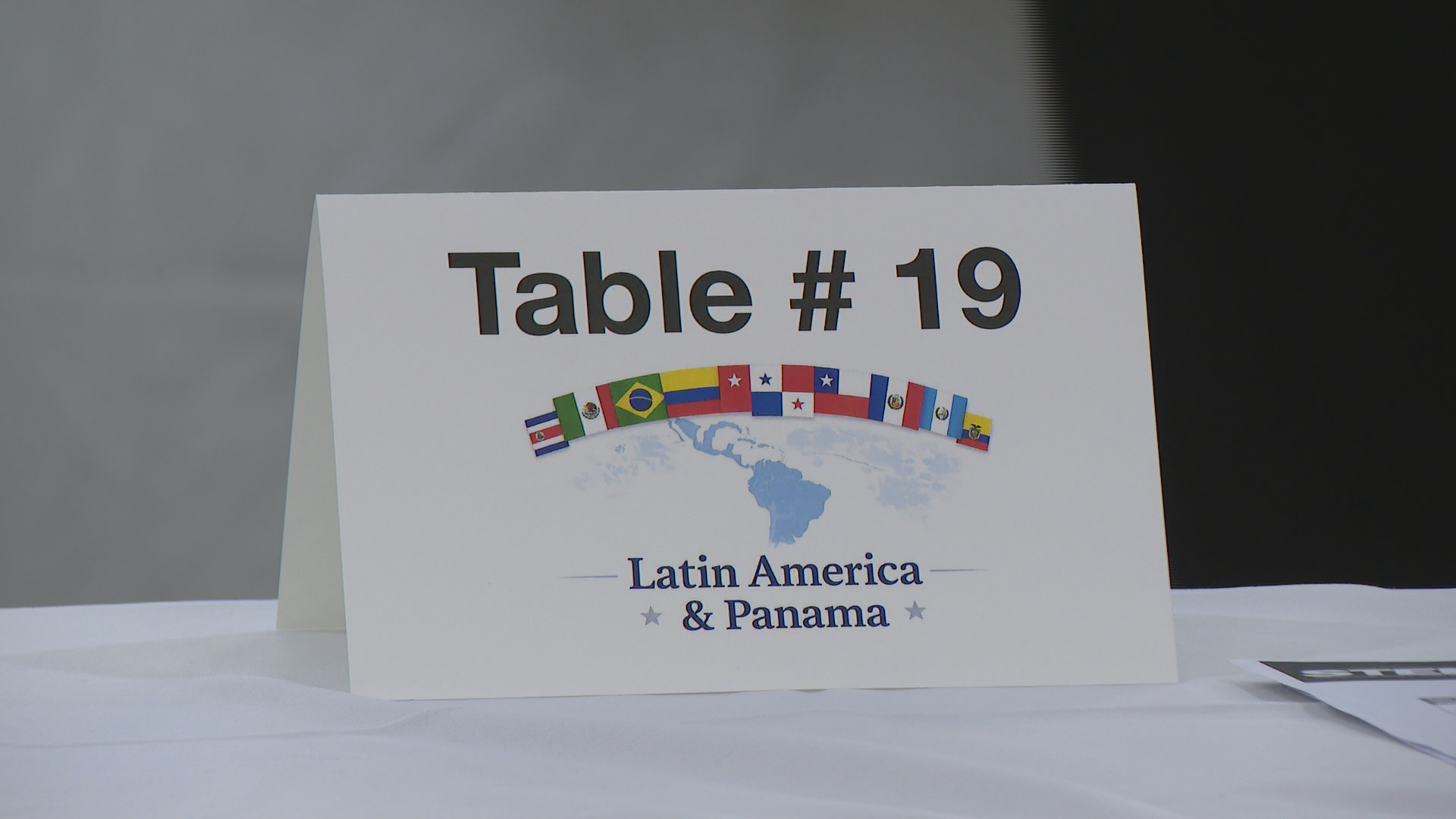
Agricultural export economies are fundamentally structurally vulnerable when dependent on high-concentration trade lanes. For decades, Western Canadian agricultural output has been bottlenecked by its reliance on a narrow triumvirate of systemic buyers: the United States, China, and India. When geopolitical friction, tariff volatility, or domestic policy shifts occur in these sovereign markets, the local producer bears the immediate downward price pressure. The inaugural Saskatchewan Global Commodities Showcase, orchestrated by the Saskatchewan Trade and Export Partnership (STEP) in Saskatoon, represents a deliberate, state-backed effort to re-engineer these trade dynamics.
By bypassing traditional clearinghouses and establishing direct pipeline integration with tier-two and tier-three sovereign markets, regional producers are attempting to hedge structural systemic risk. To understand the viability of this strategy, one must analyze the microeconomics of direct agricultural sourcing, the cost structures of intermediary friction, and the logistics of value-added crop substitution. Recently making news in related news: The Trillion Dollar IPO Bottleneck.
The Economics of Trade Concentration Risk
Exporters operating in monocultural or hyper-concentrated agricultural regions face a structural vulnerability known as monopsony-adjacent pricing. When a small number of massive buyers dominate the purchasing landscape, they dictate the terms of trade, quality premiums, and payment structures.
Export Concentration Risk = (Exports to Top 3 Partners / Total Agricultural Exports) × 100
When this ratio exceeds a critical threshold, regional producers lose sovereign pricing power. The geopolitical weaponization of phytosanitary standards or sudden tariff adjustments can instantly strand millions of metric tons of grain inland. To insulate the domestic agricultural GDP from these external shocks, the diversification of trading partners is a structural necessity rather than a public relations initiative. More details on this are explored by Harvard Business Review.
Data from the Saskatchewan Ministry of Trade and Export Development reveals a shifting trade topology. Exports to markets outside of the province's primary three trading partners grew by 27.1 percent in 2025. This pivot is a deliberate reaction to the slowing growth and heightened regulatory barriers of legacy markets. The strategy focuses on demographic corridors exhibiting high population growth and rapid urbanization, specifically the Middle East, North Africa (MENA), and South Asia.
Supply Chain Compression: Eliminating Intermediary Friction
A primary objective of direct trade matchmaking is the systematic removal of trade intermediaries, such as international grain brokers, multinational trading desks, and third-party logistics consolidators. While these entities provide liquidity and risk-mitigation services, they extract significant margin from both ends of the transactional pipe.
For international buyers, such as Pakistan’s edible oil manufacturer Dalda, direct engagement with agricultural producers is driven by the desire to minimize supply chain margin leakage.
The Intermediary Cost Function
The total landing cost ($C_L$) of an imported bulk commodity under a traditional intermediated model can be expressed as:
$$C_L = C_P + T_I + T_O + F + M_I + R$$
Where:
- $C_P$ is the producer price at the farm gate or local elevator.
- $T_I$ is inland transportation costs to port terminals.
- $T_O$ is ocean freight and maritime logistics.
- $F$ is tariff and customs clearing fees.
- $M_I$ is the cumulative margin extracted by financial and broker intermediaries.
- $R$ represents the cost of quality risk and delay hedges.
By eliminating the intermediary margin ($M_I$), both parties can capture a portion of the retained value. The producer achieves a higher average selling price (ASP) per metric ton, while the international buyer lowers their ultimate landed cost.
Direct engagement also dramatically reduces asymmetric information risk. When an international buyer acquires canola or pulses through a multinational aggregator, they receive a blended product that conforms to minimum contractual specifications but lacks traceability. Direct contracts allow buyers to specify precise agricultural parameters, such as specific protein percentages, moisture thresholds, and oil-content profiles, matching the raw input directly to their processing plant efficiencies.
Value-Added Substitution and Niche Market Creation
Bulk commodity exports are a race to the bottom on price. High-volume, low-margin crops like standard wheat and bulk canola are subject to intense global competition from low-cost producers in the Black Sea region and South America. To survive high domestic input costs and logistical bottlenecks, Western Canadian producers must shift up the value chain.
The strategic alternative is product differentiation through specialized, high-margin, value-added crop portfolios. The interest shown by Latin American retailers, such as Panama's Riba Smith Group, in specialty crops like camelina oil illustrates this market dynamic.
Comparative Margin Profiles: Bulk vs. Specialty Crops
| Metric | Bulk Canola / Wheat | Specialty Crops (Camelina, Organic Pulses) |
|---|---|---|
| Market Elasticity | Highly elastic (price-dependent) | Inelastic (specification-dependent) |
| Logistics Profile | High-volume bulk rail and vessel | Containerized, specialized freight |
| Margin Per Ton | Low, volatile, futures-pegged | High, stable, negotiated premiums |
| Customer Retention | Low (easy transactional switching) | High (long-term supply partnerships) |
Camelina oil serves as a prime example of a value-added crop that defies bulk commodity economic patterns. It is highly drought-resistant, requires fewer synthetic inputs, and possesses an ultra-high concentration of omega-3 fatty acids and antioxidants. For high-end retail chains in developing markets, this product represents a premium, health-oriented oil that commands a significant retail markup.
The transition from bulk grain shipping to specialized containerized shipping of high-value oils allows producers to bypass the systemic inefficiencies of large-scale grain terminals and bulk port congestion, creating a more predictable and resilient logistics pipeline.
Systematic Barriers to Export Diversification
While direct-to-producer trade shows clear strategic utility, several structural and economic constraints prevent immediate, wide-scale implementation. Organizations looking to operationalize these trade lanes must navigate these systemic bottlenecks.
1. Logistical Asymmetry in Inland Freight
The Canadian rail system is optimized for high-volume, unit-train movements of bulk commodities destined for deepwater ocean terminals in Vancouver or Prince Rupert. Shipping containerized specialty crops to diverse global markets requires access to empty, food-grade containers, which must be hauled inland from coastal ports. This creates a structural logistics imbalance. The cost of repositioning empty containers can sometimes exceed the domestic leg of the freight journey, suppressing the economic viability of smaller, direct container shipments.
2. Transactional Risk and Credit Worthiness
Large multinational trading houses absorb significant counterparty credit risk. When a local agricultural co-operative sells directly to an importer in an emerging market, they assume direct exposure to that buyer's sovereign currency fluctuations, local banking system liquidity, and political risk. Without sophisticated trade finance mechanisms, such as Letters of Credit or Export Development Canada (EDC) backing, the risk of payment default can outweigh the margin gains of bypassing intermediaries.
3. Regulatory and Phytosanitary Barriers
Each of the 14 sovereign nations represented at the 2026 showcase maintains its own distinct regulatory apparatus for food safety, biotechnology traits, and pesticide residue limits. For a regional exporter, navigating the compliance requirements of dozens of separate jurisdictions is administratively exhausting. A single regulatory shift or custom clearance delay due to differing pesticide residue tolerances can lead to the total loss of a shipment, highlighting a key advantage of utilizing large trading houses that possess localized compliance divisions.
Strategic Portfolio Management for Regional Producers
To successfully scale direct global sales, agricultural producers and regional trade associations must treat their export activities as an investment portfolio. The optimal allocation of production capacity should balance high-volume, low-margin bulk trade with high-risk, high-reward direct bilateral contracts.
                  [ Total Production Capacity ]
                               |
        +----------------------+----------------------+
        | (70-80% Allocation)                         | (20-30% Allocation)
        v                                             v
[ Bulk Commodity Pipeline ]                  [ Direct Bilateral Pipeline ]
  - High-Volume / Low-Margin                   - Low-Volume / High-Margin
  - Systemic Liquidity                         - Price Inelasticity
  - Legacy Trading Hubs                        - Emerging Geographies
  - Hedged via Futures Markets                 - Hedged via Custom Contracts
By maintaining this portfolio split, producers ensure they retain the operational liquidity provided by large-scale grain elevator networks while actively building the direct-to-buyer relationships needed to capture higher margins and insulate their businesses from macro-geopolitical shocks. The ultimate metric of success for initiatives like the Saskatchewan Global Commodities Showcase will not be the immediate volume of contracts signed on the exhibition floor, but the long-term migration of agricultural margin back to the primary producer.