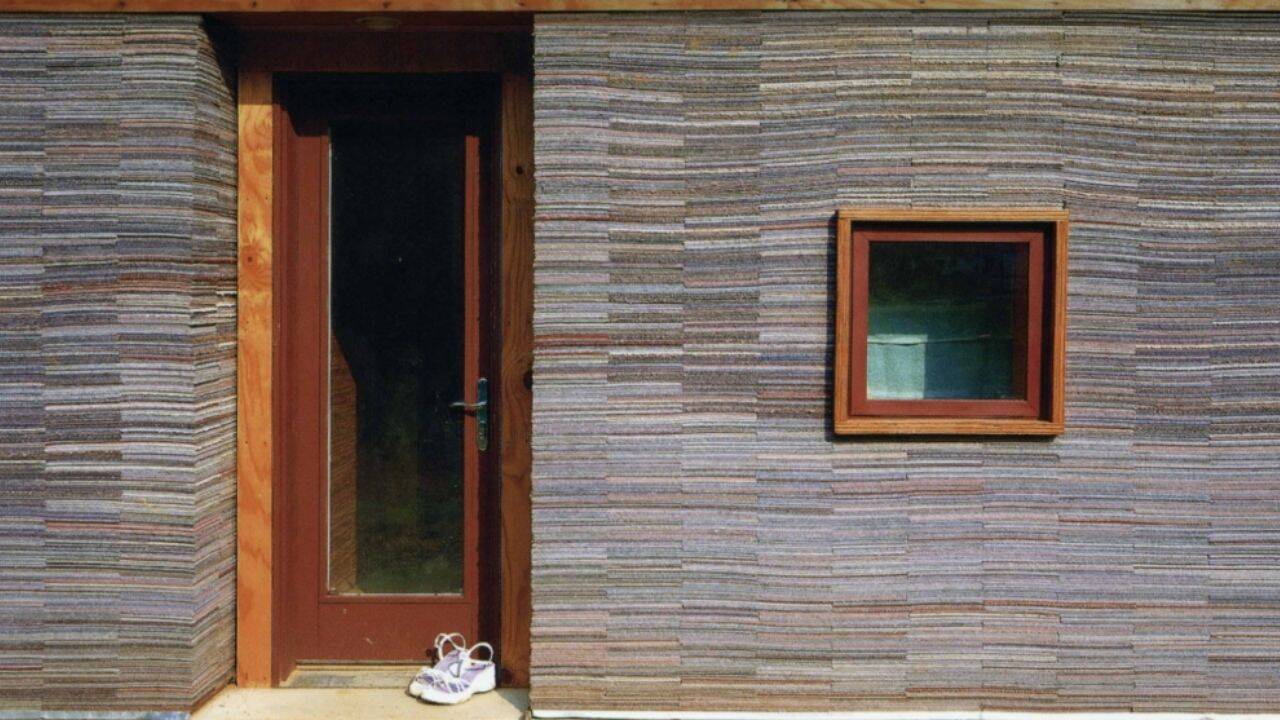
Architecture media loves a good poverty porn fairy tale. Every decade or so, a prominent architecture school rolls out the same tired narrative: brilliant, hyper-educated elites swoop into a depressed rural community, harvest industrial waste, and stack it into a sculptural masterpiece using nothing more than raw ingenuity and sweat equity. The darling of this genre remains the 2002 Rural Studio project in Alabama where students crammed seventy-two thousand discarded commercial carpet tiles into timber frames to insulate a modest family home.
The design press swooned. Awards flowed. Academics wrote breathless essays about low-cost vernacular innovation.
It is complete nonsense.
I have watched institutions burn millions of dollars chasing these photogenic dumpster-diving exercises while actual housing crises fester. When you examine the physical reality of what happens when you turn spent flooring into structural infill, the romantic facade crumbles. You are left with a toxic structural sponge, dubious thermal performance, and a masterclass in how architecture schools prioritize design portfolio clout over actual human livability.
Stop romanticizing industrial salvage as structural salvation.
The Thermodynamic Delusion of Carpet Shingles
Commercial carpet tiles are engineering nightmares. They are dense composites of nylon face fiber, polyester non-wovens, fiberglass scrims, and heavy polyvinyl chloride or bitumen backing layers. When you wedge seventy-two thousand of these heavy mats vertically into a wall cavity, you are not creating a breathable, low-cost insulation layer. You are building a moisture trap.
Carpet materials are explicitly manufactured to resist moisture, repel dirt, and handle high-traffic abuse. They are not engineered to breathe. In a wall assembly, proper thermal performance relies on vapor permeability to manage condensation. When you pack impermeable bitumen-backed squares tightly together without professional edge-sealing, you create thousands of microscopic capillary breaks where humidity settles.
Within three years in the humid Alabama climate, interstitial condensation begins to pool inside those wall cavities. Mold blooms in the dark, organic-rich backing layers. The architectural establishment celebrates the recycling metric—diverting waste from a landfill—while ignoring the fact that they have constructed a continuous chemical off-gassing chamber wrapped around a low-income family.
Real expertise means understanding material science, not just counting up diverted tonnage. If an engineer tried to specify unrated, recycled industrial waste with variable chemical treatments as a primary wall infill on a commercial project, they would lose their license. Yet, when students do it under the banner of community outreach, the design world gives them a standing ovation.
The Real Cost of Cheap Labor
The hidden calculus behind every architectural stunt of this scale is free labor. Graduate students trading tuition credits and portfolio prestige for brutal manual labor do not represent a scalable economic model.
Calculate the man-hours required to harvest, transport, sort, trim, and manually stack seventy-two thousand heavy carpet tiles into tight timber frames. If you paid those students prevailing construction wages, the cost of that wall assembly would outstrip high-end rigid foam insulation by a factor of ten.
This is the dirty secret of academic design-build programs. They externalize massive labor costs onto students while masquerading as champions of affordable housing. You cannot scale a housing solution that relies on an infinite supply of tuition-paying laborers willing to ruin their backs cutting industrial backing with utility knives for college credit.
When we evaluate housing affordability, we must look at total lifecycle cost, labor input, and maintenance overhead. A home that requires constant remediation because its walls are made of discarded office flooring is not affordable. It is an ongoing maintenance disaster for occupants who do not have the resources to fix experimental academic prototypes.
The Sunk Cost Fallacy of Upcycled Vernacular
There is a profound difference between utilizing local vernacular materials—like rammed earth, stone, or timber—and desperately engineering waste products into structural elements because they are free.
Vernacular architecture works because civilizations spent centuries refining materials that respond to local climate physics. Industrial waste does not respond to climate physics. It responds to corporate manufacturing trends. Carpet tiles are designed for corporate offices with drop ceilings and HVAC systems, not for exterior load-bearing wall assemblies exposed to diurnal temperature swings and driving rain.
When designers attempt to force industrial byproduct into structural roles, they violate basic material integrity.
What We Should Be Doing Instead
If we genuinely care about housing precarity and ecological responsibility, we need to abandon aestheticized poverty projects and focus on boring, unsexy systemic solutions.
- Standardize modular framing: Predictable dimensions eliminate waste at the source rather than trying to invent creative ways to hide industrial garbage inside walls.
- Prioritize thermal mass over novelty: Simple, local masonry and proper orientation outperform clever recycling gimmicks every single day of the week.
- Fund proper materials: Low-income families deserve new, non-toxic, structurally sound building products, not the industrial runoff of corporate America dressed up as avant-garde philanthropy.
The next time an architecture school brags about building a home out of discarded tires, license plates, or office flooring, look past the glossy magazine spreads. Ask who has to live with the mold, who paid for the labor, and why we continue to offer our poorest communities the experimental leftovers of our wealthiest industries.