Don't believe the headlines telling you the Western alliance is on the verge of collapsing every time Donald Trump picks a public fight with a European leader. If you looked closely at what just happened at the Ankara NATO summit in Turkey, the real story wasn't the public bickering over Iran or sudden statements about Greenland. The real story is the massive shifting of cold, hard cash that proves the alliance is undergoing its most radical transformation since the Cold War.
NATO Secretary General Mark Rutte walked out of President Erdogan’s massive 1,000-room palace in Ankara declaring a huge win. He pointed to a sense of unity and, more importantly, tens of billions of dollars in fresh defence deals. For anyone trying to figure out if Western security is actually falling apart, the numbers out of this summit show the exact opposite.
We are watching the birth of what insiders call NATO 3.0. It's a new era where Europe and Canada finally stop treating the US military like a free security guard. They are stepping up to run their own conventional defence because they don't have a choice. The US is shrinking its troop footprint in Europe to focus elsewhere, and Europe is forced to fill the vacuum.
Here is exactly what went down in Ankara, why the massive new spending agreements matter, and what this rebalanced alliance means for the future of global security.
The Massive Scale of the Ankara Defence Procurement
The media loves to focus on political drama, but the defense industry cares about contracts. The single biggest takeaway from the Ankara NATO summit is the sheer volume of money committed in an incredibly short window. During the Defence Industry Forum held at the summit, member states announced over $50 billion in new procurement deals in just one day.
This isn't vague future promises or soft commitments. These are actual signed agreements to build hardware, scale production, and buy weapons. The goal is to immediately convert skyrocketing defense budgets into tangible military power.
Look at the specifics of what some of these nations are doing. The Netherlands and the UK signed a multibillion-dollar deal to jointly build new amphibious transport ships. The Dutch are also teaming up with Germany to mass-produce Stinger anti-aircraft missiles. Ten different alliance members agreed to fund a complete replacement for the aging AWACS radar aircraft that handle early warning and air surveillance across Europe.
These deals show a clear intent to stop the fragmentation that has plagued European militaries for decades. Instead of 32 countries buying 32 different types of custom equipment, they are finally pooling their money to buy standardized weapons at scale. This driving force scales up production lines faster and keeps factories running on both sides of the Atlantic.
The Reality Behind the New Spending Target
For years, the magic number for the alliance was 2% of GDP spent on defence. Most European nations treated that target like an optional suggestion rather than a rule. That era is dead. Following agreements made last year, the official benchmark is now a massive 5% of GDP by 2035.
Many analysts thought a 5% target was pure fiction. However, Rutte dropped a bombshell statistic in Ankara. Just one year into this 10-year project, total defense and security spending across the alliance has already reached roughly 4% of GDP.
European allies and Canada increased their defence budgets by over $139 billion. That is a massive spending surge. The alliance estimated that total defence spending across European members and Canada will hit $258 billion across 2025 and 2026 combined.
Rutte has been incredibly smart about how he handles this spending boom politically. He recently visited the White House and literally showed Donald Trump a chart titled in big golden letters: "THE TRUMP TRILLION." The chart detailed over $1.2 trillion in extra defense spending by non-US allies since Trump's first term. By framing the spending surge as a direct result of Trump's pressure, Rutte managed to keep the US president engaged while getting Europeans to pay their bills.
It turns out Trump's constant complaints about Europe being security freeloaders worked. European leaders openly admit they were naive to rely entirely on the American security umbrella. Countries like the Netherlands are even moving to write these massive spending targets directly into national law.
Unmanned Systems and the New Drone Edge Initiative
The war in Ukraine completely changed modern warfare, proving that cheap, mass-produced drones can neutralize multi-million-dollar traditional military assets. The alliance is completely restructuring its future doctrine around this reality.
In Ankara, leaders officially launched the NATO Drone Edge initiative. This program represents a massive $40 billion investment purely in uncrewed systems over the next five years.
This initiative isn't just about buying reconnaissance drones. It is a massive project to build an interconnected network of autonomous aerial, naval, and land vehicles. The plan integrates these uncrewed systems into a shared transatlantic warfighting cloud powered by advanced artificial intelligence.
The alliance is also pouring €27 billion into modernizing its fuel storage and distribution pipelines. They are building new fuel infrastructure stretching directly toward the eastern flank. It doesn't matter how many high-tech drones or tanks you buy if you can't get the fuel or energy to the frontline during a crisis.
Dealing With the Trump Factor and Internal Fractures
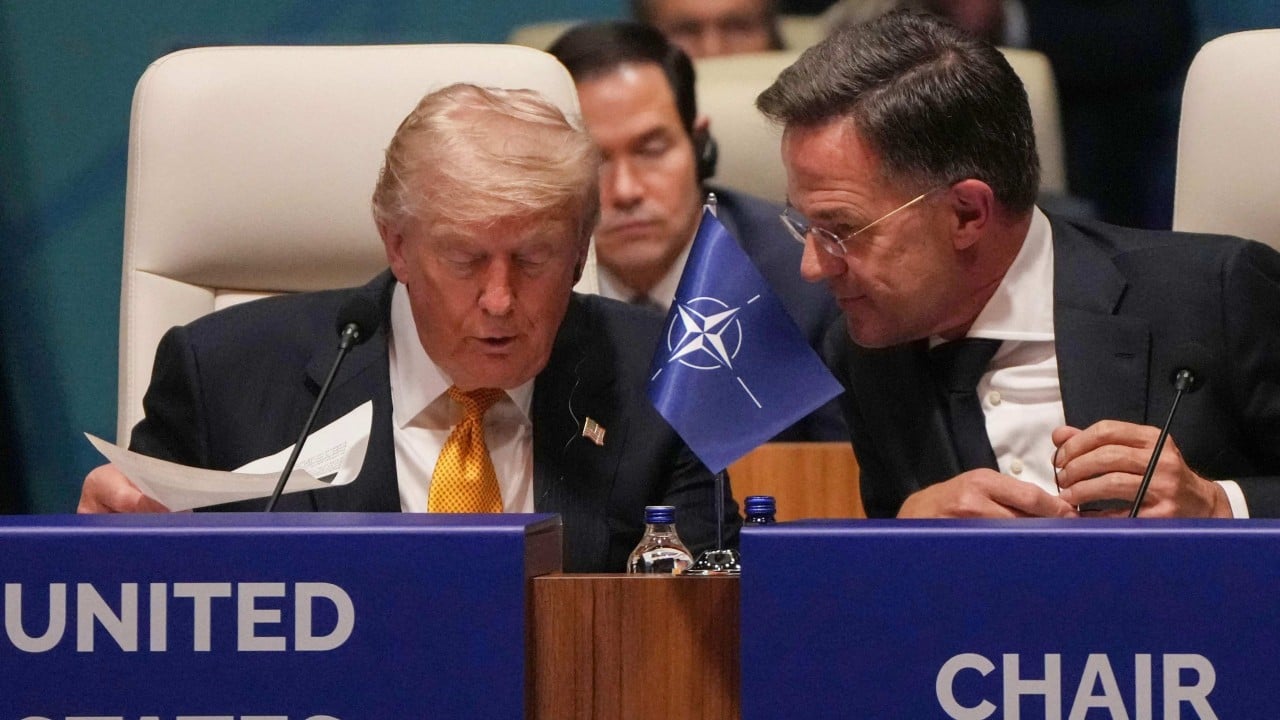
You can't talk about this summit without addressing the blatant tension in the room. Donald Trump arrived in Ankara and immediately shook things up. He publicly threatened trade ties with Spain, dragged up old arguments about the war in Iran, and brought up his old claims about buying Greenland.
When the US launched airstrikes in Iran right before the summit, it created a massive diplomatic headache. Trump openly criticized European allies for not offering enough immediate support for his actions.
Rutte handled the situation by refusing to fight publicly. He pointed out that the US used European bases as a power projection platform for those strikes, which inherently served Western security interests by keeping adversarial threats in check. Rutte later defended the US actions, calling them necessary to enforce ceasefires that Iran had violated.
When reporters asked Rutte if the public arguing made the alliance look weak to Russian President Vladimir Putin, his answer was direct. He argued that open, forceful debates are a sign of democratic strength, not weakness. In a real democracy, leaders argue out in the open. Rutte even joked that Putin should try having a few open discussions himself instead of running a closed dictatorship.
The strategy is clear. Rutte praises Trump's leadership in public, crediting him with transforming the alliance and making it stronger. Behind closed doors, European diplomats are quietly backfilling the military capabilities that the US is withdrawing.
The Move to NATO 3.0 and the American Drawdown
The core driver behind all of this spending is a classified but highly understood reality: the Pentagon is shrinking its long-term troop presence in Europe. The US military is executing a massive force posture review to shift its primary focus to other theatres of potential conflict around the globe.
Reports indicate the US is cutting a third of its F-15 fighter jets, half of its armed drones, and various strategic bombers and aircraft carriers previously assigned to European defense plans. The US is telling Europe quite clearly that it can no longer be the primary defender against conventional threats on the European continent.
This shift is exactly why NATO 3.0 exists. The goal is to build a stronger Europe that operates effectively within the broader alliance structure. European nations must take the lead on their own conventional defense.
This structural rebalancing is a massive logistical challenge. European militaries have suffered from a lack of deep precision strike capabilities, integrated air defense, and basic ammunition manufacturing for decades. The $50 billion in contracts signed in Ankara is the first real attempt to fix these structural holes without relying on American manufacturing lines.
Keeping the Lifeline to Ukraine Open
Amidst all the spending on internal alliance capabilities, the summit delivered a massive financial package for Ukraine. Allies committed to a pledge of €70 billion in military equipment, training, and direct assistance for this year, with a guaranteed promise of at least an equivalent level of support for 2027.
This €140 billion multi-year commitment provides long-term stability for Ukraine's defense planning. Crucially, this specific financial package is structured to run completely independent of direct US funding.
The funding uses a mix of bilateral support from European nations and capital drawn from the frozen Russian asset loans agreed upon by international partners. By taking the US budget out of the primary equation for this specific package, European leaders have insulated their support for Ukraine from the chaotic political battles happening in Washington.
The alliance continues to explicitly define Russia as the primary long-term threat to Euro-Atlantic stability. The Ankara declaration makes it clear that the collective defense commitment under Article 5 remains completely ironclad. An attack on one member is an attack on all, and the massive buildup of equipment on the eastern flank is designed to ensure that deterrence remains entirely credible.
What Needs to Happen Next
The political speeches are over, and the diplomats have left Turkey. Now the real work begins for governments and defense contractors across the alliance. If you want to see if the Ankara commitments are actually working, look for these specific actions over the next twelve months.
First, watch how fast individual European nations finalize their domestic procurement orders. The $50 billion framework announced at the Defence Industry Forum requires national parliaments to sign off on specific budget lines. If countries delay these approvals, the momentum from the summit will stall.
Second, monitor the construction of the €27 billion fuel infrastructure project on the eastern flank. Building pipelines and fuel storage facilities requires massive coordination across multiple borders. Tracking the speed of these infrastructure projects will give you a real look at the alliance's actual wartime readiness.
Finally, watch the deployment of the initial investments from the Drone Edge initiative. The goal is to get uncrewed systems into production quickly. If European defense companies can scale up drone manufacturing lines by the end of the year, it will prove that NATO 3.0 is a functional reality, not just a collection of clever buzzwords designed to please Washington.