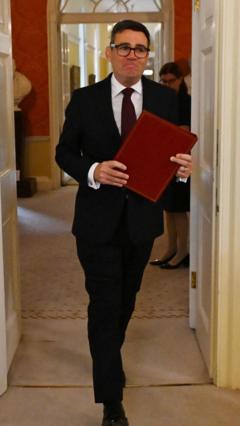
When Andy Burnham stepped up to the podium outside Downing Street, the political chat immediately turned to geography. For years, critics complained that British politics revolved entirely around the M25. Now, with a former Mayor of Greater Manchester running the country, the narrative shifted overnight. Everyone wanted to know whether Whitehall was about to get a massive northern shakeup.
Look at the surface level, and it seems like the North has taken over completely. The top job belongs to the MP for Makerfield. The new Chancellor, John Healey, represents Conisbrough in South Yorkshire. Foreign Secretary Ed Miliband represents Doncaster North. For the first time in modern political history, not a single one of the four traditional Great Offices of State is held by an MP representing a London constituency.
Does swapping London addresses for northern constituencies actually change how power works in Britain? The reality is far more complex than a quick regional map suggests. When you examine where these ministers were educated, how they built their careers, and how the new Cabinet operates, the picture gets complicated fast.
The North West Takeover of Downing Street
If you look purely at constituency boundaries, the North West dominates Andy Burnham's new cabinet. Seven full Cabinet members hail from North West seats, with five of them representing Greater Manchester constituencies alone.
Lisa Nandy stays at Culture, driving regional investment from Wigan. Lucy Powell takes over Education while holding Manchester Central. Jonathan Reynolds moves to Business from his Stalybridge and Hyde seat. Angela Rayner keeps her Housing role, representing Ashton-under-Lyne.
Add Yorkshire into the mix with four Cabinet seats, and the North East with two, and northern constituencies account for nearly half of the entire top table. London dropped down to just two Cabinet ministers, a massive drop compared to previous administrations where London and South East MPs routinely held a majority of senior portfolios.
On paper, this looks like the least London-centric government in living memory. The geographic center of gravity shifted hundreds of miles north in a single afternoon.
The Oxbridge Divide Behind the Northern Rhetoric
Geographic representation tells only half the story. While the map shows a northern landslide, the educational background of Andy Burnham's new cabinet tells a very different tale.
According to data compiled by the Higher Education Policy Institute, 54 percent of the new Cabinet earned their undergraduate degrees from Oxford or Cambridge. That is actually higher than Keir Starmer's initial Cabinet, where Oxbridge graduates made up 29 percent. Furthermore, 86 percent of Burnham's Cabinet attended Russell Group universities.
Philosophy, Politics, and Economics (PPE) remains the dominant degree around the table. Six ministers studied PPE, including Foreign Secretary Ed Miliband, Health Secretary Yvette Cooper, and Home Secretary Shabana Mahmood. Burnham himself earned an English degree from Fitzwilliam College, Cambridge. Chancellor John Healey studied Social and Political Sciences at Christ's College, Cambridge.
Here is how the top team breaks down by degree background:
- Prime Minister Andy Burnham: English (Cambridge)
- Chancellor John Healey: Social and Political Sciences (Cambridge)
- Foreign Secretary Ed Miliband: PPE (Oxford)
- Home Secretary Shabana Mahmood: Law (Oxford)
- Health Secretary Yvette Cooper: PPE (Oxford)
- Defence Secretary Wes Streeting: History (Cambridge)
This reveals a striking tension. The government claims to represent a break from the traditional Westminster establishment, yet its key decision-makers attended the exact same elite elite institutions that produced decades of SW1 insiders. Replacing a London MP who went to Oxford with a Yorkshire MP who went to Oxford might change constituency casework, but it does not automatically overturn the cultural norms of Whitehall.
The Structural Move with No 10 North
Where Burnham is actually trying to force change is through structural reshuffling rather than just individual appointments. Instead of relying on regional accents around the Cabinet table, he is creating dedicated institutions designed to pull decision-making out of London.
The most aggressive move is the creation of No 10 North in Manchester. This is not just a secondary office for photo opportunities. Burnham merged parts of the Cabinet Office, Treasury, and the Ministry of Housing, Communities and Local Government into a expanded Office of the Prime Minister and Cabinet.
Crucially, teams responsible for local growth and regional economic development are being moved directly into the No 10 North unit. Civil servants are already being offered relocation packages to move from Whitehall to Manchester. The aim is to place economic strategy right next to regional policy teams instead of keeping them buried deep inside the Treasury building on Great George Street.
Louise Haigh, appointed First Secretary of State and Chancellor of the Duchy of Lancaster, is tasked with driving this new machinery. Her job is to act as the political enforcer, ensuring civil service departments actually respond to instructions coming out of Manchester rather than treating the northern base as an afterthought.
Will civil servants actually accept moving north? That remains the biggest open question. Previous attempts to decentralize government departments often resulted in senior officials staying in London while lower-level administrative roles were moved. If senior directors refuse to relocate, No 10 North risks becoming an expensive regional satellite rather than a real engine of power.
What This Regional Split Means for Policy
Having a heavy concentration of North West MPs sitting alongside an Oxbridge-educated front bench creates specific policy priorities that look distinct from previous governments.
First, expect an immediate push on public transport integration. Burnham's time as Mayor of Greater Manchester was defined by bringing buses back under local control through the Bee Network. Unsurprisingly, transport and regional infrastructure sit right at the top of his agenda. With Jonathan Reynolds at Business and Angela Rayner at Housing, the government is aligning transport planning with housing build targets and local industrial policy.
Second, the departmental reshuffle shows a strong bias toward consolidating power. Burnham abolished the standalone Department for Science, Innovation and Technology, folding its responsibilities back into Business and Culture. The goal is simple: cut down on departmental turf wars and funnel regional innovation funding directly through local combined authorities.
However, this focus on northern metro-regions creates friction elsewhere. MPs representing rural constituencies in the South East and East Midlands already argue that their areas are being overlooked. Moving civil service focus to Manchester helps the North West, but it does not automatically solve economic stagnation in coastal towns in Norfolk or rural communities in Devon.
How to Evaluate Regional Representation in Politics
If you want to track whether a government is truly decentralizing power or just putting on a regional display, ignore the speeches and watch these four concrete metrics over the next year:
- Civil service headcount shifts: Track how many Senior Civil Service (SCS) roles actually move their contracts to No 10 North rather than junior policy officers.
- Capital spending distribution: Watch the Treasury Green Book evaluations for infrastructure projects to see if funding formulas favor northern rail and transit projects over southern schemes.
- Devolution settlements: Look at whether new powers over skills, housing, and budget allocation are handed to single-tier councils and combined authorities without Whitehall sign-off.
- Legislative speed: Monitor how quickly bills regarding local transport control and regional planning reform clear the House of Commons.
Regional accents in Downing Street make for great news stories, but policy outcomes depend entirely on where spending decisions get signed off. Andy Burnham's Cabinet is heavily northern by constituency geography, deeply traditional by education, and radically centralized in its structural ambitions. Watching how those three forces collide will tell you everything you need to know about where Britain is actually headed.