Benjamin Netanyahu entered Israel's October 27, 2026 election campaign facing a political reality no previous prime minister had survived: asking voters to trust him as the nation's sole security guarantor after overseeing the October 7, 2023 Hamas attack. According to Reuters reporting from late September 2026, Netanyahu responded not by reinventing his political brand, but by doubling down on the exact campaign formula that had kept him in power almost continuously since 2009. Even after his bloc fell short of a parliamentary majority and former general Gadi Eisenkot received the mandate to form a government in November 2026, Netanyahu's campaign tactics—rooted in existential framing, opposition delegitimization, and institutional deadlock—continued to dictate the terms of Israeli politics.
For decades, the core premise of Netanyahu's electoral appeal rested on a single brand identity. Supporters called him "Mr. Security." His pitch was straightforward: in a volatile region, only a seasoned, uncompromising leader could keep ordinary Israelis safe while maintaining economic prosperity.
The Collapse of the Fortress Doctrine
To understand why the 2026 campaign felt so dissonant to outside observers, one has to look at what broke three years earlier. For over fifteen years, Netanyahu governed through what analysts at The Guardian described as a "Fortress Israel" doctrine. The strategy relied on technological deterrence—the Iron Dome missile defense shield, underground sensors, and a $1.1 billion smart barrier along the Gaza border—combined with the political assumption that the Palestinian conflict could be indefinitely managed without diplomatic resolution.
Hamas's assault on October 7, 2023, which killed roughly 1,200 people and saw 251 taken hostage, dismantled every pillar of that premise. The physical barrier failed. Intelligence warnings went unheeded, though Netanyahu consistently denied reports of prior warnings. As Yohanan Plesner, president of the Israel Democracy Institute, noted to Reuters during the 2026 campaign, Netanyahu had run in many elections before, but never after presiding over such a catastrophic security breakdown.
In conventional political calculus, an incumbent presiding over a disaster of that magnitude faces an insurmountable referendum on competence. A standard campaign playbook would dictate contrition, a pivot toward domestic renewal, or an attempt to rebrand around post-war reconstruction. Netanyahu rejected all three. Instead, he treated the aftermath of the war not as a failure of deterrence, but as proof that the region remained locked in an existential struggle requiring his specific brand of leadership.
Manufacturing the Binary Choice
A closer examination of Likud's 2026 messaging reveals how a tarnished security record gets repurposed into an electoral weapon. Rather than defending the past, the campaign aggressively narrowed the voter's field of vision into a stark binary choice.
In a September 18, 2026 campaign video highlighted by Reuters, Netanyahu directly targeted his primary rival, former IDF Chief of Staff Gadi Eisenkot and his Yashar party. "There is no straight. Yashar is a bluff," Netanyahu told viewers, playing on the Hebrew word for "straight". "There's either left or right. That is the essence of this election. Do you want a Palestinian state, or do you want a Jewish state?"
This framing serves a dual mechanical purpose in Israeli parliamentary politics:
- Erasing the center: Israeli elections are won and lost in the soft center-right. By branding centrist military figures like Eisenkot as disguised leftists, Likud attempts to prevent disillusioned right-wing voters from defecting to moderate alternatives.
- Weaponizing coalition arithmetic: Under Israel's proportional representation system, no single party wins an outright majority of the 120-seat Knesset. A prime minister must assemble a coalition of at least 61 seats. Likud's digital campaign saturated social media with posts—including AI-generated images—depicting Eisenkot alongside leaders of Israel's Arab political parties.
The message was unmistakable. Any alternative government, Netanyahu argued, would inevitably rely on Arab factions representing Israel's 20 percent Palestinian minority, rendering that government too weak to confront Palestinian militancy. It was the exact same rhetorical playbook Netanyahu deployed during the deadlocked election cycles between 2019 and 2022, updated with generative AI tools for faster social media distribution.
Theatrics on the Global Stage
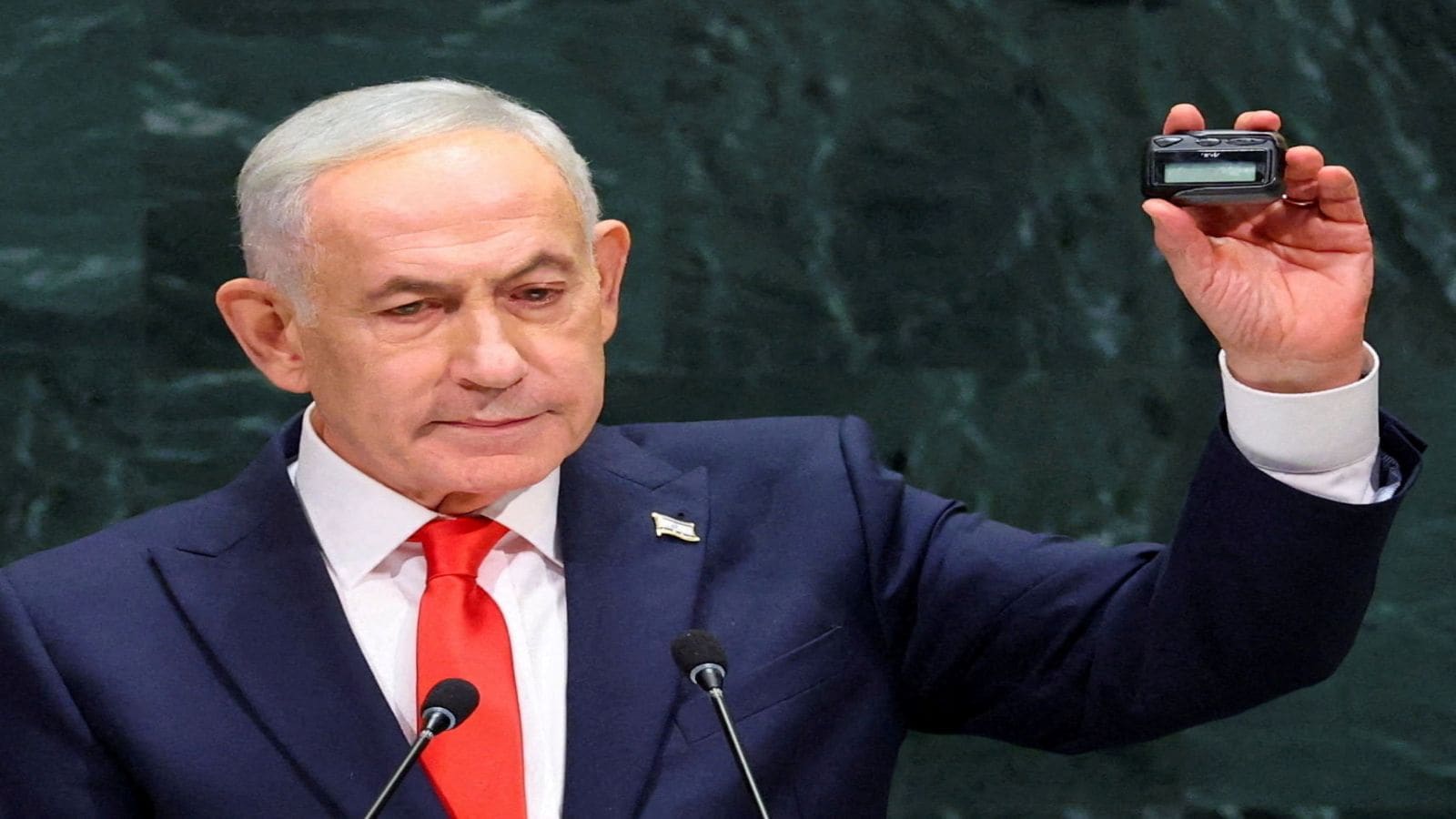
When domestic polling falters, Netanyahu historically shifts the venue. In late September 2026, just weeks before Israelis went to the polls, the prime minister traveled to New York to address the 81st United Nations General Assembly.
The trip itself was brief, reflecting what international observers noted as strained diplomatic ties following years of devastating warfare in Gaza. Yet Likud's media team treated the podium at UN headquarters as a domestic campaign stage. Before the speech, Netanyahu's accounts released six teaser videos, declaring he was "proud to represent you to the world" and preparing "to fight for Israel against the UN". Afterward, the full address was circulated in Hebrew under a four-word caption: "Netanyahu takes on the world".
The strategy relies on a well-documented psychological dynamic in Israeli politics. International criticism—over the scale of Palestinian civilian casualties in Gaza, diplomatic isolation, or waning support even among traditional allies in Washington—is reframed not as a consequence of government policy, but as evidence of global hostility that only a defiant leader can withstand.
Notably, one staple of previous Likud campaigns vanished from the 2026 video reels: the image of the American president. In past cycles, giant billboards featuring Netanyahu shaking hands with U.S. leaders served as visual proof of his unmatched diplomatic clout. With public and political support for Israel eroding in the United States, Likud quietly retired the imagery, pivoting entirely to the posture of a solitary defender standing against external pressure.
Staging Security in Real Time
On the ground, the campaign blurred the boundary between statecraft and electioneering. Days after his UN appearance, Netanyahu released a video filmed at a military airbase, warning that intelligence showed Israel's adversaries were planning a pre-election attack. "Don't mess with us, not now and not ever," he said against a backdrop of fighter jets. "Our long arm will reach you".
In early October, days before the three-year anniversary of the October 7 assault, Netanyahu and Defense Minister Israel Katz publicly warned that Hamas was plotting to target Israeli troops in Gaza specifically to influence the upcoming vote.
Critics viewed these announcements as an effort to keep the electorate in a permanent state of emergency, where changing leadership feels like an unacceptable gamble. Supporters, conversely, saw a wartime leader projecting deterrence and communicating clear red lines to enemies watching Israel's domestic political calendar. Both interpretations highlight the same structural reality: as long as active military threats dominate the daily news cycle, voters evaluate candidates through the lens of immediate physical survival rather than long-term governance or past accountability.
The Counter-Argument Why the Playbook Still Resonates
Dismissing Netanyahu's approach as mere political cynicism misses why it remained potent enough to deny his rivals an easy victory. Analysts at the European Council on Foreign Relations noted in October 2026 that the trauma of October 7 did not push the Israeli electorate toward diplomatic compromise; instead, it hardened ethno-nationalist sentiment across large segments of the public.
For a substantial bloc of voters, the failure of October 7 proved not that Netanyahu was too hawkish, but that Israel's defense establishment had grown complacent. When Netanyahu rejected diplomatic frameworks, expanded military operations across Gaza, Lebanon, and Syria, and campaigned on "peace through strength," he was speaking directly to a population convinced that survival in the Middle East depends on overwhelming force.
Furthermore, his opponents struggled to offer a clear, unified counter-narrative. While figures like Eisenkot campaigned on restoring public trust, launching a state commission of inquiry into the October 7 failures, and reversing judicial overhauls, their coalition math remained fragile. To reach 61 seats without Netanyahu, opposition leaders had to bridge deep ideological divides between right-wing secularists, centrist generals, left-wing democrats, and Arab parties—a balancing act that gave Likud's attack ads constant ammunition.
Stalemate as a Victory Condition
Perhaps the most overlooked aspect of Netanyahu's 2026 playbook is that winning an outright majority was never strictly necessary for it to succeed.
As political columnist Amotz Asa-El observed to Reuters ahead of the vote, Netanyahu's core strategic objective was simply to capture enough seats to block the emergence of a stable alternative government. In Israel's parliamentary system, political deadlock carries an enormous structural advantage for the incumbent.
When the 26th Knesset was sworn in on November 10, 2026, the mechanics of that strategy became immediately visible. Even as Gadi Eisenkot received the initial mandate to assemble a governing coalition and began moves to replace the Knesset speaker, Netanyahu remained in office as caretaker prime minister.
In a caretaker role, a prime minister faces judicial restrictions on certain domestic appointments and budgets, yet retains full operational authority over national security and the military. Every month that coalition negotiations drag on—or every cycle that ends in another snap election—keeps Netanyahu at the center of decision-making. According to policy analysts at the Arab Center Washington DC, remaining in office also shields him politically while he navigates his ongoing corruption trial and delays the formation of an independent inquiry into the events of October 7.
Following the Knesset swearing-in ceremony in November, Netanyahu wasted no time deploying the next phase of the script. Despite certified election results showing his bloc short of a majority, he publicly alleged that Arab-led parties had "stolen" the election, called on Jewish opposition factions to abandon coalition talks with Arab lawmakers, and urged rival parties to join a Netanyahu-led unity government to confront the threat of Iran.
Eisenkot responded by calling the speech "divisive" and "hate-filled," abruptly canceling scheduled coalition talks with Likud. Yet the exchange demonstrated the enduring power of the playbook. By polarizing the Knesset floor around questions of national identity and existential threat, Netanyahu forced his rivals into a defensive crouch before they had even seated a cabinet.
The strategy does not require universal popularity, nor does it require erasing the memory of October 7. It requires only that the electorate remain sufficiently fractured that no cohesive alternative can govern—leaving the architect of the system standing in the center of the deadlock, daring anyone else to take the wheel.