Subterranean rescue operations executed within unmapped, flooded karst topography represent one of the most complex domains of emergency logistics. The ongoing extraction of artisanal gold miners from a flooded cave system in Laos’ central Xaisomboun province underscores a critical engineering reality: human survival in these environments is governed by strict physical, physiological, and logistical bottlenecks. While mainstream media accounts frame these events through narratives of hope and emotional relief, an objective analysis reveals that successful extraction relies on managing a complex matrix of fluid dynamics, atmospheric physics, and physiological decay.
The incident began between May 19 and May 20, 2026, when seven local villagers entered a remote cave system in the Longcheng district to prospect for artisanal gold ore. Torrential monsoonal rainfall triggered rapid flash flooding, sealing the entry and exit portal with water and sediment. Although one individual escaped early to sound the alarm, seven men were left unaccounted for deep within the formation. Following a multi-day international intervention involving Lao, Thai, Finnish, and other global specialists, divers located five survivors on May 27, sitting on an elevated rock shelf approximately 260 to 300 meters from the cave entrance. Two individuals remain missing. The extraction of the first survivor on Friday night, May 29, confirms that the operation has transitioned from a search phase to a highly technical extraction phase.
The Three Operational Constraints of Subterranean Extraction
An evaluation of the Xaisomboun cave system reveals that the rescue operation is constrained by three interdependent vectors: structural geometry, fluid dynamics, and environmental hazards.
Structural Geometry and Sump Topology
The cave's physical layout dictates the type of diving and transport equipment that can be used. Karst systems in Xaisomboun are characterized by highly irregular, narrow channels formed through the dissolution of soluble rocks like limestone.
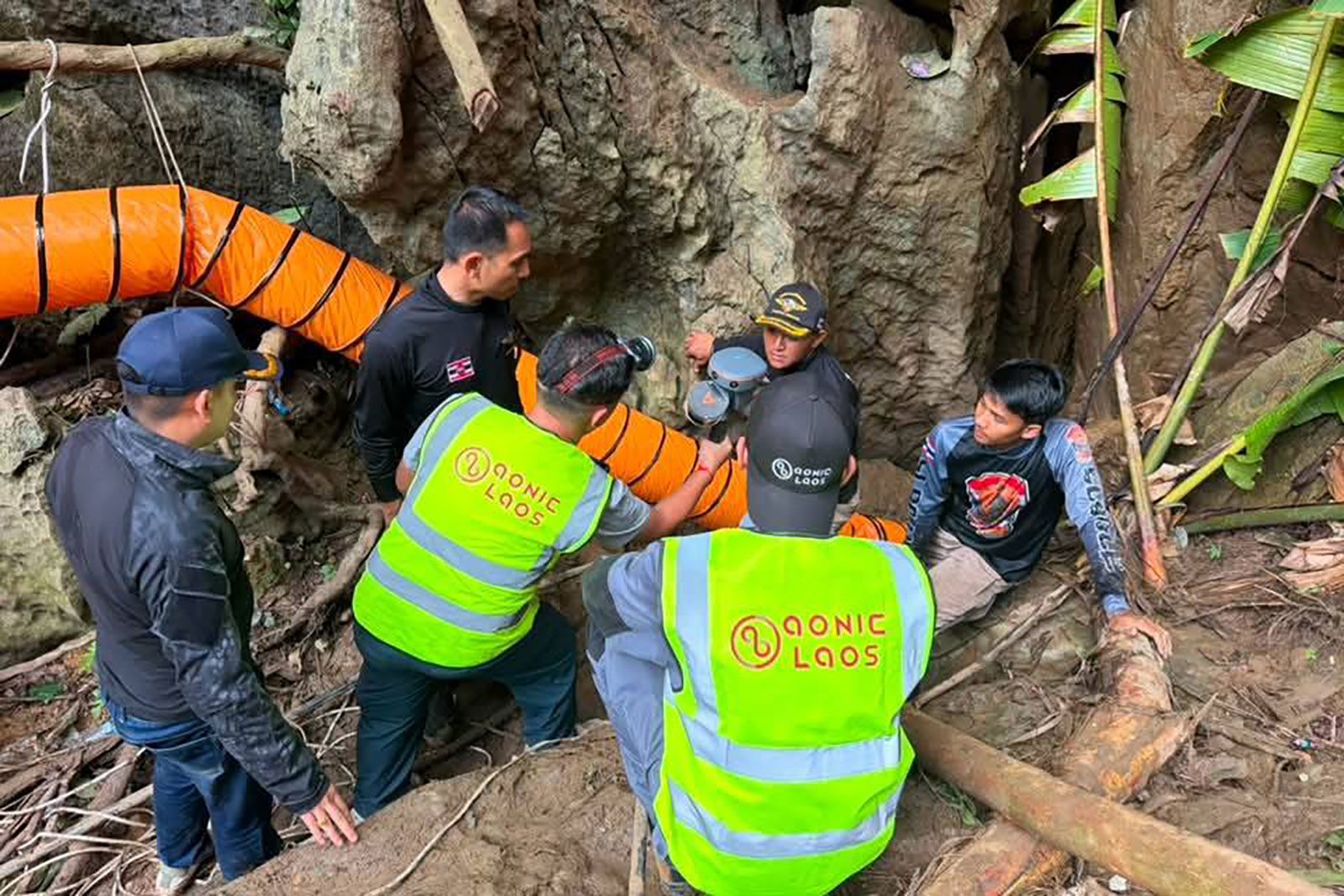
- The Approach Bottleneck: The initial logistics chain is constricted by a 4-kilometer (2.5-mile) jungle trek over steep, mountainous terrain just to deliver equipment to the staging hub.
- Portal Restrictions: The cave entrance is a steep, rocky fissure barely wide enough for a single technician to pass through at one time.
- Internal Micro-Geometry: The internal conduit features choke points where passages restrict to a cross-sectional depth of just 60 centimeters (approximately 24 inches). This structural geometry eliminates the use of standard open-circuit scuba configurations with back-mounted twin cylinders. Divers must instead use side-mount configurations to navigate these restrictions, pushing their cylinders ahead of them through zero-visibility water.
Fluid Dynamics and Sediment Transport
The primary catalyst for the crisis is hydrological. Monsoonal downpours alter the equilibrium of the cave's internal water levels. The system acts as a natural drain for the surrounding mountain topography, meaning that surface precipitation correlates directly with internal volumetric flow rates.
The water blocking the 300-meter passage is not static; it is a high-turbidity slurry containing suspended sand, gravel, and mud. This sediment load creates two distinct challenges. First, it drops underwater visibility to absolute zero, forcing divers to navigate entirely by tactile sense and pre-installed guide lines. Second, the deposition of sand and gravel inside narrow passages can physically alter the tunnel cross-sections mid-operation, potentially trapping divers or rendering previously passable routes completely blocked.
Atmospheric and Environmental Contamination
The chamber where the five survivors were located is an isolated air pocket, or dry terminal chamber. While this spatial feature prevented immediate drowning, its closed nature introduces atmospheric degradation over time.
The primary atmospheric threat is the accumulation of carbon dioxide ($CO_2$) exhaled by the survivors, coupled with the potential intrusion of toxic gases like hydrogen sulfide ($H_2S$) from decaying organic matter or mineral strata. As $CO_2$ levels exceed 2% to 3% of the total atmospheric composition, individuals experience hypercapnia, which triggers headaches, confusion, and tachypnea (increased breathing rate). Higher concentrations can induce unconsciousness.
Furthermore, the physical exertion required to breathe contaminated air rapidly exhausts a starving individual, directly degrading their ability to assist in their own extraction. To counteract this, teams have deployed air lines and ventilation pumps to introduce oxygen and evacuate toxic gases, though managing the friction loss of air flowing through hundreds of meters of narrow tubing remains a constant mechanical challenge.
The Logistics of Hyper-Local Communication and Life Support
In standard search and rescue scenarios, radio communications provide instantaneous data loops. In a deep karst environment, high-frequency and low-frequency radio waves are heavily attenuated by hundreds of meters of solid, mineral-rich rock. To bypass this barrier, the rescue team deployed a highly reliable, low-tech solution: physically running local area network (LAN) internet cables from the surface deep into the cave system.
This hardwired communication infrastructure provides two distinct strategic advantages:
- De-conflicting One-Way Conduits: Because the underwater pathways are too narrow for two divers to pass each other safely, real-time surface coordination ensures that inbound supply divers do not collide with outbound reconnaissance teams.
- Real-Time Triage and Advice: Field doctors at the surface staging area can receive immediate descriptions of the survivors' physical states, allowing them to adjust the nutritional and medical payloads sent inside.
The life support protocol for the survivors must follow a precise sequence to prevent refeeding syndrome and metabolic shock. When individuals undergo severe nutritional deprivation for over a week, their intracellular electrolyte stores are severely depleted. Introducing heavy or complex carbohydrates too quickly can cause massive shifts in insulin levels, leading to a fatal drop in serum phosphate, potassium, and magnesium.
The rescue teams mitigated this risk by delivering a controlled payload consisting of:
- Oral Rehydration Salts (ORS): To correct profound electrolyte imbalances without overloading the kidneys.
- Soft, Easily Digestible Rations: Formulated to provide immediate caloric intake without demanding significant metabolic energy for digestion.
- Hypothermia Mitigation: Space blankets (foil blankets) were provided immediately. Because the survivors are trapped in a high-humidity environment with ambient temperatures lower than core body heat, continuous evaporative cooling poses a severe risk of hypothermia, which accelerates muscle weakness and cognitive decline.
Technical Comparison of Extraction Methodologies
The incident commander faces a binary choice in extraction strategy: wait for hydrological equilibrium via high-volume pumping, or execute a hazardous dive-extraction.
| Variable | Strategy A: Hydrological Depletion (Pumping) | Strategy B: Controlled Dive Extraction |
|---|---|---|
| Execution Mechanism | Deploy high-capacity axial flow pumps to lower water level below conduit ceilings. | Fit survivors with positive-pressure full-face masks and swim them through sumps. |
| Primary Risk | Inbound monsoonal rainstorms can overwhelm pump capacity, causing rapid re-flooding. | Panic under water, acute hypothermia, or mask displacement in narrow choke points. |
| Time to Execution | High latency; dependent on pump efficiency, fuel logistics, and weather cycles. | Immediate execution capability once divers and gear are staged. |
| Survivor Fitness Requirement | Low; requires minimal physical stamina if water levels drop enough to allow crawling. | High; requires psychological resilience to tolerate zero-visibility immersion. |
The Mechanics of Dive Extraction
As demonstrated by the successful removal of the first villager on May 29, waiting for the cave to dry completely was deemed too high-risk due to unpredictable weather patterns. A controlled dive extraction relies on specialized hardware to neutralize survivor panic.
Standard scuba regulators require a conscious, disciplined effort to hold a mouthpiece in place. If an untrained person panics or loses consciousness under water, the jaw relaxes, leading to immediate drowning. To prevent this, rescuers utilize full-face masks (FFMs) supplied with positive pressure. A positive-pressure system maintains an internal mask pressure slightly higher than the surrounding water pressure. If the seal is compromised slightly by a jagged rock, air leaks out rather than water leaking in.
During the execution phase, each survivor is paired with an expert diver who acts as a primary navigator. The survivor is essentially passive, guided through the 60-centimeter restrictions by the rescue diver. The round-trip time for a diver traversing from the entrance to the terminal chamber and back spans approximately four hours (two hours each way), highlighting the grueling physical demand placed on the dive team.
Strategic Forecast and Operational Recommendation
The successful extraction of the first villager confirms the technical viability of the dive-extraction protocol under the current hydrological parameters. However, the operational window remains exceptionally narrow. A morning rainstorm on Friday has already demonstrated how quickly surface weather can disrupt internal pumping operations.
The immediate strategic priority must be a dual-track execution model. First, dive teams must capitalize on the current guide-line infrastructure to extract the remaining four known survivors individually, prioritizing them based on medical urgency determined via the LAN communication link. Survivors expressing extreme fatigue, such as the individual who informed rescuers he lacked the strength to swim, must be heavily stabilized with calories and thermal protection before being moved, as hypothermia accelerates under water.
Second, the search for the two missing villagers cannot be abandoned, but it must be strictly decoupled from the extraction path of the survivors. The missing individuals entered the cave system separately and may be located in deeper, unexplored sumps further down the hydraulic gradient. Exploration of these unknown zones introduces variables—such as unquantified $H_2S$ gas pockets and unstable rock faces—that could compromise the main exit route.
The incident command must maintain a strict line-holding policy: extraction of the known survivors must take precedence over deep-system exploration until the five stabilized assets are safely past the final 60-centimeter portal restriction. Liability protections and government clearances, which the international diving team wisely requested early in the operation, must be maintained to ensure that the complex technical maneuvers required in the coming hours can proceed without administrative delays.