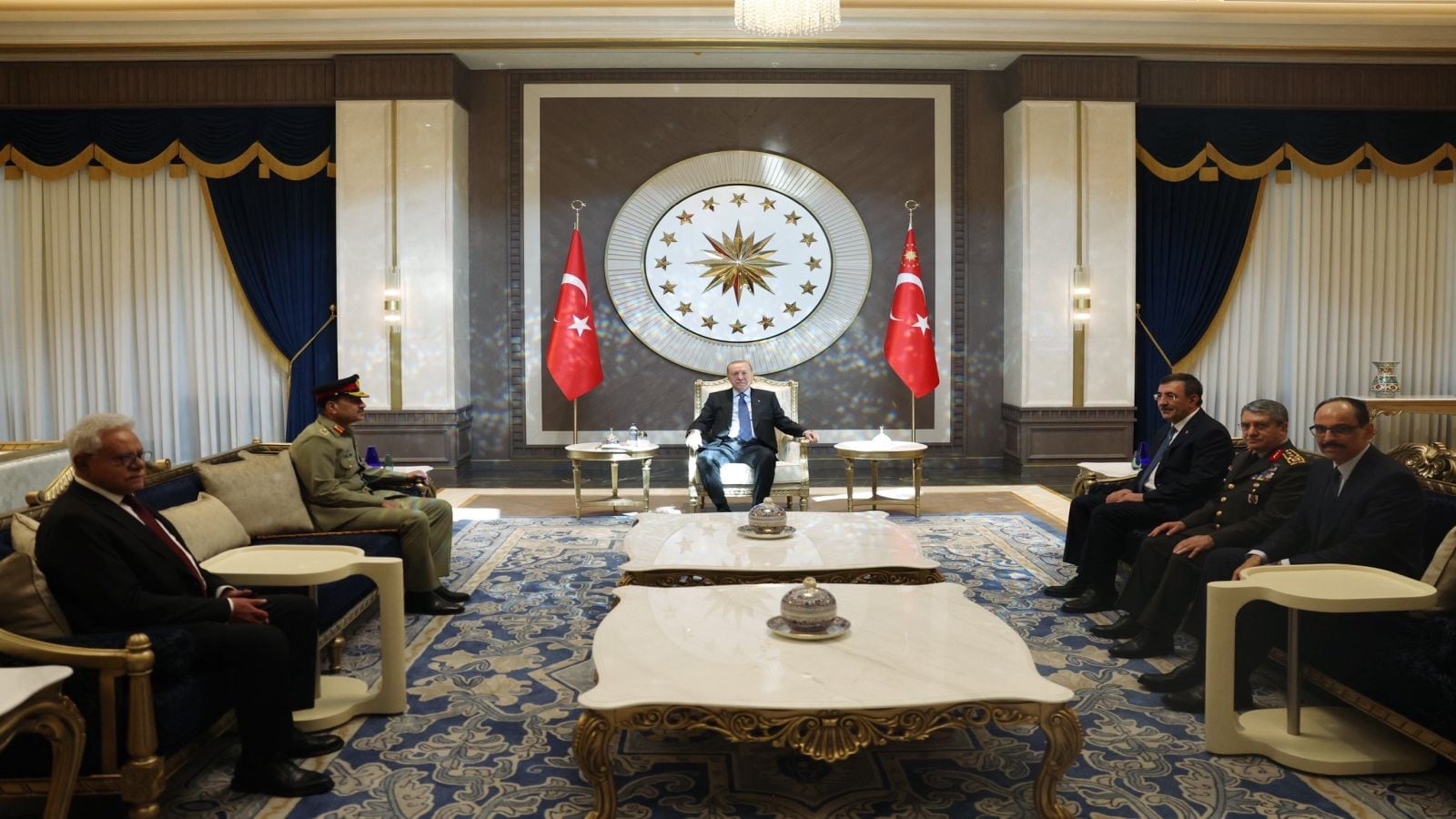
The structural breakdown of Pakistan's authority in Pakistan-occupied Jammu and Kashmir (PoJK) is not an organic outburst of sudden political anger. It is a predictable crisis of fiscal insolvency meeting military overreach. While Pakistan's Chief of Army Staff, Field Marshal Asim Munir, visits Ankara to secure defense collaboration and shore up strategic ties with Türkiye, the territory he left behind is experiencing an unprecedented structural fracture.
The unrest led by the Jammu Kashmir Joint Awami Action Committee (JAAC) is the direct result of an unsustainable economic equilibrium. By examining the mathematical and structural realities of this crisis, we can understand why traditional military suppression is no longer yielding its historical results.
The Economic Cost Function of Subjugation
For decades, Islamabad maintained a fragile stability in the region through an unspoken transaction: local populations surrendered comprehensive political autonomy and control over their natural resources in exchange for heavily subsidized essential goods, specifically wheat flour and electricity.
This model operated successfully only as long as the federal government possessed the fiscal space to fund these subsidies. The current crisis represents the total collapse of this transaction due to three intersecting fiscal pressures:
- The Sovereign Debt Bottleneck: Under the stringent conditions of international bailout programs, Pakistan’s federal administration was forced to eliminate unfunded provincial and regional subsidies to stabilize its balance of payments.
- The Resource Extraction Asymmetry: PoJK produces highly cost-effective hydroelectric power via major installations like the Mangla Dam. However, under the centralized federal grid model, this cheap energy is exported to the industrial hubs of Punjab and Sindh. The local population is then forced to buy back electricity at heavily taxed, inflated national tariffs.
- Hyper-Inflation of Basic Goods: The systemic devaluation of the Pakistani Rupee has made non-subsidized wheat flour prohibitively expensive for the average household, turning a basic nutritional requirement into a flashpoint of survival.
When the federal government dismantled the subsidy framework, it unilaterally breached the social contract. The JAAC’s 38-point charter of demands—anchored heavily on subsidized wheat, affordable electricity, and the rollback of elite administrative privileges—is not a radical political manifesto; it is a demand for the restoration of that original transaction.
The Hard State Strategy and Its Limits
In late 2024, constitutional and legislative maneuvers extended Asim Munir's military command, centralizing executive authority. This consolidation is defined by a shift from the historical posture of a "soft state" toward a "hard state" doctrine. Under this framework, civil dissent is treated not as a localized governance failure, but as an existential national security threat requiring kinetic neutralization.
To suppress the JAAC mobilization, the military establishment has deployed a systematic, multi-layered containment strategy:
[Social Mobilization (JAAC)]
         │
         ▼
[Legislative Ban (Anti-Terror Classification)]
         │
         ▼
[Information Asymmetry (Digital Blackouts)]
         │
         ▼
[Kinetic Enforcement (Rangers & Paramilitary Force)]
This structural suppression operates through three distinct levers:
1. Legislative Criminalization
By designating the JAAC under anti-terror provisions, the state bypasses standard judicial protections. This allows for the arbitrary detention of organizers, the freezing of local trading accounts, and the justification of lethal force against assembly.
2. Digital and Information Blackouts
Total communication blackouts are enforced across volatile districts such as Rawalakot, Mirpur, and Muzaffarabad. By disabling mobile networks and internet infrastructure, the state aims to disrupt the coordination of the JAAC's "long march" and prevent real-time documentation of human rights abuses from reaching the global press.
3. Paramilitary Kinetic Intervention
When local police forces proved hesitant to use lethal force against their own communities, the state deployed the Pakistan Rangers and advanced paramilitary units. This escalation has led to clashes, resulting in dozens of civilian casualties and hundreds of arrests.
The Geopolitical Divergence: Ankara and London
While the military apparatus enforces domestic containment, its leadership is pursuing external validation. Munir’s diplomatic mission to Türkiye is a calculated effort to project external stability and advance defense industrial partnerships.
Ankara has historically provided diplomatic cover for Islamabad on the international stage. By reinforcing ties with Turkish President Recep Tayyip Erdogan, the Pakistani military aims to ensure that its domestic security maneuvers do not isolate it globally.
However, this outward projection of power is failing to mask the domestic reality. The severity of the crackdown has triggered a severe international backlash:
- The Diaspora Multiplier: The Kashmiri diaspora, particularly in the United Kingdom, has mobilized quickly. Massive protests outside Pakistani consulates have forced the issue onto the floor of foreign parliaments.
- Legislative Pressure: Dozens of British Members of Parliament have signed formal letters to the UK Foreign Secretary demanding diplomatic intervention and expressing concern over the human rights violations occurring under the communication blackout.
- Regional Repercussions: India’s Ministry of External Affairs has capitalized on the crisis, calling on the international community to hold Islamabad accountable for systemic abuses and economic neglect in the territory.
The Impending Strategic Bottleneck
The "hard state" doctrine is built on a fundamental structural flaw: it assumes that the cost of resisting the state will eventually exceed the cost of enduring economic deprivation.
In PoJK, this calculation has flipped. Because the local population faces systemic economic ruin from hyper-inflation and resource exploitation, the threat of state violence has lost its deterrent power. The JAAC's leadership has openly signaled their willingness to sustain casualties, transforming a localized labor and trade dispute into an unmanageable mass civil movement.
The military establishment now faces an unsustainable choice. Continuing with kinetic suppression will deepen the region’s alienation, permanently breaking any remaining political legitimacy Pakistan claims over the territory. Conversely, fully conceding to the JAAC’s economic demands would require fiscal concessions that Pakistan’s fragile economy simply cannot support.
With a major march organized toward Muzaffarabad, any attempt to resolve this structural crisis through brute force will likely accelerate the decline of federal authority over the region.