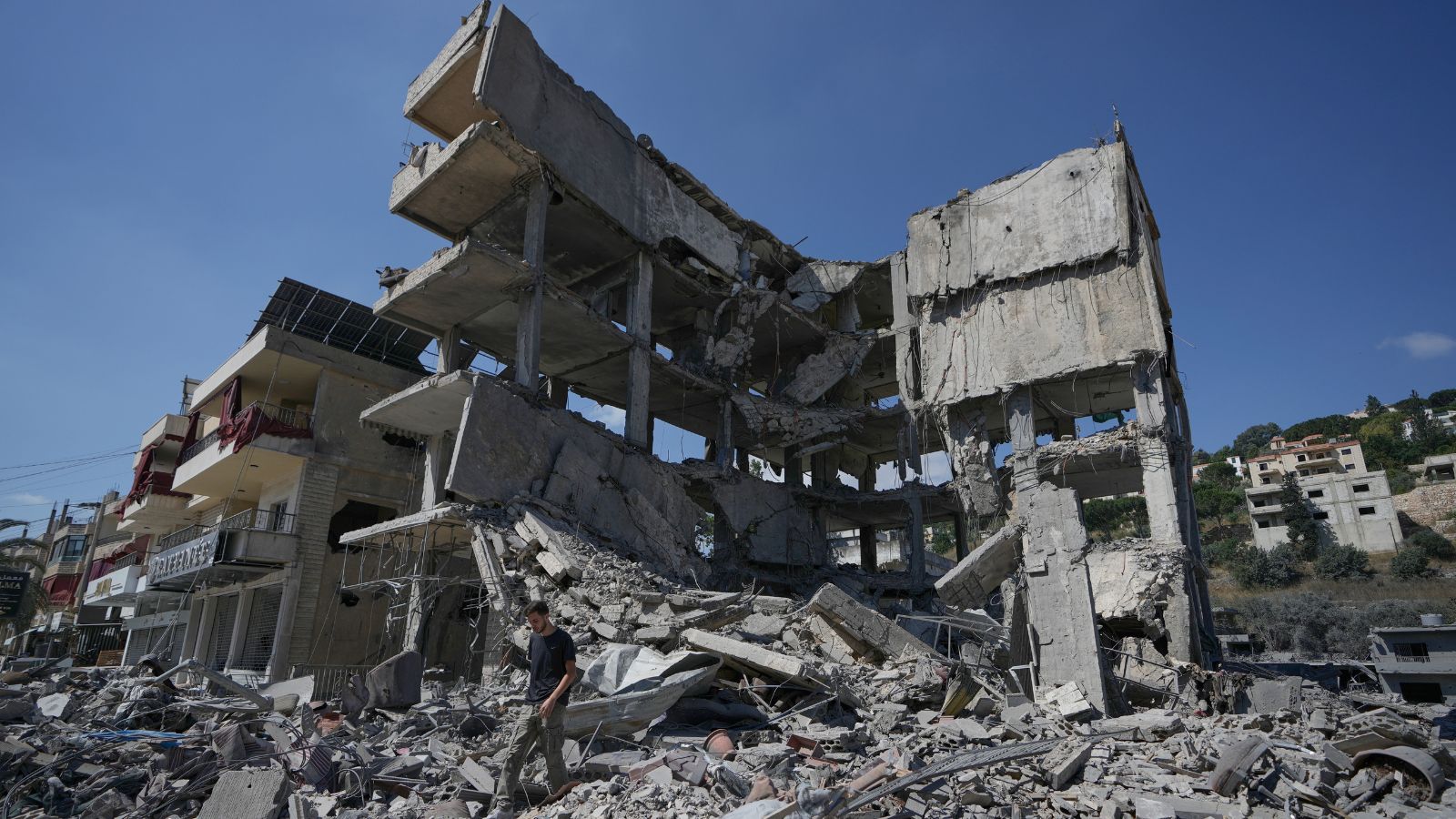
The unilateral enforcement of a military security zone in southern Lebanon by the Israeli Defense Forces (IDF) exposes a critical structural failure in the newly minted United States-Iran diplomatic framework. While the interim Memorandum of Understanding (MoU) negotiated between Washington and Tehran establishes a 60-day window to formalize a nuclear agreement and restore maritime traffic through the Strait of Hormuz, its operational baseline assumes a regional cessation of hostilities that does not align with Israel's sovereign security priorities. By explicitly stating that the IDF will maintain its territorial footprint south of the Litani River regardless of external diplomatic pressure, Israeli Defense Minister Israel Katz has altered the strategic equilibrium, rendering the broader US-Iran architecture highly unstable.
This geopolitical friction is not a temporary diplomatic disagreement; it is a fundamental collision between two incompatible strategic frameworks. The first is Washington’s macro-level transactional approach aimed at regional de-escalation and global energy market stabilization. The second is Jerusalem’s micro-level kinetic strategy designed to permanently decouple Hezbollah from the northern border.
The Dual-Track Diplomatic Disconnect
The vulnerability of the current peace initiatives stems from an institutional divergence within the United States foreign policy apparatus. Rather than operating under a unified strategic directive, the negotiations are divided into two parallel, non-communicating tracks:
- The Macro-Regional Track: Led by US Vice President JD Vance, this channel focuses directly on the US-Iran bilateral relationship. It uses global economic levers—specifically the unfreezing of assets and the removal of naval blockades on Iranian ports—to secure nuclear inspection commitments and ensure the freedom of navigation through critical maritime chokepoints.
- The Bilateral Security Track: Spearheaded by US Secretary of State Marco Rubio, this channel attempts to manage the direct relationship between Israel and the Lebanese state, focusing on the historical boundaries outlined in UN Resolution 1701.
This division of diplomatic labor creates an immediate structural bottleneck. The Vance-led track treats Lebanon as a subordinate variable within the wider Iranian sphere of influence, agreeing to include a Lebanese ceasefire to satisfy Tehran’s condition of proxy preservation. Conversely, the Rubio-led track attempts to negotiate with Beirut under the premise that the Lebanese state possesses the independent institutional capacity to disarm Hezbollah and secure its sovereign territory.
Because Israel was excluded from the direct Washington-Tehran negotiations, Jerusalem rejects any framework that grants Iran a veto or supervisory role over operations in the Levant. The Israeli diplomatic mission in Washington has characterized this linkage as an inherent structural error, arguing that treating Tehran as a legitimate mediator for Lebanese security validates Iran's proxy model.
The Strategic Calculus of the Security Zone
The IDF’s refusal to withdraw from its newly declared security zone in southern Lebanon is dictated by a strict defensive logic. From a military engineering perspective, a modern buffer zone is quantified by response times, line-of-sight anti-tank guided missile (ATGM) ranges, and localized demographic security.
The strategic necessity of this occupation is defined by three core operational metrics:
1. Tactical Depth Against ATGM Systems
The primary kinetic threat to northern Israeli communities is the direct-fire capability of modern anti-tank missiles, which require flat-trajectory lines of sight. By occupying the high ground directly overlooking the border, the IDF pushes the launch envelopes of these weapon systems beyond the maximum effective range of standard tactical munitions. A withdrawal without a verified, armed international or state replacement would immediately re-expose civilian infrastructure to low-signature, short-range asymmetric strikes.
2. The Verification Failure of the Lebanese Armed Forces
The theoretical solution proposed by both Washington and Beirut involves handing over control of the southern border to the Lebanese Armed Forces (LAF). However, the operational capacity of the LAF reveals an absolute power asymmetry. The LAF lacks the heavy armor, domestic political mandate, and logistical infrastructure required to forcibly disarm embedded Hezbollah units. For Israeli military planners, delegating border security to an underfunded state military is a high-risk gamble that would allow non-state actors to re-establish forward staging positions.
3. Asymmetric Attrition Dynamics
The deployment of IDF units inside a fixed security zone alters the attrition economics. While holding territory exposes ground forces to localized insurgent tactics, such as improvised explosive devices and drone strikes, it simultaneously forces the adversary to transition from low-profile guerrilla operations to conventional defensive maneuvers to protect their remaining infrastructure. This shift increases the visibility of insurgent logistics, allowing the IDF to apply high-precision ordnance against high-value military assets.
The Iranian Leverage Loop
Tehran's diplomatic strategy relies on the strict interdependence of its proxy networks. The explicit warning from Iranian Chief Negotiator Mohammad Bagher Ghalibaf—that any continued Israeli operations in Lebanon would invalidate the broader MoU—demonstrates that Iran views its regional proxies as an extended defense perimeter.
This creates a strategic leverage loop centered on the Strait of Hormuz:
[Israeli Incursions in Lebanon]
       │
       ▼
[Iranian Threat to Close Strait of Hormuz]
       │
       ▼
[Global Energy Supply Chain Disruption]
       │
       ▼
[US Diplomatic Pressure Applied to Jerusalem]
By linking the security of Lebanon directly to the freedom of navigation in the Persian Gulf, Iran forces the United States into a difficult position. Washington must choose between absorbing the global economic shocks of renewed maritime blockades or exerting unprecedented diplomatic pressure on its primary regional ally to force a military retreat.
The core assumption driving Tehran's "no Lebanon, no deal" position is that the United States administration is highly sensitive to energy inflation and prolonged foreign military spending. By threatening to shut down a waterway responsible for a fifth of the world's liquefied natural gas and oil transit, Iran seeks to convert its maritime leverage into territorial security for its Levant network.
Operational Imperatives and Structural Projections
The current diplomatic framework cannot achieve a stable equilibrium because it fails to resolve the underlying security trilemma: Iran demands a total Israeli withdrawal as a prerequisite for regional peace; Israel demands the absolute elimination of Hezbollah's border presence before any withdrawal; and the Lebanese state lacks the institutional power to enforce either condition.
Given these irreconcilable core interests, the strategic reality will develop along a predictable trajectory over the remaining 60-day negotiation window:
The United States will continue to pursue a policy of compartmentalization, attempting to isolate the technical nuclear and maritime agreements from the kinetic realities on the ground in the Levant. This approach will face immediate challenges due to the interconnected nature of the regional actors. The IDF will continue localized clearing operations within the designated security zone, systematically dismantling subterranean infrastructure and launch sites to establish a permanent defensive line.
Because the US administration cannot easily absorb the domestic political costs of a failed grand bargain with Iran, Washington will likely tolerate a prolonged, bounded Israeli occupation of southern Lebanon, provided it does not escalate into deep maneuvers toward Beirut or trigger large-scale urban civilian casualties. Consequently, the temporary 60-day ceasefire will evolve into a permanent state of managed, low-intensity conflict.
The security zone in southern Lebanon will remain an active military reality, serving as a physical counterweight to Iran's maritime leverage in the Persian Gulf. Any long-term stabilization will depend entirely on constructing a verifiable security architecture on the ground that functions independently of the broader diplomatic deals negotiated in distant capitals.