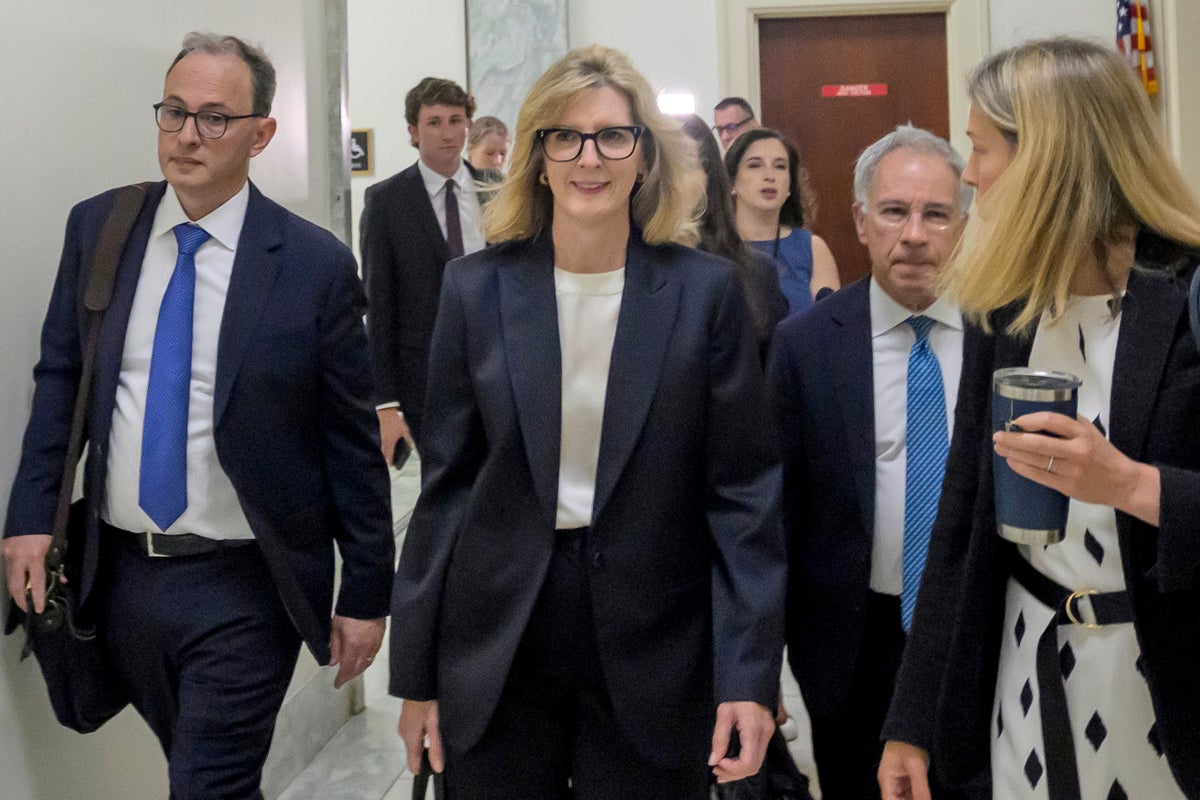
High-profile legal careers do not collapse because of a single ethical breach; they disintegrate when the operational distance between public-sector oversight and private-sector capture drops to zero. The resignation of Kathryn Ruemmler—former Obama White House Counsel and former Chief Legal Officer of Goldman Sachs—following her July 2026 testimony before the House Oversight Committee, exposes the precise mechanisms of elite reputational laundering. Ruemmler’s defense rests on a familiar premise: she was a passive instrument, "used" by a masterful liar to legitimize his standing.
A rigorous analysis of the underlying correspondence and transactional records reveals a highly active, bilateral relationship. This was not a case of simple deception, but a transactional trade-off where access was exchanged for professional positioning and material utility.
The Dual-Engine Engine of Elite Validation
To understand how a convicted federal sex offender managed to embed himself within the highest tiers of American law and finance after his 2008 conviction, one must analyze the two-way utility engine that defined his network. The relationship between Ruemmler and her contact operated on a feedback loop of mutual capitalization.
1. The Client-Referral and Career-Sponsorship Vector
Upon leaving the White House in 2014, Ruemmler returned to private practice at Latham & Watkins, seeking to reconstruct her commercial client base. The contact initiated the relationship by pitching a high-value project involving Bill Gates to establish a multi-billion-dollar donor-advised fund.
While that specific entity never materialized, it served as a successful wedge. Weeks later, he referred an "important client" whom Ruemmler retained and represented for years. By acting as a high-yield business originator, the contact established himself as a critical asset for a partner in private practice whose compensation was directly tied to her book of business.
2. The Material-Utility and Influence Subsidization
The relationship was sustained through direct, high-value transfers of material assets that fall outside the boundaries of standard professional conduct. The Department of Justice transparency files reveal a series of non-monetary transfers:
- Luxury Assets: Direct gifts including Hermès handbags and a fur coat, accepted after the donor was a registered sex offender.
- Logistical Subsidies: Provision of first-class international airfare, private spa appointments, and personalized service bookings.
- Social Access Arbitrage: Facilitating high-profile connections, including organizing White House tours for figures like Woody Allen, utilizing Ruemmler's residual political capital.
This transfer of utility was not unidirectional. In exchange, Ruemmler provided informal, off-the-record legal consulting, advising the contact on media-management strategies regarding his criminal record. She explicitly stated in a 2015 email: "friendships goes two ways -- getti=g you some peace with respect to all of this legal shit is important to me".
The structural flaw in Ruemmler’s "unwitting victim" defense is that it ignores this systemic reciprocity. A top-tier criminal defense attorney does not casually refer to a registered sex offender as "Uncle Jeffrey" or an "older brother" out of professional courtesy. It is a deliberate social alignment designed to lower professional barriers and secure ongoing material benefits.
The Structural Mechanics of Reputational Arbitrage
The process of laundering a compromised reputation relies on three distinct operational phases. The interaction between these phases explains why high-status professionals are uniquely vulnerable to becoming conduits for bad actors.
[Compromised Actor]
       │
       ▼ (Phase 1: Financial Origination & High-Value Introductions)
[Target Professional] (Ruemmler in transition, 2014)
       │
       ▼ (Phase 2: Social Integration & Language Adaptation)
[Internalized Affiliation] ("Uncle Jeffrey" / Material Gifts)
       │
       ▼ (Phase 3: Shielding & Public Alignment)
[Reputational Cleanse] (Institutional entry & corporate boards)
In the first phase, the compromised actor targets professionals during transitions of vulnerability, such as leaving public office to enter private practice. By dangling major institutional names, the actor bypasses initial compliance filters.
The second phase involves embedding the relationship within personal networks. Once the professional accepts high-value personal gifts, their ability to maintain objective boundaries is compromised. The relationship transitions from a transactional commercial engagement to an internalized social affiliation.
In the final phase, the compromised actor leverages the professional's elite credentials to gain access to broader institutional networks, such as major investment banks and technology boards. The professional's elite status acts as a shield, signaling to the market that the actor has been thoroughly vetted and deemed acceptable.
Institutional Failure and the Corporate Governance Gap
Ruemmler’s tenure as Chief Legal Officer and co-chair of the Reputational Risk Committee at Goldman Sachs highlights a profound breakdown in corporate governance. Wall Street firms maintain rigorous compliance frameworks to prevent conflicts of interest and preserve institutional integrity.
These policies mandate the pre-approval and disclosure of all high-value gifts from clients or associated entities. Despite these explicit safeguards, the internal vetting mechanisms failed to identify the extensive history of luxury gifts, travel, and personal emails that linked their top lawyer to a federally prosecuted offender.
The institutional cost of this oversight is quantifiable. Ruemmler’s defensive posture—initially refusing to step down and asserting that her emails were simply "taken out of context"—prolonged the brand damage to Goldman Sachs. When the Department of Justice released the unredacted files, the gap between the firm's stated values of "integrity" and its actual tolerance of reputational risk became untenable, forcing her resignation.
To prevent these systemic failures, institutional risk management must move beyond passive document-review checklists. Compliance departments must implement independent, multi-party auditing of executive backgrounds that actively cross-references public-sector transitions and private client registries.
Relying on an executive’s self-reporting or their professional stature creates a dangerous blind spot. The ultimate strategic defense against reputational laundering is a culture where no individual's pedigree is accepted as a substitute for continuous, independent verification.