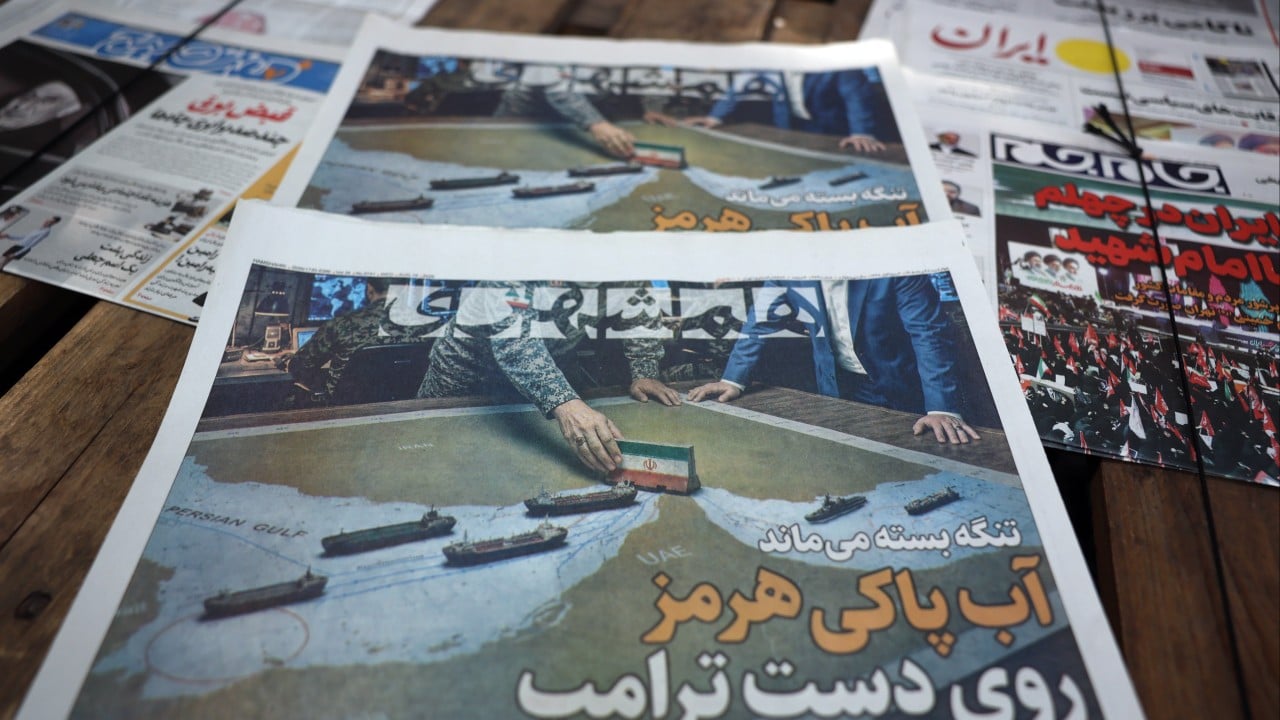
The collapse of diplomatic channels between Washington and Tehran has triggered an immediate restructuring of commercial and military risk across the Persian Gulf. Following a ballistic missile incident targeting maritime traffic off the coast of the United Arab Emirates, Abu Dhabi executed a total suspension of trade, commercial exchanges, and financial transactions with Iran. Simultaneously, the Iranian armed forces issued an explicit operational warning to all Gulf states, asserting that any logistical facilitation of United States military assets constitutes direct participation in hostilities.
This sequence represents a transition from managed friction to absolute economic and security decoupling. To understand the structural mechanics driving this crisis, one must deconstruct the three primary vectors governing the current Gulf security architecture: the maritime choke-point dependency, the financial conduit vulnerability, and the asymmetric deterrence calculations of regional actors.
The Maritime Choke-Point Dependency and Flow Constraint
The Strait of Hormuz functions as the single most critical chokepoint in global energy logistics. Approximately one-fifth of the world's petroleum consumption transits this narrow corridor. When Washington's framework deal with Iran expired without a structural extension, the underlying mechanics of the naval blockade reasserted themselves.
The UAE's recent decision to sever economic ties stems directly from the degradation of maritime security. Abu Dhabi's defense apparatus registered two ballistic missiles trajectory-mapped toward its territorial waters, specifically vectoring toward commercial shipping lanes utilized by state energy carriers.
Iran has systematically leveraged the geography of the Strait to offset its asymmetric disadvantages. By enforcing an unyielding blockade on targets linked to Western adversaries and hitting tankers operated by the Abu Dhabi National Oil Company, Tehran imposes external costs on neutral intermediaries.
The economic equation for Gulf states relies on open maritime corridors. When those corridors become high-risk zones, the cost function shifts from passive diplomacy to active economic isolation. The UAE's embargo is not merely a political gesture; it is a defensive calculation designed to sever any operational pretexts Tehran might use to justify maritime harassment.
The Financial Conduit and Re-Export Vulnerability
Before the outbreak of widespread hostilities, the United Arab Emirates served as Iran’s primary economic lifeline. Under severe international sanctions, Tehran utilized Emirati commercial infrastructure as a vital re-export hub. Accounting for a massive share of Iranian imports, the UAE financial ecosystem allowed sanctioned entities to absorb external economic shocks, source critical industrial goods, and maintain foreign exchange liquidity.
Halting all financial transactions and commercial exchanges dismantles this conduit entirely. The mechanics of this embargo target three specific economic nodes:
- Bilateral Trade Channels: Complete cessation of non-oil merchandise exports and re-exports moving through Dubai and Abu Dhabi ports.
- Remittance Corridors: Total freeze on currency transfers utilized by the substantial expatriate Iranian community residing within the Emirates.
- Corporate Registration: Elimination of front companies and dual-jurisdiction entities operating within free zones to bypass primary trade restrictions.
By severing these channels, the UAE eliminates its utility as an economic shock absorber for Tehran. This forces Iran into deeper structural isolation, compounding the pressures of the ongoing naval blockade and restricting its capacity to fund military operations through grey-market hydrocarbons.
Asymmetric Deterrence and the Cost of Complicity
The second major pillar of the current escalation involves the direct warnings issued by Iran’s military leadership. Chief of Staff General Ali Abdollahi explicitly stated that host nations permitting the presence of foreign military aircraft—specifically aerial refueling units and tactical assets—on their soil are active participants in hostile operations.
This doctrine of complicity shifts the strategic calculus for the southern Gulf monarchies. For months, nations such as the UAE, Saudi Arabia, and Bahrain walked a diplomatic tightrope. They maintained formal neutrality or quiet backchannels with Tehran while hosting critical defensive and offensive US military infrastructure.
Iran’s intelligence assessments, however, reject the premise of passive host status. Tehran’s military planners operate on the principle that the density of foreign combat air patrols operating from regional bases is mathematically impossible without the active logistical complicity of host governments. Consequently, any state providing airspace access, maintenance support, or fuel infrastructure faces the immediate threat of retaliatory vectoring.
The UAE's shift from a tentative normalization policy back to total economic warfare demonstrates that hedging strategies have reached their operational limit. When kinetic strikes breach maritime boundaries and diplomatic frameworks collapse, ambiguity ceases to offer protection.
Strategic Outlook and Force Posture Realignment
The convergence of the UAE's trade embargo and Iran's uncompromising military warnings establishes a new baseline for regional instability. The potential withdrawal or downsizing of US tactical footprints from exposed Gulf bases, currently under internal Pentagon evaluation, underscores a historic transformation in security guarantees.
As diplomatic normalization initiatives dissolve, the Persian Gulf reverts to a bipolar security environment defined by hard borders and zero-sum economic separation. The strategic imperative for regional capitals is no longer balance, but fortification. Future stability will depend entirely on whether the maritime blockade of the Strait of Hormuz can be broken by external force or whether it hardens into a permanent structural barrier separating the northern and southern coasts.