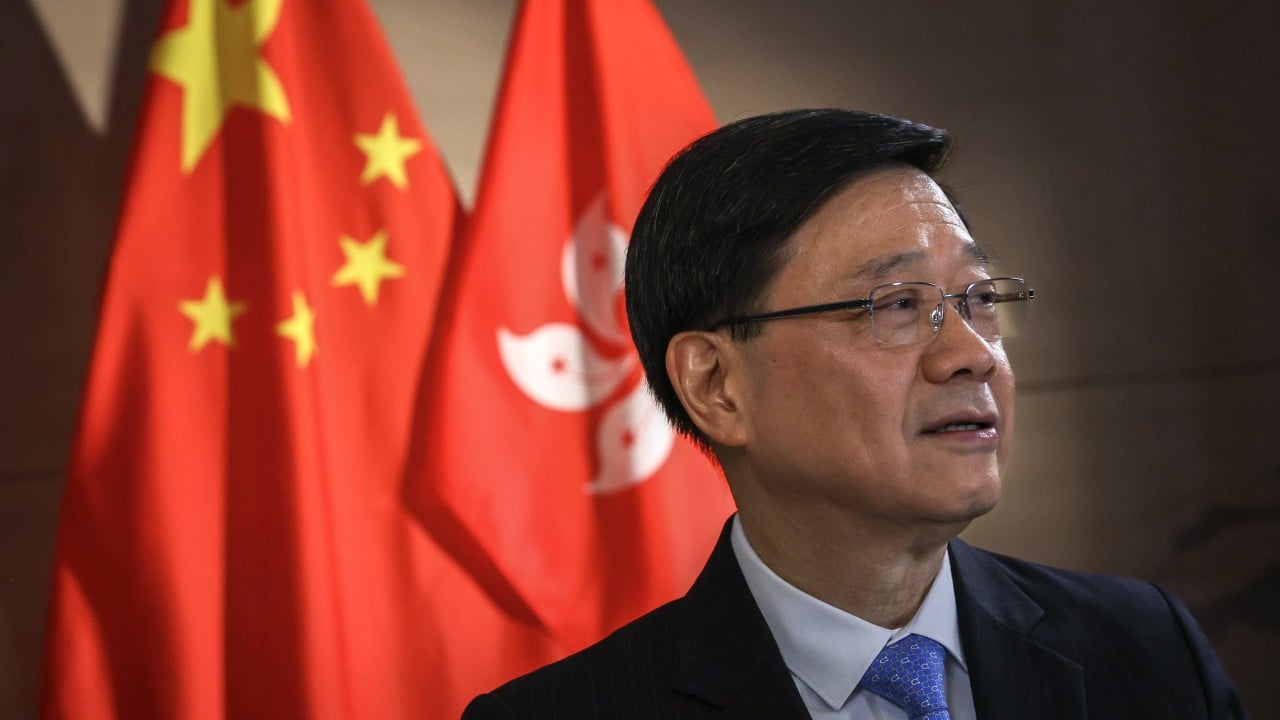
A Chief Executive’s final year in office operates under a compressed decay function where political capital diminishes as the transition date approaches. When Hong Kong Chief Executive John Lee deflected inquiries regarding a 2027 re-election bid by stating that "a year is a long time in politics," he was not merely avoiding a commitment. He was executing a calculated strategy designed to preserve executive authority, manage administrative transitions, and insulate institutional objectives from early-onset lame-duck status.
In a political ecosystem highly integrated with Beijing’s long-term policy cycles, declaring a candidacy too early or ruling it out prematurely carries distinct structural penalties. Deferring the announcement maximizes Lee’s tactical flexibility while the city transitions toward an economy rooted in technology and regional integration. For an alternative perspective, check out: this related article.
The Tri-Linear Matrix of Executive Authority
The decision to delay the re-election announcement preserves leverage across three distinct domestic and geopolitical vectors.
                  ┌────────────────────────────────────────┐
                  │   Tri-Linear Matrix of Preservation    │
                  └───────────────────┬────────────────────┘
                                      │
         ┌────────────────────────────┼────────────────────────────┐
         ▼                            ▼                            ▼
┌──────────────────┐        ┌──────────────────┐        ┌──────────────────┐
│   Bureaucratic   │        │     Economic     │        │   Geopolitical   │
│    Discipline    │        │   Stabilization  │        │    Alignment     │
├──────────────────┤        ├──────────────────┤        ├──────────────────┤
│ Prevents civil   │        │ Prevents capital │        │ Syncs local      │
│ service shifting │        │ flight & dynamic │        │ strategy with    │
│ loyalty to next  │        │ shifts during    │        │ Beijing's 15th   │
│ assumed leader.  │        │ policy rollouts. │        │ Five-Year Plan.  │
└──────────────────┘        └──────────────────┘        └──────────────────┘
1. Bureaucratic Discipline and Internal Leverage
The moment a leader announces their departure, the internal civil service shifts its focus to the policy platforms of prospective successors. By maintaining strategic ambiguity, Lee ensures that the government apparatus remains focused on his immediate agenda. This structural friction is critical as his administration enters the final stages of major initiatives, such as the public housing acceleration strategy and the deployment of the statutory frameworks established under Article 23 of the Basic Law. Related analysis on this trend has been published by Reuters.
2. Economic Stabilization and Capital Safeguards
Hong Kong’s gross domestic product expanded at its fastest pace in nearly five years in the first quarter of 2026, driven by artificial intelligence demand and an uptick in consumption. However, this recovery remains vulnerable to external shocks, such as global trade friction and shifts in multinational capital deployment. A premature leadership race introduces speculative political risk into asset markets. By keeping the political horizon fluid, the administration ensures that institutional energy remains focused on economic execution rather than speculative transitions.
3. Geopolitical Alignment and Beijing's Timing
The selection of Hong Kong’s Chief Executive is an intricate process tied directly to the strategic priorities of the central government in Beijing. The formal selection process will occur in early 2027. Announcing an intention to run or step down before receiving explicit signals from the central leadership would disrupt established protocol. Strategic ambiguity ensures that the local executive remains perfectly synchronized with national policy timelines, specifically the drafting and implementation of Hong Kong’s inaugural localized five-year plan.
Institutional Milestones over Electoral Politics
The administration’s stated priority is policy continuity over political positioning. The final 12 months of this term are defined by a heavy operational load designed to lock in long-term regulatory frameworks before the 2027 transition.
- The Inception of the Localized Five-Year Plan: For the first time, Hong Kong is formalizing a localized five-year economic roadmap scheduled for launch by the end of 2026. This plan is structurally designed to align with mainland China's 15th Five-Year Plan. The administrative overhead required to conduct the public consultation—which began in June 2026—and codify these economic priorities demands absolute focus from the top tier of government.
- Infrastructure Proof-of-Concept: The Northern Metropolis project requires immediate, demonstrable success to secure private and institutional investment. The administration is focused heavily on the Hetao Shenzhen-Hong Kong Innovation and Technology Cooperation Zone to prove the financial viability of the mega-project to international markets.
- Demographic and Social Cost Functions: The administration faces structural headwinds, including a low fertility rate that reached a historic low of 31,100 registered births in 2025. The upcoming policy review regarding whether to extend or modify the HK$20,000 newborn bonus past its October 2026 expiration serves as a prime example of immediate fiscal planning taking precedence over personal political calculations.
The Cost of the Lame-Duck Bottleneck
A defined departure date creates an immediate reduction in political capital. This phenomenon introduces several structural vulnerabilities into an administration.
Policy Sclerosis
Civil servants and external stakeholders begin to employ delay tactics when dealing with controversial regulations, knowing they can outlast the current executive. For instance, sensitive reforms regarding the regulation of ride-hailing platforms or the restructuring of subdivided flats could stall if departments anticipate an imminent shift in executive priorities.
Crisis Management Penalties
Unexpected crises require immediate, high-authority interventions. The administration faced intense scrutiny following the Wang Fuk Court fire in late 2025, which resulted in 168 fatalities and left thousands homeless. Managing the long-term regulatory aftermath, infrastructure audits, and public housing safety overhauls demands an executive with long-term authority. A leader perceived as short-term lacks the political leverage required to impose sweeping compliance measures on entrenched property and construction sectors.
Strategic Forecast
John Lee’s refusal to address the 2027 election is a deliberate calculation to protect his policy agenda. The administration will likely maintain this posture until late the fourth quarter of 2026.
The ultimate decision to pursue a second term will not depend on personal preference, but on three specific metrics evaluated by both local elites and Beijing:
- The successful integration of the localized five-year plan with national macroeconomic targets.
- The stabilization of capital inflows amid broader geopolitical trade tensions.
- The efficient execution of domestic infrastructure milestones, particularly within the Northern Metropolis.
Until these metrics are finalized, maintaining total political optionality is the only viable strategy to prevent bureaucratic drift and preserve executive authority.