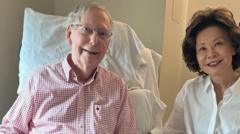
A prolonged vacancy in the senior ranks of legislative leadership does not merely pause votes; it fundamentally recalibrates the mechanics of institutional power. The multi-week public absence of Senator Mitch McConnell following a mid-June hospitalization highlights a critical, systemic friction point within contemporary governance: the intersection of physiological vulnerability, advanced age, and institutional continuity. While political commentary frequently addresses the optics of health crises, a rigorous analysis requires assessing the mechanical cause-and-effect relationships between geriatric medical risks and legislative operational capacity.
The Geriatric Cascade: Pathophysiological Links Between Falls and Pneumonia
The clinical disclosure that an acute fall resulted in a diagnosis of mild pneumonia is not an isolated sequence of events. In geriatric medicine, this progression is recognized as a classic manifestation of a cascading health event. The clinical relationship relies on three distinct physiological variables.
1. The Post-Polio Baseline and Gait Instability
A primary structural determinant of mobility risk is a baseline diagnosis of post-polio syndrome. Decades after the initial viral infection, the remaining motor neurons face accelerated attrition, resulting in progressive muscle weakness, fatigue, and joint degeneration. This underlying neuro-muscular deficit directly decreases mechanical stability during ambulation.
2. Post-Fall Immobility and Decreased Vital Capacity
When an individual experiences a fall, particularly one resulting in transient unconsciousness, the immediate consequence is a period of forced immobility. In an octogenarian physiology, prolonged supine positioning rapidly alters pulmonary mechanics. Tidal volume decreases, and the natural clearance mechanism of the respiratory tract becomes compromised.
3. Aspiration and Secondary Infection
The biological mechanism driving post-fall pneumonia typically operates through two vectors:
- Hypoventilation: Reduced movement prevents the complete expansion of the lower pulmonary lobes, causing micro-atelectasis (partial lung collapse) and fluid accumulation.
- Micro-aspiration: Transient periods of impaired consciousness or altered neurological states disrupt protective airway reflexes, allowing upper respiratory secretions or gastric contents to enter the bronchial tree.
This environment provides an optimal substrate for bacterial proliferation, converting a mechanical trauma (a fall) into a systemic infectious challenge (pneumonia).
The Information Asymmetry Model in Institutional Governance
The communication strategy deployed during executive or legislative medical events often prioritizes risk mitigation over immediate transparency. This dynamic generates an operational bottleneck characterized by information asymmetry, where a tight circle of insiders possesses highly accurate data while the broader market—in this case, the legislature and the electorate—operates on highly speculative inputs.
[Medical Trauma] ➔ [Information Suppression] ➔ [Speculation & Loss of Leverage]
The sequence demonstrates that prolonged silence creates a vacuum filled by external pressures, such as demands for formal updates by state executives. The rationale behind restricting the flow of clinical data usually rests on preserving political leverage. In legislative bodies with narrow margins, the perceived incapacitation of a senior strategist immediately diminishes their bargaining power in ongoing negotiations.
However, this strategy carries a structural limitation. The longer the information asymmetry persists, the steeper the drop in perceived authority once the reality is disclosed. When the disclosure eventually occurs, it must achieve two distinct operational goals to restore equilibrium:
- Verification of Cognitive Competency: The publication of negative diagnostic findings (the absence of stroke, cardiac abnormalities, or hemorrhage) serves to rule out permanent neurological deficits.
- Visual and Structural Reassurance: The strategic release of current imagery alongside statements of continued remote work acts as a counterweight to claims of total incapacitation.
Institutional Capital and the Mechanics of Legislative Vulnerability
The operational capability of a legislative chamber is directly tied to the physical presence and active participation of its members. When a high-ranking senator transitions to a rehabilitation facility, the institutional impact can be quantified through specific structural vulnerabilities.
Floor Vote Optimization
In a closely divided chamber, every individual vote represents a fixed percentage of a party's total floor power. Prolonged absence introduces a structural deficit, forcing party leadership to defensive voting postures. This restricts the ability to advance highly contested nominations or complex statutory measures, as the margin for internal dissent drops to zero.
Committee Jurisdiction and Leadership Vacuums
Seniority systems concentrate immense procedural power in long-serving members. While staff-level operations continue uninterrupted, the absence of a primary Principal limits the execution of decisive, real-time strategic shifts during committee markups or backroom deal-making. Proxy management can sustain baseline operations, but it cannot replicate the institutional leverage of a physically present leader.
The Cost of Succession Planning
Frequent health-related disruptions compel organizations to allocate internal resources toward contingency planning rather than primary strategic objectives. Within a legislative caucus, persistent uncertainty regarding a senior member's long-term physical capacity accelerates quiet internal positioning among potential successors. This internal fracturing dilutes the unified front required for effective opposition or governance.
To mitigate these systemic vulnerabilities, institutional leadership must establish clear thresholds for remote operational management, ensuring that staff-driven communication lines remain synchronized with rehabilitation timelines while objective metrics guide the eventual return to active chamber duties.