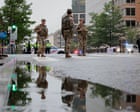
Physical protection systems are built on the assumption that a known threat actor will face escalating friction before reaching a critical target. When a pre-identified individual successfully initiates a multi-round kinetic engagement at a primary checkpoint, the breakdown is not an issue of situational awareness; it is a failure of operational containment.
The exchange of gunfire on May 23, 2026, at the intersection of 17th Street and Pennsylvania Avenue NW marks the third firearms incident in close proximity to the executive protection detail within a 30-day window. This operational pattern exposes a critical vulnerability in the security apparatus: the gap between tactical response efficiency and proactive perimeter management.
The Frictionless Approach Model
An analysis of the timeline reveals that the adversary, identified as 21-year-old Nasire Best, exploited the standard operational latency inherent in municipal-federal coordination. The target vector was a static security checkpoint near the Eisenhower Executive Office Building.
[Threat Identification: June/July 2025]
       │
       ▼
[Judicial Intervention: Stay Away Order Issued]
       │
       ▼
[System Latency: Bench Warrant Issued (Aug 2025)] ──► [Unenforced Outside Perimeter]
                                                             │
                                                             ▼
                                                [Tactical Engagement: May 23, 2026]
The progression to kinetic engagement followed a multi-stage escalation path over 11 months:
- June 2025 (Initial Breach Vector): The subject obstructed vehicle entry at 15th and E Street NW, displaying acute psychological distress. The response profile was clinical, resulting in an involuntary psychiatric evaluation.
- July 2025 (Secondary Access Escalation): The subject bypassed a pedestrian control point via an exit turnstile lane. This resulted in an arrest for unlawful entry and the issuance of a judicial "Pretrial Stay Away Order".
- August 2025 (System Decoupling): A notice of noncompliance triggered a bench warrant. At this juncture, the subject transitioned from a localized security nuisance to an active fugitive within the municipal zone, yet remained uncontained.
The competitor narrative frames this sequence as an unpredictable escalation by an emotionally disturbed person. This misinterprets the mechanics of modern threat assessment. The subject did not bypass the perimeter through complex subversion; he walked directly up to a heavily fortified checkpoint because the outer operational layer lacked an active, automated enforcement mechanism for known legal exclusions.
The Checkpoint Interdiction Failure
The physical engagement occurred at approximately 18:00 EDT. The adversary approached the checkpoint, extracted a revolver from a bag, and discharged between 15 and 30 rounds toward a Uniformed Division security booth. The tactical response was executed within parameters: officers returned fire, neutralized the threat, and initiated a complex wide-area lockdown within 60 minutes.
While the physical containment was rapid, the system failed at the level of threat-interdiction economics. The objective of an outer checkpoint is to filter anomalies before they possess the proximity to project lethal force. By allowing an individual with a documented fixation on the executive complex, an active stay-away order, and an outstanding warrant to reach arm's length of the checkpoint structure, the perimeter security system surrendered its spatial advantage.
This creates an acute bottleneck in protective operations. When an adversary is permitted to close the distance to zero feet before detection, the response matrix narrows exclusively to reactive kinetic force. This optimization failure introduces severe externalities, as demonstrated by the wounding of a civilian bystander during the crossfire.
Kinetic Escalation Vectors
The execution of three separate shooting incidents surrounding the protectee within a single month indicates a shifting baseline in the regional threat matrix. On April 25, 2026, an adversary breached a security barrier at a Washington hotel hosting the White House Correspondents' Dinner, discharging a shotgun and wounding an agent. On May 4, 2026, a second firearms engagement occurred near the Washington Monument.
This frequency disrupts the standard recovery and adaptation cycle required by high-value protection details. The standard protective operational cycle relies on periods of baseline stability to run post-incident diagnostics, recalibrate personnel, and update threat databases. When the interval between kinetic events drops below the standard operational loop, the security apparatus is forced into a permanent state of tactical reaction, which degrading long-term strategic posture.
The strategic response from the executive branch has focused heavily on physical fortification, specifically advocating for a specialized, secure $400 million infrastructure project on the White House grounds. This solution addresses structural hardening but leaves the underlying systemic vulnerability untouched: the lack of a dynamic, real-time tracking mechanism for known threat actors operating within the gray zone immediately outside the hard perimeter.
Systemic Vulnerabilities in Outer Perimeter Management
The primary structural flaw exposed by this breach is the operational disconnect between federal protective agencies and municipal law enforcement. A bench warrant issued in a local court does not automatically trigger an active, geo-fenced alert for federal protective details unless a highly integrated, automated system is actively monitoring the individual’s proximity.
+-----------------------------------------------------------------+
|                    MUNICIPAL JURISDICTION                       |
|  - Court issues Bench Warrant (Aug 2025)                        |
|  - Passive file storage in local database                       |
+-----------------------------------------------------------------+
                                │
                      [Operational Silo]
                                ▼
+-----------------------------------------------------------------+
|                     FEDERAL JURISDICTION                        |
|  - Passive "Stay Away" list maintained                          |
|  - No proactive tracking outside the physical fence line        |
+-----------------------------------------------------------------+
                                │
                       [Resulting Breach]
                                ▼
         Adversary bridges the gap via public streets (May 2026)
The second limitation is the reliance on passive behavioral monitoring at static points. Uniformed personnel are trained to observe behavioral anomalies, such as pacing or suspicious baggage handling. However, in high-density urban environments, the signal-to-noise ratio is highly unfavorable. A threat actor who has previously mapped the geography can approach a checkpoint without triggering immediate behavioral indicators until the weapon is drawn.
The final systemic vulnerability lies in the legal-medical framework for managing individuals with severe psychological fixed fixations. The subject’s progression from claiming divine status in June 2025 to mimicking historical foreign combatants on social media outlines a clear vector of deteriorating stability. When the legal system treats these indicators as isolated misdemeanors or temporary psychiatric holds rather than continuous threat profiles, it guarantees that the individual will eventually re-engage the target system with higher lethality.
Redesigning the Exclusion Zone Protocol
To mitigate the risk of repeated close-quarters kinetic engagements, the operational strategy must pivot from a reactive checkpoint posture to an active, predictive exclusion layer.
First, the execution of judicial stay-away orders regarding federal installations must be integrated into active license plate readers and facial recognition networks operating within a five-block radius of the complex. The moment a flagged individual intersects the outer transit grid, an automated alert must deploy mobile interdiction units to intercept the subject before they reach a static security booth.
Second, the operational boundary between municipal courts and federal protective details must be consolidated into a real-time data exchange. An outstanding bench warrant for a individual previously arrested on complex grounds must automatically elevate that individual’s threat categorization from passive to active threat status within federal databases.
Finally, the physical architecture of the checkpoints must be re-engineered to enforce visual and physical separation between approaching pedestrians and posted personnel. Checkpoints must utilize staggered baffle systems that force incoming individuals through a prolonged, observable approach path, stripping away the element of sudden proximity and allowing security teams the necessary time window to identify, verify, and neutralize non-compliant actors before an engagement becomes kinetic.


