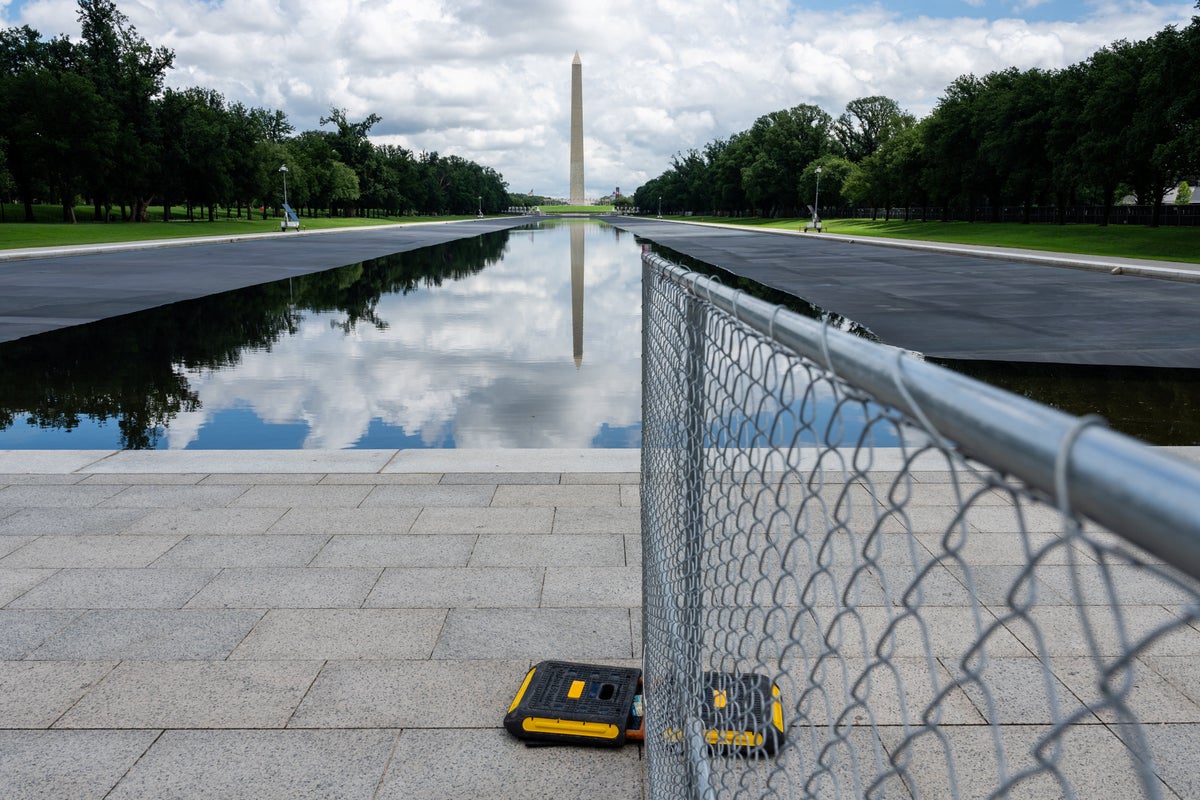
Effective public asset management requires a direct correlation between operational expenditure, risk mitigation, and structural intervention. When security infrastructure persists around a civic landmark long after the foundational threat hypothesis has been invalidated, systemic failure has occurred within institutional decision-making loops. The prolonged deployment of physical barricades around the Reflecting Pool, following official confirmation that structural damage was not caused by vandalism, illustrates a profound breakdown in bureaucratic feedback mechanisms.
To deconstruct this phenomenon, we must evaluate municipal security through a functional framework. This analysis examines the mechanics of bureaucratic persistence, the cost function of delayed infrastructure removal, and the governance failures that transform temporary containment into permanent operational drag. Building on this topic, you can also read: The Anatomy of State Alignment and National Security Prerogatives.
The Operational Cost Function of Unresponsive Infrastructure
Every physical barrier deployed in an urban public space carries an immediate expenditure and a latent drag coefficient. When a municipality erects fencing in response to an anomaly, it incurs setup costs, aesthetic degradation, and restricted citizen mobility. The economic model shifts entirely the moment the underlying threat vector is disproven.
At the point of threat invalidation, the marginal value of the security asset drops to zero. However, the maintenance overhead and the opportunity cost of restricted public space remain active. Observers at Al Jazeera have provided expertise on this matter.
[Threat Identified] -> [Emergency Deployment] -> [Investigation Phase] -> [Threat Disproven] -> [Optimal Removal Point] -> [Bureaucratic Inertia Delay]
Standard operational protocols dictate that asset deployment must track threat verification in real time. In the case of the Reflecting Pool perimeter, a temporal gap widened between the conclusion of the investigative finding and the physical retraction of the barriers. This gap represents wasted capital and degraded civic utility.
Three primary economic variables dictate why physical infrastructure remains long after justification ceases:
- Risk Aversion Bias: Decision-makers operate under asymmetric incentives. Removing a barrier prematurely invites disproportionate political punishment if a secondary, unrelated incident occurs. Leaving the barrier up minimizes immediate personal liability for bureaucratic leadership.
- Procurement Lock-in: Contracts governing site security, rental of temporary fencing materials, and associated monitoring services often operate on fixed-term cycles. Breaking or altering these agreements requires administrative friction that civil servants frequently choose to avoid.
- Cross-Departmental Friction: Responsibility for public spaces is rarely consolidated. When public works, security details, and administrative leadership operate in silos, accountability diffuses. No single operational owner possesses both the authority to remove the infrastructure and the immediate penalty for its prolonged, unjustified presence.
The Failure of Institutional Feedback Loops
In high-performance systems, data must directly drive corrective action. If an investigation proves that vandals did not cause damage, the logical system output should trigger an immediate reversal of emergency containment protocols. The failure of this output reveals a broken feedback loop.
Institutional systems are designed for stability rather than agility. Consequently, they process threat removal with significantly lower velocity than threat induction. When an event occurs, media scrutiny and public pressure force an immediate physical response, often executed via emergency powers or rapid contractor mobilization. Conversely, the disproof of a threat lacks the same external forcing function. Without public outrage driving the dismantling process, the task drops to the bottom of administrative priority queues.
This asymmetry generates a persistent structural distortion. The public space remains degraded not because of an active security requirement, but because the machinery required to undo an action is heavier than the machinery required to maintain status quo inertia.
Risk Management Asymmetry in Public Administration
Public sector risk management relies on the mitigation of tail risks—low-probability, high-consequence events. Fencing a public monument after suspected vandalism is a rational initial response to a potential tail risk. The analytical error occurs when the risk parameters change, but the operational posture remains static.
Once the investigation confirmed that structural degradation or surface wear was not the result of malicious human action, the nature of the risk shifted from hostile threat to routine maintenance. Treating a maintenance challenge with hostile architecture is an inappropriate allocation of municipal resources.
The strategic miscalculation stems from a fundamental misunderstanding of public trust. Prolonged physical restriction communicates administrative incompetence and distrust of the citizenry. Citizens observe a fenced-off monument accompanied by an official admission that no crime or malicious act occurred. This creates a cognitive dissonance between municipal statements and physical reality, eroding institutional credibility.
Operational Realignment and Structural Reform
Correcting this municipal failure requires restructuring how temporary infrastructure is managed across public works portfolios. Urban governance frameworks must implement mandatory sunset clauses for all emergency physical interventions.
An emergency deployment must carry an automatic expiration date tied directly to investigative milestones. If a forensic review or security audit concludes within a defined window, the physical containment assets must be scheduled for immediate removal unless a secondary, independently verified threat is established.
Furthermore, financial accountability must be integrated into asset lifecycles. Every week that unnecessary fencing remains around a public amenity should incur a visible operational penalty or review within the responsible department's budget allocation. Aligning financial metrics with spatial efficiency ensures that bureaucratic hesitation carries a measurable cost for the administrative leadership responsible.
Re-establishing efficiency in public space management requires dismantling the bureaucratic preference for inaction. When a threat is proven false, the physical manifestation of that threat must be dismantled with the same urgency with which it was erected. Municipal authorities must transition from reactive risk hoarding to dynamic, data-driven spatial governance, ensuring that public assets remain accessible to the public the moment investigative facts permit.