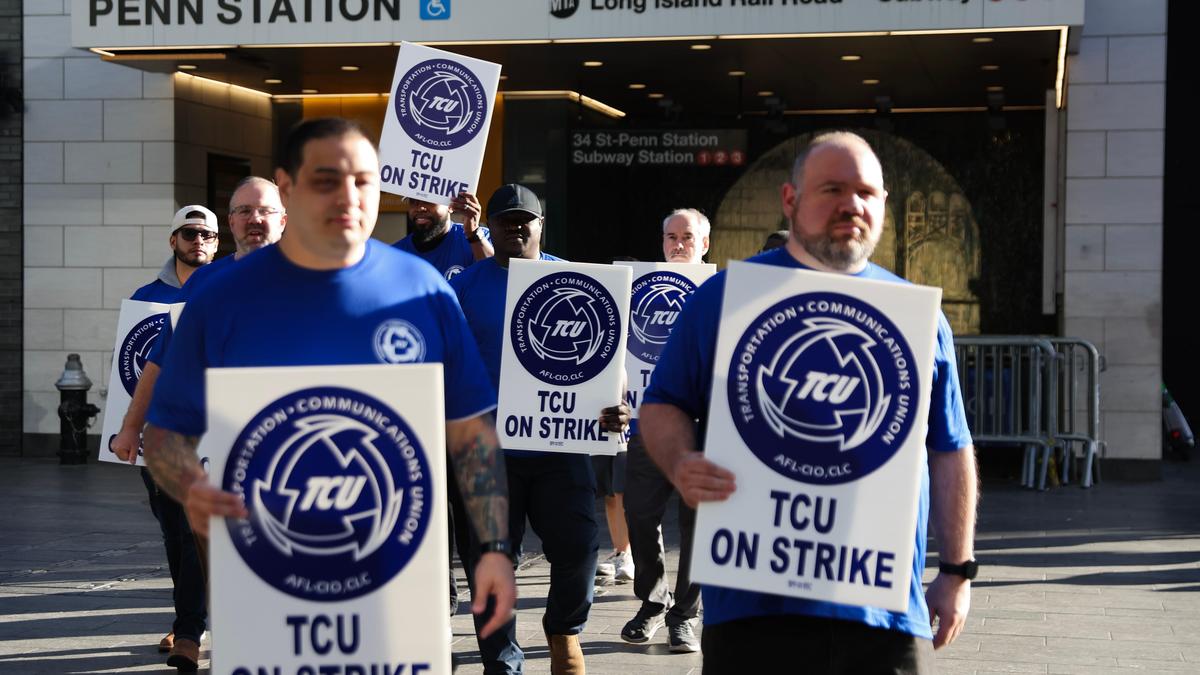
The systemwide shutdown of the Long Island Rail Road (LIRR) exposing a complete operational stoppage across its 700-mile network represents a structural failure in public sector labor economics rather than a localized labor dispute. As the busiest commuter rail infrastructure in North America, the system functions as a high-density labor pipeline funneling approximately 250,000 to 300,000 daily passengers into the New York metropolitan core. When five labor unions representing roughly 3,500 infrastructure and operational workers walked off the job, they did not merely halt trains; they severed a macroeconomic artery. The immediate result is a projected economic loss of $61 million per day, calculated by the state comptroller’s office. This disruption highlights the extreme vulnerability of monolithic transit systems to localized collective bargaining bottlenecks.
To analyze this crisis accurately, one must bypass the political messaging and examine the structural cost functions, labor-imbalance mechanics, and network externalities that turned a two-percentage-point contract variance into an absolute regional freeze.
The Cost Function of the Two Percent Contract Variance
The primary mechanism driving the impasse is a rigid mathematical conflict between backward-looking inflationary indexing and forward-looking fiscal sustainability. Both the Metropolitan Transportation Authority (MTA) and the labor coalition had previously established a baseline agreement regarding retroactive compensation. This baseline included a 9.5% cumulative wage increase spanning the years 2023 through 2025 to compensate for the historic macroeconomic inflation that depleted real wages post-2022.
The structural breakdown occurs exclusively in the final year of the proposed four-year contract term, specifically concerning the period beginning June 2026. The labor unions demand a flat 5.0% wage increase, while the MTA has capped its baseline offer at 3.0%, conditioning a maximum scale-up to 4.5% upon specific, structural work-rule concessions.
[Union Demand: 5.0% Flat Increase]
       ▲
       │ 2.0% Core Variance (Conditional Gap: 0.5%)
       ▼
[MTA Baseline Offer: 3.0%] ───(+1.5% via Work-Rule Concessions)───► [MTA Maximum Offer: 4.5%]
The friction here is governed by two opposing economic priorities:
- Labor's Purchasing Power Protection Model: The union's position is dictated by the compounding effect of regional cost-of-living increases. In high-density metropolitan zones, nominal wage stagnation relative to consumer price index (CPI) growth yields an immediate contraction in real disposable income. Because workers have operated without an active contract or structural raise since 2022, the union views the 5.0% demand not as an expansion of real wages, but as a preservation tactic against trailing asset-and-rent inflation.
- The MTA’s Pattern Bargaining and Solvency Framework: The public transit authority operates under a strict budget constraint where labor costs represent the largest variable expense. Management’s resistance to the unhedged 5.0% increase is rooted in structural contagion. Accepting an unhedged wage expansion for 3,500 LIRR employees establishes a costly precedent for upcoming contract negotiations with tens of thousands of transit workers across subways and buses.
The rider-funded cost transfer model further complicates this dynamic. According to the LIRR Commuter Council, if the transit authority capitulates to the union's nominal demands without offsetting productivity gains, the fiscal shortfall will directly alter the system's fare-indexation formula. This would effectively accelerate a planned 4.0% fare increase into a mandatory 8.0% hike. Consequently, the dispute is a zero-sum capital allocation problem: the cost must be borne either by the labor force via real-wage compression, or by the consumer base via fare inflation.
Asymmetric Structural Leverage and Tiered Benefit Demands
A secondary, highly critical friction point involves health care premium structures for future labor cohorts. The MTA offered to meet specific nominal wage targets on the condition that incoming employees pay structurally higher healthcare premiums. The union rejected this two-tiered benefit framework.
This rejection demonstrates a long-term labor retention strategy. While a two-tiered system protects incumbent workers at the expense of future hires, it structurally weakens the union's long-term collective bargaining power by creating internal stratification. From an operational standpoint, introducing asymmetric benefit structures undermines workforce cohesion and degrades the talent pipeline for specialized roles like signalmen, machinists, and locomotive engineers. These positions require lengthy certification cycles and face recruitment competition from private freight and aerospace industries.
The timing of the walkout reveals deliberate leverage optimization by union leadership. Striking immediately prior to a weekend featuring concurrent high-density regional events—specifically major professional baseball series and high-stakes NBA playoff games at Madison Square Garden—maximizes immediate political and social pressure. Because Penn Station sits directly beneath Madison Square Garden, the labor suspension instantly creates an operational vacuum at the precise moment regional transit demand spikes. This tactical selection of maximum vulnerability allows a workforce of 3,500 to incapacitate a regional economy supporting millions.
Microeconomic Elasticity and Network Substitute Failures
The immediate broader consequence of a total commuter rail shutdown is the forced reallocation of passenger volume across alternative transit modalities. However, the cross-elasticity of demand in the New York metropolitan region is highly inelastic due to fixed infrastructure constraints. The regional transit network cannot absorb the sudden displacement of 250,000 daily commuters.
The contingency protocols deployed by the state and the MTA illustrate this capacity mismatch:
- The Fleet Capacity Bottleneck: The MTA deployed a contingency fleet of 275 shuttle buses to link key suburban hubs to peripheral subway stations in Queens. From a pure volume standpoint, this measure is fundamentally inadequate. Assuming a standard charter bus capacity of 55 passengers per vehicle, a 275-bus fleet operating a single synchronous run can move precisely 15,125 individuals. Even with multi-turn optimization throughout a peak morning window, the maximum throughput capacity fails to absorb even 10% of the standard weekday passenger deficit.
- Subway Arterial Saturation: Directing displaced suburban commuters to peripheral subway terminuses like Jamaica-179th Street or Howard Beach shifts the structural bottleneck rather than solving it. The Queens and Brooklyn subway arteries already operate at high capacity during peak morning intervals. Injecting tens of thousands of regional commuters into these urban lines strains platform safety margins and increases dwell times, causing cascading delays throughout the urban transit core.
- Roadway Gridlock Mechanics: The remaining unabsorbed passenger volume must pivot to personal vehicles or ride-share platforms. The highway infrastructure connecting Long Island to Manhattan—primarily the Long Island Expressway and the Grand Central Parkway—routinely operates at or near peak vehicle saturation during standard business hours. The addition of tens of thousands of single-occupancy vehicles inevitably triggers severe traffic gridlock. This slows commercial freight, increases regional fuel burn inefficiencies, and drives ride-share surge pricing to levels that exclude lower-income workers from the labor market.
The ultimate systemic buffer in 2026 is remote work elasticity. The state's executive leadership has instructed regional businesses to transition all eligible personnel to remote workflows. While this digital substitute minimizes the macroeconomic shock for knowledge-sector corporations, it offers zero mitigation for essential physical-presence workers. Hospital staff, construction trades, hospitality personnel, and service-industry workers cannot execute their roles via digital networks. The strike, therefore, inflicts an asymmetric financial penalty on wage earners who lack remote flexibility, widening the economic divide across the regional workforce.
Macroeconomic Vulnerability Analysis
The current dispute underscores a fundamental vulnerability in public infrastructure asset management: the high concentration of systemic risk within highly unionized, specialized monopolies. The LIRR operates as a natural monopoly; there is no parallel private rail alternative for commuters in the Long Island geography. When contract negotiations stall, the lack of market competition removes standard price-discovery mechanisms, leaving raw leverage as the sole arbiter.
The political dimension adds another layer of complexity. With state executive leadership facing an upcoming reelection cycle, the timeline for resolution is dictated as much by political risk mitigation as by fiscal calculations. Public tolerance for prolonged transit disruptions degrades rapidly as personal economic losses accumulate. Consequently, the structural pressure shifts heavily onto the public authority to concede to labor’s wage premium demands to restore regional equilibrium, even if that choice creates long-term fiscal deficits or forces future fare hikes.
Strategic Reconsideration of Public Transit Labor Architecture
The LIRR shutdown proves that traditional contingency planning—relying on limited shuttle buses and voluntary remote work—cannot fully offset a total operational strike on a primary transit artery. To prevent future regional economic paralysis, public transit authorities and regional governance must transition from reactive crisis management to structural isolation strategies.
The optimal long-term play requires a multi-layered policy and operational overhaul:
- Mandatory Binding Arbitration Triggers: Legislative frameworks must be updated to mandate binding arbitration well before the expiration of federally enforced cooling-off periods. For critical infrastructure systems where a shutdown generates verified losses exceeding $50 million per day, the right to strike must be legally counterbalanced by automated, independent economic arbitration. This process can peg wage adjustments directly to local CPI movements paired with documented productivity gains, taking raw leverage out of the equation.
- Cross-Training and Operational Interchangeability: The MTA must systematically restructure its labor rules to eliminate rigid, siloed job descriptions that prevent operational flexibility during a partial walkout. Establishing baseline operational cross-training across distinct transit divisions (subway, bus, and regional rail) would allow the authority to maintain skeletal services on core trunk lines during localized strikes, weakening the asymmetric leverage of individual unions.
- Automated Rolling Stock Capital Allocation: Future capital allocations must prioritize accelerating automated train operation (ATO) technologies across the commuter rail infrastructure. While retrofitting a legacy 700-mile system with full automation requires intense upfront capital, reducing the systemic dependency on physical locomotive crews is the only permanent hedge against total network vulnerability.
Until these structural transformations are executed, the regional economy remains exposed to recurring labor bottlenecks. The immediate path forward requires the MTA to abandon its demands for two-tiered healthcare premiums for new hires—which represent a structural red line for union solidarity—in exchange for binding, enforceable work-rule modernization metrics that offset the 2% wage gap through documented operational efficiencies.