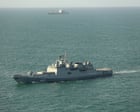
A standard pleasure yacht drifting off course does not typically trigger kinetic military protocols, yet the open-fire incident 20 nautical miles south of the Isle of Wight exposes a volatile friction point in modern maritime security. When the Russian Black Sea Fleet frigate Admiral Grigorovich fired small-arms warning shots near the British-flagged sailing vessel Bright Future, public commentary quickly collapsed into geopolitical narratives. A rigorous operational analysis reveals that this encounter was driven by compressed defensive windows, mechanical asymmetries between civilian and military vessels, and strict protocols governing maritime escalation.
Understanding the incident requires moving beyond political posturing to analyze the fundamental physics of the encounter, the statutory framework of international waters, and the strict rules of engagement that dictate how a warship handles an unidentified approaching radar signature.
The Operational Mechanics of the Encounter
The confrontation occurred in international waters within the UK’s Exclusive Economic Zone (EEZ). Under the United Nations Convention on the Law of the Sea (UNCLOS), warships enjoy sovereign immunity and freedom of navigation within an EEZ. However, this freedom is legally bound by the "due regard" principle, which requires military vessels to operate with consideration for the safety of civilian navigation.
The physical environment acted as the primary catalyst for escalation. Dense fog significantly degraded visual identification parameters, forcing both crews to rely on electronic sensor data and audible signaling.
[Target Detection: Radar/Visual]
       │
       ▼
[Phase 1: Bridge-to-Bridge Radio (VHF Ch 16)] ──(No Response)──┐
       │                                                      │
       ▼                                                      ▼
[Phase 2: Auditory/Visual Signaling (Horn/Flares)] ──(No Response/Ineffective)─┐
       │                                                                      │
       ▼                                                                      ▼
[Phase 3: Kinetic Escalation (Warning Shots)] ─────────────────────────────────┴─► [Course Alteration / Collision Avoidance]
The progression of the encounter followed a distinct three-tier tactical sequence dictated by standard operating procedures for close-quarters maritime interactions:
Phase 1: Electronic and Verbal De-escalation
Upon detecting a closing radar silhouette on a constant bearing, decreasing range (CBDR) track—the classic signature of an inbound collision course—the warship initiated standard communication protocols. This began with targeted broadcasts on VHF Channel 16, the international calling and distress frequency. Because the Bright Future is a 40-foot sailing yacht operating without an engine in low-wind, foggy conditions, its electrical generation capacity and monitoring vigilance may have been degraded, leading to a breakdown in bridge-to-bridge communications.
Phase 2: Auditory and Visual Signaling
Failing to establish radio contact, the Admiral Grigorovich escalated to active signaling as prescribed by the International Regulations for Preventing Collisions at Sea (COLREGs). The frigate blasted five short and rapid signals on its ship's horn, the universal maritime signal for doubt and danger under COLREG Rule 34(d). According to accounts from the yacht's crew, two distinct sets of five-blast signaling sequences were executed.
Phase 3: Kinetic Escalation
When the distance closed to approximately 150 meters—an exceptionally tight envelope for a 4,000-ton military vessel with significant displacement inertia—the frigate’s commander executed a non-lethal kinetic escalation. Crew members utilized small arms to fire warning shots into the air and across the bow of the yacht. This measure is designed to create an unavoidable visual and auditory interruption to force immediate course alteration.
The Asymmetry of Navigational Threat Inflation
A critical driver of this incident is the stark asymmetry in situational awareness and threat perception between a civilian pleasure craft and a deployed frontline warship. This friction can be quantified through two primary operational factors.
The Maneuverability Deficit
The Bright Future was operating under sail power alone in adverse atmospheric conditions. In drifting scenarios, a sailing vessel lacks the immediate thrust required to execute rapid evasive maneuvers. Conversely, a guided-missile frigate like the Admiral Grigorovich possesses immense kinetic power but requires considerable sea room to alter heading or scrub forward momentum when operating at standard transit speeds.
The Royal Navy evaluated the possibility that the Russian frigate was suffering from temporary mechanical or propulsion limitations at the time of the encounter. If the warship was operating with restricted maneuverability, its defensive posture would naturally constrict, lowering the threshold for kinetic intervention to preserve its perimeter.
Force Protection and Asymmetric Warfare Vulnerability
Modern naval doctrine is deeply shaped by historical vulnerabilities to small-craft asymmetric attacks. From a warship's bridge, an unidentified civilian vessel closing to within 200 meters without radio response is not viewed merely as a navigational hazard; it is evaluated as a potential security threat.
Naval commanders operate under strict force protection parameters. When a vessel enters the inner defense zone (typically defined as a 500-yard perimeter), the command structure must assume hostile intent if civilian status cannot be verified. This structural nervousness explains why the frigate skipped or compressed standard intermediate steps and moved rapidly to small-arms warning fire.
Geopolitical Proximity vs. Tactical Isolation
The timing of the event invited immediate correlation with broader strategic developments in the English Channel. Just 48 hours prior to the encounter, British commandos executed a high-profile boarding and detention of the MV Smyrtos, a sanctioned tanker suspected of operating within Russia's "shadow fleet"—the network of roughly 700 vessels used to circumvent Western fossil fuel export restrictions.
Despite the tight chronological proximity, structural evidence supports the UK Ministry of Defence assessment that the two events were operationally isolated.
- Navigational Reality: The Admiral Grigorovich has been deployed in or near the English Channel since April, primarily serving a logistical and protective role escorting Russia-linked merchant and energy vessels. Its presence was continuous and monitored by NATO long before the seizure of the Smyrtos.
- Escalation Typology: A deliberate, politically motivated retaliatory action by a state actor typically utilizes formal military gray-zone tactics, such as aggressive maneuvering, radar illumination, or electronic jamming targeted at state assets like HMS Mersey or HMS Tyne, which were shadowing the frigate. Firing small arms at an unmotorized civilian yacht yields zero strategic leverage and carries significant reputational risk without altering the tactical landscape.
- Command Autonomy: The decision to fire small-arms warning shots at 150 meters fits the profile of an ad-hoc, bridge-level tactical reaction to a perceived immediate collision or security risk rather than a coordinated directive originating from senior naval command in Moscow.
Limits of Enforcement and Sovereign Immunity
The investigation launched by the UK Ministry of Defence faces hard walls established by international maritime law. Because the incident occurred 20 nautical miles offshore, it sits firmly outside the 12-nautical-mile boundary of UK territorial waters. Within the contiguous zone and EEZ, international vessels retain legal immunity.
┌─────────────────────────┐     ┌─────────────────────────┐
│   UK Territorial Sea    │     │  Exclusive Economic Zone│
│     (0 - 12 NM)         │     │      (12 - 200 NM)      │
├─────────────────────────┼─────┼─────────────────────────┤
│ Full UK Sovereignty     │     │ Sovereign Immunity for  │
│                         │     │ Foreign Warships        │
│ Direct Enforcement      │     │                         │
│ Jurisdiction            │     │ Diplomatic Remedies Only│
└─────────────────────────┘     └─────────────────────────┘
                                             ▲
                                             │
                                     [Incident Location: 20 NM]
Because the Admiral Grigorovich is a sovereign military asset operating in international waters, UK authorities possess zero legal mechanisms for physical detention, boarding, or direct domestic prosecution of the crew or commander. The legal remedies available to the coastal state are strictly limited to diplomatic protests, formal bilateral inquiries, and the potential declaration of specific naval personnel as personae non gratae if they enter domestic jurisdiction.
The investigation’s practical utility is therefore confined to internal data collection. Royal Navy assets, specifically the River-class patrol vessels HMS Mersey and HMS Tyne, routinely log electronic signatures, radar tracks, and communications traffic during these transits. This forensic data allows analysts to map the exact tracking history, verifying whether the frigate’s claims of an unavoidable dangerous course align with the digital telemetry recorded by NATO sensors.
Strategic Operational Outlook
The English Channel incident demonstrates that the primary risk in crowded maritime chokepoints is not immediate, calculated warfare, but rather accidental escalation born from tactical friction. As European waters see increased deployments of both shadowed merchant fleets and high-readiness naval assets, the margins for operational error are contracting sharply.
Mariners navigating high-density transit corridors must adapt to an environment where military vessels operate under heightened defensive readiness. This requires civilian vessels to maintain strict adherence to continuous VHF monitoring, active radar reflector deployment, and defensive routing that avoids closing paths with foreign warships. The absolute baseline for civilian operations must be the early, unambiguous projection of navigational intent. When a civilian craft makes minor, ambiguous heading changes in low visibility, a military command team viewing the world through a radar scope may misinterpret those actions as an intercept course, setting off an escalating defensive loop that concludes with live ammunition.