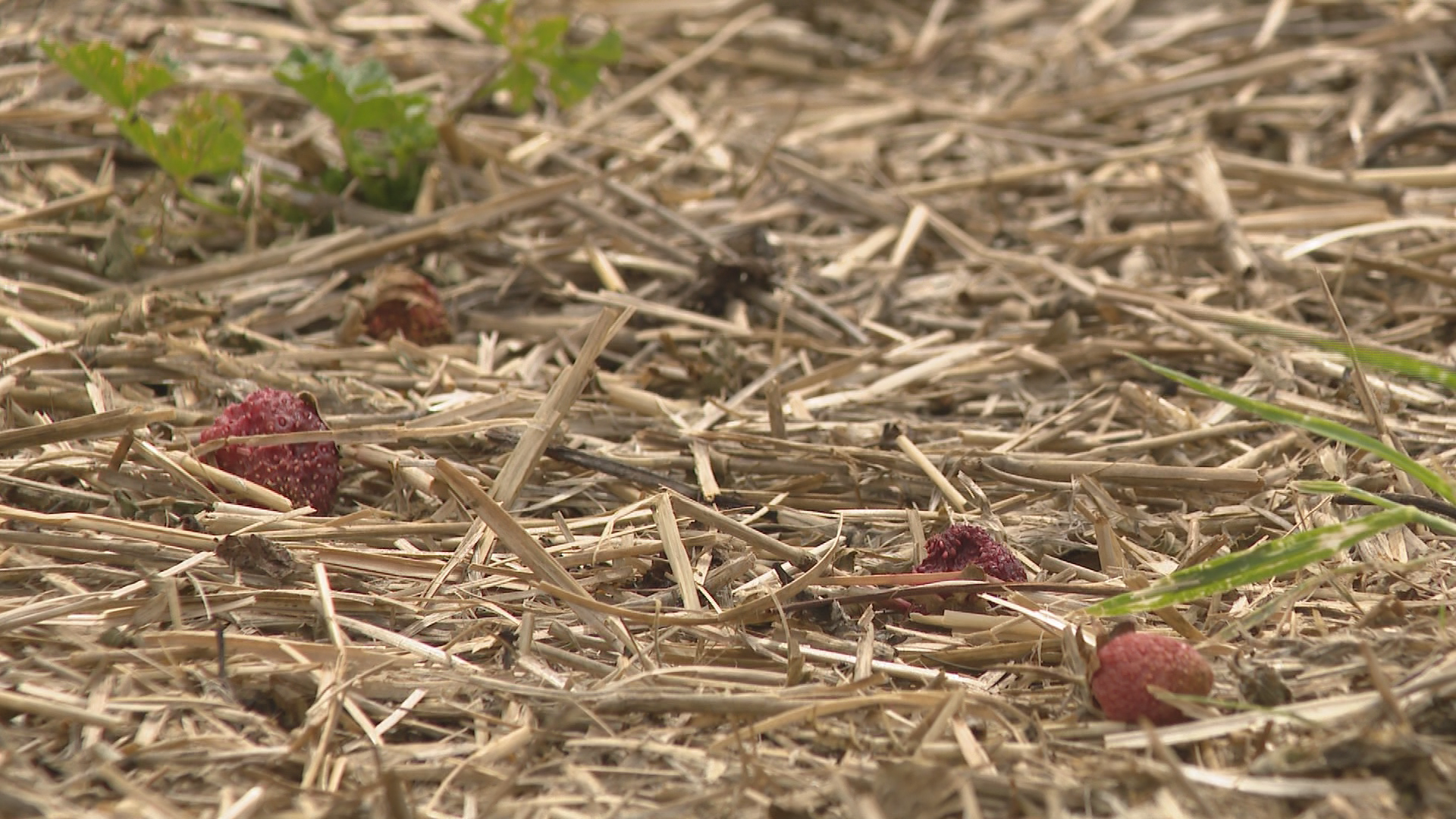
Agricultural revenue models that rely heavily on a narrow, high-value harvest window face an structural vulnerability: the compression of annual risk into single, volatile atmospheric events. When an ice storm severe enough to leave lingering pellets hits a specialty crop farm days before its major opening weekend, it demonstrates that micro-climate volatility can instantly bypass regional agricultural averages. The recent complete destruction of the strawberry fields at Prairie Pathways, an agritourism operation just outside Saskatoon, illustrates the profound friction between fixed capital deployment and unhedged environmental exposures.
To analyze the commercial reality of this event requires looking past the immediate emotional shock. We must systematically unpack the financial, biological, and operational mechanics that govern localized crop failures. In other updates, read about: Why China's Broken Inflation Cycle Still Matters to Global Markets.
The Cost Function of Specialty Agritourism
Specialty fruit operations, specifically "u-pick" or farm-gate retail setups, operate on an entirely different cash-flow architecture than broad-acre commodity farming. The cost function of high-value horticulture is heavily front-loaded.
- Fixed Capital Deployment: Initial planting inputs, such as the purchasing and planting of strawberry plugs or crowns, require significant upfront capital. For an operation the size of Prairie Pathways, planting costs for a season's crop hover around $50,000 in immediate material inputs, excluding labor and specialized land management.
- Irreversible Input Costs: Strawberry production requires intense early-season maintenance, weed management, irrigation infrastructure installation, and fertilizer programs over May and June. These costs are fully sunk before the first berry is harvested.
- Revenue Compression: Unlike grain or oilseed farming, where the harvest can be stored, distributed over time, or hedged through futures contracts, u-pick operations compress 80% to 90% of their annual fruit revenue into a 3-to-4-week consumer window.
[May: Fixed Input & Capital] ---> [June: Sunk Maintenance Costs] ---> [July: 3-Week Revenue Window]
                                                                                   ^
                                                                          [15-Minute Hail Event]
When a 15-minute hailstorm occurs at the peak of this compressed timeline, the revenue potential is completely erased while 100% of the production costs remain on the balance sheet. This creates an immediate working capital deficit that cannot be recouped within the current fiscal year. The Wall Street Journal has provided coverage on this important issue in extensive detail.
The Biological Constraints of Mechanical Trauma
When assessing a field decimated down to the crown, the recovery timeline is dictated entirely by plant physiology, not operational intent. The impact of high-velocity ice pellets on a strawberry field causes specific mechanical trauma that halts the biological engine of the crop.
First, total defoliation removes the plant’s photosynthetic machinery. Without leaves, solar energy capture drops to zero, forcing the plant to rely entirely on stored carbohydrate reserves in the root system just to survive, let alone produce fruit. Second, mechanical force shatters the structural integrity of developing green fruit and primary flowers, inducing rapid tissue necrosis and rot.
At this late stage of the growing season, a producer cannot simply replant the field. Commercial strawberry crowns are unavailable on the wholesale market in July, and even if stock were sourced, the remaining degree-days in the northern growing season are insufficient to establish a new root system capable of supporting a secondary crop before the first autumn frost. The only remaining biological pathway is to maintain the land and hope for vegetative regrowth, pushing potential production to late autumn or, more realistically, writing off the entire fruit cycle for the calendar year.
The Micro-Climate Paradox and Volatility Profiles
A defining characteristic of summer convective storms in the Canadian Prairies is their hyper-localization. This creates a stark operational paradox: one farm can face economic ruin while an identical operation less than two kilometers away escapes completely unscathed.
This spatial variation was explicitly clear near Saskatoon, where Black Fox Farm and Distillery—located only a kilometer down the road—and other nearby growers reported zero hail accumulation, noting instead that their primary challenge was simply a minor delay in plant development due to a cool, overcast spring. This creates a highly fragmented regional supply landscape:
| Metric | Impacted Operation (Prairie Pathways) | Nearby Unimpacted Operations |
|---|---|---|
| Primary Structural Damage | Total defoliation; crown-level mechanical shredding | Zero mechanical structural damage |
| Crop Yield Status | Complete near-term loss of strawberry harvest | Intact crops; delayed maturity profiles |
| Operational Strategy | Immediate cash-flow pivot to secondary channels | Standard execution of late-summer harvest |
This micro-climate behavior exposes the limits of standard regional risk assessments. A regional weather station or historical grid average might indicate a highly favorable or standard growing season, masking the reality that an individual farm's production assets were completely neutralized by a highly isolated storm cell.
Structural Diversification and Agritourism Asset Preservation
When a primary cash crop is eliminated, the survival of the enterprise depends on its asset diversification strategy. Farms that operate purely as monoculture fruit production facilities face immediate insolvency under these conditions. Conversely, modern agritourism models construct diversified asset portfolios designed to decouple a portion of their revenue from single-crop vulnerability.
The operational pivot executed by management involves a tactical shift from agricultural production to experiential asset utilization. While the strawberry field represents zero near-term cash-generation capability, the physical infrastructure of the farm remains intact. By opening the property to the public using alternative revenue streams, the business attempts to extract value from its existing consumer footprint.
The preservation strategy relies on three secondary operational channels:
- Durable Agronomic Assets: Fall-maturing crops with different physical structural profiles, such as corn mazes and sunflowers, possess higher resilience to mid-summer hail because their peak growth and reproductive phases occur later in the season. These assets allow the farm to maintain its scheduled late-summer and autumn events.
- Consumable and Concession Retail: Pivoting the on-site retail space to focus entirely on high-margin third-party goods, such as local honey, fresh vegetables sourced from unimpacted sub-regions, and concession items, converts foot traffic directly into cash flow.
- Community Brand Equity Utilization: Agritourism operations rely heavily on localized brand loyalty. By explicitly communicating the reality of the crop loss, the farm leverages its community standing to drive solidarity foot traffic, converting what would have been a u-pick transaction into a direct farm-gate retail purchase.
The fundamental limitation of this diversification strategy is margin erosion. Sourcing external vegetables, honey, and concession inventory introduces wholesale acquisition costs that do not exist in a self-grown u-pick model. Consequently, while this pivot preserves cash flow and maintains market presence, it operates at a significantly lower net margin, serving as an emergency stabilization mechanism rather than a true replacement for the lost primary harvest.
A definitive operational outlook for the region indicates that as convective summer storm cells grow increasingly volatile, the standard unhedged agritourism model must evolve. Producers will be forced to either invest in capital-intensive physical protection infrastructure, such as high-density hail netting for high-value per-acre crops, or adjust their financial models to treat the complete elimination of a seasonal harvest not as an anomalous catastrophe, but as a predictable, recurring cost of doing business on the northern plains.