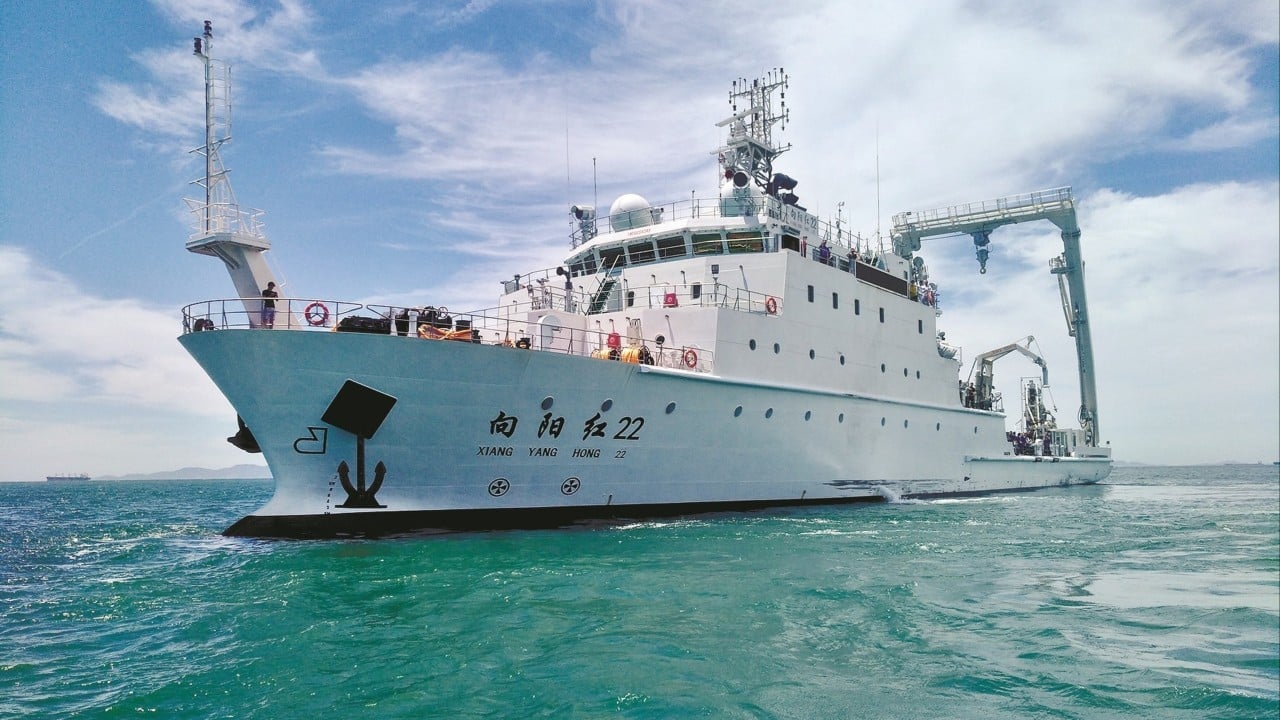
Beijing has initiated a major structural shift in the maritime boundary economics of the Western Pacific. By deploying the Ministry of Natural Resources' research vessel Xiangyanghong 22 to execute a multi-disciplinary marine environmental survey immediately east of Taiwan, China has moved beyond mere reactive diplomacy. The three-day deployment, designed to gather hydrological, meteorological, and environmental DNA (eDNA) profiles, follows a coordinated "special maritime law enforcement operation" launched by the Chinese Coast Guard.
This operational surge directly counters the bilateral maritime delimitation talks initiated between Tokyo and Manila. Understanding this friction requires moving past political rhetoric and analyzing the underlying legal mechanics, geographic choke points, and structural frameworks governing this gray-zone escalation.
The Tri-Regional Choke Point Framework
The waters flanking Taiwan's eastern coast represent the geographic hinge connecting three distinct maritime arenas: the East China Sea, the South China Sea, and the Philippine Sea. For regional powers, this space functions within a strict tri-regional framework where stability in one sector is mathematically linked to the operational density of the others.
       [ East China Sea ]
               │
               ▼
[ Taiwan Strait ] ─── (TAIWAN) ─── [ Waters East of Taiwan ] (Current Incursion)
               ▲                           ▲
               │                           │
       [ South China Sea ] ──────── ─── [ Bashi Channel ]
Japan and the Philippines sought to codify overlapping exclusive economic zone (EEZ) boundaries during the Tokyo summit between Prime Minister Sanae Takaichi and President Ferdinand Marcos Jr. The strategic logic behind these bilateral talks centers on closing the geographic gaps along the First Island Chain. By formalizing their boundaries, Tokyo and Manila aim to build a contiguous legal and security belt spanning from the Japanese southwest islands (Yonaguni, Ishigaki, Miyako) down to northern Luzon.
This creates a severe strategic bottleneck for the People's Liberation Army Navy (PLAN). For Beijing, the deep waters east of Taiwan are essential for deploying its submarine fleet and projecting blue-water naval force into the wider Pacific Ocean without running through shallow, monitored choke points like the Taiwan Strait.
The Cost Function of Gray-Zone Survey Operations
Beijing’s counter-strategy relies on decoupling administrative claims from kinetic military actions. The deployment of civilian and paramilitary assets—scientific research vessels like the Xiangyanghong 22 alongside Chinese Coast Guard divisions—serves a specific structural function: changing the legal baseline of the region without triggering a military response under regional mutual defense treaties.
This dynamic operates under a distinct gray-zone cost function:
- The Law Enforcement Pretext: Under the United Nations Convention on the Law of the Sea (UNCLOS), coastal states hold sovereign rights over marine scientific research within their EEZ and continental shelf. By conducting and publicizing environmental data collection (eDNA sampling, whale/dolphin tracking, marine chemistry), Beijing asserts the practical responsibilities of a coastal state.
- The Sovereign Subversion Mechanism: Beijing bases its legal standing on the premise that Taiwan is a province of China, making any maritime rights attached to Taiwan part of Chinese jurisdiction. When Taiwan's foreign affairs authorities chose not to formally protest the Japan-Philippines talks, Beijing used that silence to claim that Taipei had failed to protect Chinese territory, justifying its direct administrative intervention.
- Asymmetrical Escalation Management: Deploying white-hulled coast guard and research ships instead of grey-hulled naval warships places the burden of escalation entirely on neighboring states. If regional coast guards ignore the incursions, Beijing establishes a historical precedent of unchallenged administrative presence. If regional forces respond aggressively, they risk appearing as the operational aggressor.
Operational Sequencing: The New Pressure Routine
The mid-June marine survey was not an isolated event; it formed the final phase of a calculated operational sequence designed to normalize Chinese state presence east of the island. Taiwan’s Defense Ministry recorded a clear progression of gray-zone operations leading up to the survey:
- Precursor Incursions (Early May): The Chinese research vessel Tongji conducted targeted operations off the coasts of Hengchun and Hualien, testing regional radar detection and baseline response times.
- Administrative Declaration (June 1): Beijing formally announced upcoming law enforcement patrols assigned specifically to Taiwan's eastern waters, deploying two specialized vessels to establish a legal framework for their presence.
- Tactical Disruption (June 3–5): A Chinese Coast Guard vessel actively interfered with an ongoing regional maritime drill, while a separate division of four ships operated near Kinmen. Concurrently, a mixed group consisting of one research ship and one coast guard cutter crossed into restricted waters surrounding the strategically vulnerable Pratas Islands.
- Special Operation Launch (June 6): Beijing deployed a coordinated four-ship coast guard division originating from Taiwan’s southwest, executing a transit around the southern tip of the island into the eastern sector.
- Scientific Consolidation (June 16–18): The Xiangyanghong 22 completed the sequence by conducting extensive environmental charting, collecting the physical data required to back China's claims of regulatory control over the ecosystem.
Collective Deterrence vs. The Vienna Choke
The strategic friction generated by these operations has exposed deep structural fault lines within Taiwan's internal and external defense frameworks. President Lai Ching-te countered the operations by citing the Vienna Convention on the Law of Treaties, pointing out that bilateral negotiations between Japan and the Philippines cannot legally harm or alter the rights of a third party, such as Taiwan.
However, this legal stance runs into significant operational limitations. While international law shields Taiwan’s nominal rights on paper, it does not stop the physical presence of Chinese coast guard and research vessels within its adjacent waters.
The strategy proposed by regional allies centers on a model of "collective defense and burden-sharing." This approach treats the East China, South China, and Taiwan eastern seas as a single, connected operational theater. The long-term plan aims to link Japanese maritime surveillance, Taiwanese radar tracking, and Philippine law enforcement into an integrated network.
The primary limitation of this collective strategy is its reliance on political alignment across changing administrations in Tokyo, Manila, and Taipei. A policy shift or a drop in defense spending by any single partner disrupts the entire security chain, leaving open gaps that Beijing can exploit through its targeted gray-zone operations.
The West Pacific Operational Horizon
Based on the operational logic observed throughout June, the maritime environment east of Taiwan will likely settle into a permanent state of competitive administrative presence. Beijing has successfully demonstrated a repeatable template for responding to regional security pacts by expanding its active law enforcement zone.
The next tactical shift will likely involve deploying permanent automated marine monitoring buoys and expanding regular coast guard patrols into the Western Pacific. By layering constant civilian scientific research over its security patrols, Beijing is working to steadily erode the legal and physical defensibility of Taiwan's eastern waters. This strategy aims to present the international community with an established, day-to-day reality of Chinese administrative control long before any kinetic conflict occurs.


