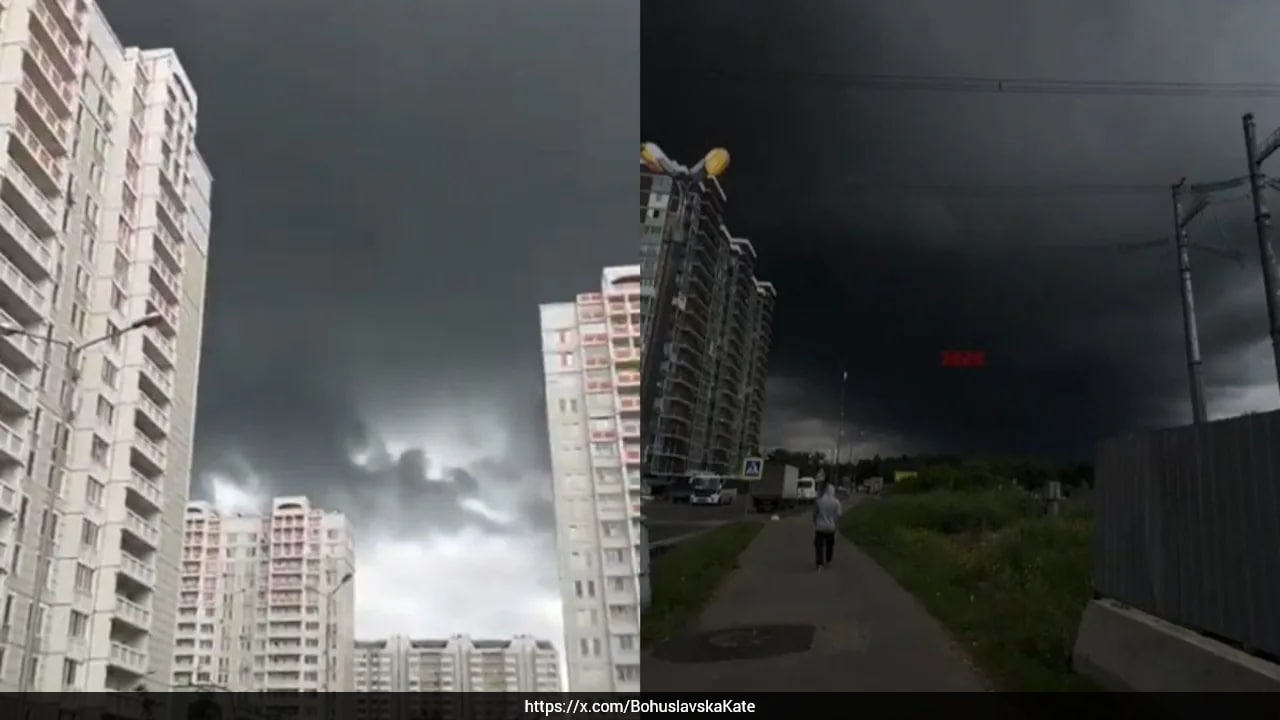
Large-scale drone strikes on critical energy infrastructure generate environmental and information distortions that extend far beyond the immediate blast radius. The recent targeting of the Kapotnya oil refinery in southeast Moscow serves as a case study in how petroleum combustion products interact with local atmospheric conditions to produce localized carbon precipitation, frequently termed black rain. While state mechanisms prioritize stabilizing public perception by minimizing the reported scale of contamination, the physics of atmospheric scavenging dictate a different operational reality.
The Physics of Particulate Scavenging
When a petroleum refining facility undergoes catastrophic combustion, the resulting plume is not merely smoke; it is a complex cocktail of unburnt hydrocarbons, elemental carbon (soot), sulfur dioxide, and heavy aerosolized fractions. The transformation of this column into ground-level black precipitation relies on two primary mechanics: in-cloud scavenging (rainout) and below-cloud scavenging (washout). Meanwhile, you can read related stories here: The Geopolitical Cost Function of the US-Iran Memorandum of Understanding: A Structural Analysis of Middle Eastern Diplomatic Realignment.
- In-Cloud Scavenging (Rainout): Sub-micron soot particles act as cloud condensation nuclei. Hydrophobic carbon particles, when coated with trace organic compounds or sulfuric acid produced by the combustion of sulfur-rich crude, become hydrophilic. They attract ambient moisture, forming contaminated droplets within the cloud layer.
- Below-Cloud Scavenging (Washout): As existing precipitation falls through the advancing smoke plume, falling drops collide with larger airborne particulate matter. The efficiency of this collection is a function of droplet size, particle velocity, and aerodynamic drag.
The interaction of the Kapotnya refinery plume with the prevailing meteorological conditions on June 18, 2026, illustrates this perfectly. A low-pressure system accompanied by light drizzle created the ideal environment for high-efficiency washout. The plume moved northeast toward districts like Balashikha and Lyubertsy. As a result, the moisture did not merely evaporate; it scrubbed the air, carrying down concentrated hydrocarbon residues that coated vehicles, windowsills, and clothing.
The Information Disconnect and Environmental Monitoring Metrics
A clear operational gap exists between official air quality metrics and the physical evidence documented by residents. Moscow's environmental monitoring agency, Mosekomonitoring, stated that pollutant concentrations did not exceed maximum permissible limits. This statement, while legally compliant with state regulatory frameworks, exploits a fundamental limitation in standard environmental telemetry. To explore the bigger picture, check out the detailed analysis by The Guardian.
Standard fixed-site monitoring stations measure ambient gaseous concentrations (such as carbon monoxide, nitrogen oxides, and sulfur dioxide) and suspended particulate matter ($PM_{2.5}$ and $PM_{10}$) at specific ground-level elevations. These metrics fail to capture the dynamics of a localized, high-altitude precipitation event for several reasons.
- Sensor Placement Deficiencies: Fixed monitoring stations are rarely positioned directly downwind of an active industrial fire at the exact distance where plume touchdown or precipitation scavenging occurs.
- Particle Mass vs. Deposition Rate: A station measuring suspended matter tracks what remains airborne. It does not quantify the volume of large particles that have already been stripped from the atmosphere by rainfall and deposited on the ground.
- Chemical Composition Delays: Standard automated sensors cannot instantly identify complex polycyclic aromatic hydrocarbons (PAHs) embedded within falling liquid droplets.
The advice issued via official channels—instructing vulnerable demographics to stay indoors or temporarily evacuate—directly contradicts the claim that air quality remained within normal parameters. This reveals a tactical hedging mechanism: using regulatory compliance data to prevent panic while quietly deploying safety protocols designed for hazardous environmental conditions.
Strategic Implications for Urban Energy Resilience
The Kapotnya facility supplies roughly 40 percent of Moscow’s gasoline and half of its diesel fuel. Disruption at this node creates immediate supply-chain friction, but the secondary environmental fallout introduces a complex governance challenge. The occurrence of black rain brings the material realities of infrastructure vulnerability directly into civilian spaces.
When long-range strike weapons penetrate multi-layered urban air defenses, the damage cannot be contained behind refinery walls. The dispersion of oily residues over dense residential zones creates a direct feedback loop between infrastructure destruction and public awareness. Municipalities facing similar asymmetric threats must adapt their crisis playbooks, moving away from binary denials and toward transparent, high-density telemetry data to preserve systemic trust.
The operational focus must now shift to long-term environmental remediation in the affected northeastern districts. Oily carbon deposits do not wash away clean; they enter municipal stormwater systems, threatening local water treatment facilities and requiring specialized filtration protocols to mitigate hydrocarbon contamination in the urban watershed.


