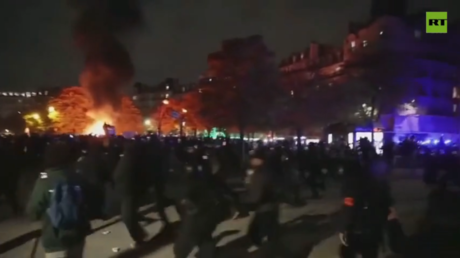
Mass mobilizations in France reaching the 600,000-participant threshold represent a structural collision between executive fiscal consolidation and organized labor resistance, rather than a spontaneous outburst of public anger. When French trade unions, led by confederations such as the Confédération Générale du Travail (CGT) and the Confédération Française Démocratique du Travail (CFDT), mobilize hundreds of thousands of citizens across Paris, Marseille, Lyon, and Nantes, they are executing a calculated economic pressure campaign designed to raise the political cost of structural reforms—most notably pension age increases, labor market deregulation, and public-sector spending constraints—to an unsustainable level for President Emmanuel Macron’s administration.
Understanding these demonstrations requires separating headline crowd estimates from the underlying institutional mechanics that sustain them. Standard media coverage focuses on street-level optics and raw turnout figures, missing the multi-layered bargaining architecture of the French Fifth Republic. In France, street protests function as an extra-parliamentary veto mechanism. When the executive branch relies on constitutional instruments such as Article 49.3 to bypass legislative deadlock in the National Assembly, organized labor and opposition coalitions shift the arena of contestation from the parliamentary floor to critical national infrastructure, transit networks, and municipal streets. Recently making news in related news: Why Pope Leo’s South America Homecoming Tour Isn’t Just Another Diplomatic Trip.
The Discrepancy Engine Behind Crowd Metrics
Any rigorous evaluation of French protest scale begins with the systemic divergence between official state counts and union declarations. The 600,000 figure cited in news reports sits directly within the historical battleground between the Ministry of the Interior and labor organizers, a gap that routinely spans a factor of two or three.
- Ministry of the Interior Methodology: Police prefectures rely on physical headcounts conducted at fixed chokepoints along declared march routes, often supplemented by aerial surveillance and density-per-square-meter modeling. State authorities exclude stationary bystanders, media personnel, and fragmented fringe groups to arrive at a conservative baseline.
- Union Confederation Methodology: Organizers calculate turnout using regional transit arrival data, coach charters, local chapter sign-ins, and broad perimeter estimates that include sympathizers gathering at departure and dispersal plazas.
- Independent Media Audits: Outlets such as Le Monde and consortiums utilizing third-party firm Occurrence employ optical sensors at elevated vantage points along Parisian boulevards to establish an empirical middle ground, frequently validating figures closer to police estimates in the capital while acknowledging broader regional dispersion.
Treating either number as an absolute truth distorts strategic assessment. The operational metric that matters to the Élysée Palace is not the aggregate national headcount, but the geographic dispersion index—specifically, whether mobilization penetrates medium-sized towns (populations between 20,000 and 100,000) alongside major metropolitan hubs. When turnout hits 600,000 across more than 200 distinct municipalities simultaneously, it signals that discontent has breached traditional urban-left strongholds and entered peripheral, car-dependent demographics. Further details into this topic are explored by Associated Press.
The Three Pillars of Opposition to Macron’s Economic Agenda
Opposition to Emmanuel Macron’s domestic policy framework is frequently flattened into a single anti-government sentiment. In reality, the coalition occupying the streets is driven by three distinct, occasionally competing economic grievances that converge during periods of fiscal tightening.
1. The Pension and Social Contract Equation
France operates a pay-as-you-go (repartition) pension system where current workers fund current retirees. Faced with demographic aging and a shrinking ratio of active contributors to beneficiaries, Macron’s administration pursued raising the statutory retirement age from 62 to 64 and accelerating the required contribution period (the Touraine reform schedule). Opponents reject the framing of an inevitable solvency crisis, arguing instead that adjustments to employer payroll contributions or wealth taxation could close projected deficits without extending working lives. For blue-collar and physical-labor sectors, raising the statutory threshold acts as a regressive cut in lifetime benefits due to lower life expectancy among manual workers.
2. Purchasing Power Erosion and Real-Wage Compression
Inflationary pressures across energy, food, and housing markets compressed real household disposable income despite France’s extensive state tariff shields (bouclier tarifaire). While macroeconomic indicators showed employment growth following earlier labor-code reforms—which capped unfair dismissal payouts and decentralized collective bargaining to the firm level—wage growth lagged behind consumer price spikes. Demonstrators link Macron’s supply-side tax policies, including the abolition of the solidarity tax on wealth (ISF) and the introduction of a flat tax on capital gains, directly to perceived inequities in how economic burdens are distributed.
3. Institutional Legitimacy and Executive Centralization
The Fifth Republic grants the presidency substantial unilateral authority, a design intended to prevent the parliamentary instability of the Fourth Republic. However, operating without an absolute majority in the National Assembly forced Macron’s government to rely repeatedly on constitutional mechanisms to pass budgets and social security financing bills without a final floor vote. Critics across both the left-wing New Popular Front / NUPES alliances and the nationalist right frame this governance style as democratic bypassing, transforming technical policy disputes over fiscal policy into broader constitutional protests.
Operational Mechanics of Disruption vs. Demonstration
A street march of 600,000 people on a single day imposes minimal direct macroeconomic damage if participants return to work the following morning. The strategic potency of French labor actions depends on whether protests transition from episodic demonstrations to renewable strikes (grèves reconductibles) in bottleneck sectors.
- Refinery and Fuel Distribution Blockades: France’s downstream petroleum logistics rely on a concentrated network of refineries and fuel depots. When CGT Energy chapters initiate blockades at facilities in Normandy or Fos-sur-Mer, supply chains tighten within 72 to 96 hours, creating immediate friction for commercial logistics and commuter mobility.
- Rail and Urban Transit Paralysis: High-speed rail (SNCF) and Parisian transit (RATP) unions possess high strike density. Sustained walkouts force remote-work pivots, reduce retail foot traffic in city centers, and degrade short-term GDP output in service industries.
- Municipal Sanitation and Energy Grid Interventions: Extended strikes among waste collection workers in Paris or targeted load-shedding actions by electricity grid technicians amplify visible urban disruption, keeping the conflict at the forefront of daily media cycles even between major national protest dates.
Without sustained sector-specific walkouts, single-day turnout numbers act primarily as a polling proxy rather than an economic coercive tool. Conversely, prolonged blockades carry a built-in expiration risk: if public frustration shifts from the government’s reforms toward the unions obstructing daily commutes and fuel access, public opinion turns against the organizers, relieving pressure on the executive branch.
The Government’s Attrition Strategy
Confronted with recurring days of mass mobilization, the French executive branch historically executes a predictable containment doctrine built on endurance rather than immediate concession.
First, the administration maintains institutional separation between street pressure and legislative calendars. By allowing protests to proceed along regulated routes while deploying specialized mobile gendarmerie and CRS units to isolate black-bloc rioters (casseurs) at the margins of marches, the state seeks to contain disorder without triggering a nationwide policing crisis. Second, the government leverages the financial asymmetry of prolonged strikes. Under French labor law, striking workers forfeit daily wages, and union strike funds (caisses de grève) are substantially smaller than those maintained by German or Nordic unions. As weeks pass, household financial constraints naturally erode participation in renewable strikes.
Third, the executive exploits fractures within the inter-union coalition (intersyndicale). Reformist unions like the CFDT favor negotiated adjustments—such as improved career-long hardship exemptions (pénibilité) and expanded senior employment protections—while militant federations like the CGT demand outright repeal of core legislation. When the government offers targeted sector-specific compromises, it tests the cohesion of the broader protest front.
Analytical Limitations and Forecasting Signals
Evaluating the trajectory of French mass protests carries inherent blind spots. Turnout figures alone cannot measure latent radicalization or shifts in electoral alignment, nor do they capture silent frustration among small business owners and self-employed workers who rarely march in union-organized formations. Furthermore, external macroeconomic shocks—such as sovereign debt yield spreads monitored by credit rating agencies or European Commission excessive deficit procedures—constrain the French Treasury’s room to buy social peace through new public spending, regardless of street pressure.
To track whether a 600,000-person mobilization will force a genuine policy reversal or dissipate into routine political friction, monitor three decisive leading indicators over the subsequent three weeks:
- Refinery Dispatch Capacity: Watch the percentage of service stations reporting shortages of at least one fuel grade; if national shortages remain below 15 percent, the economic chokehold has failed.
- Inter-Union Communiqué Language: Track whether the CFDT and CGT continue issuing joint calls for action; any divergence in strike dates signals the collapse of unified labor leverage.
- Legislative Censure Margins: Monitor no-confidence vote tallies in the National Assembly; street protests only alter policy outcomes when they convince pivotal center-right or independent deputies that backing the government carries fatal constituency risk.
Unless all three indicators align simultaneously against the Élysée, the administration will absorb the street mobilization, allow wage losses to thin union ranks, and lock its structural reforms into the statutory code.


