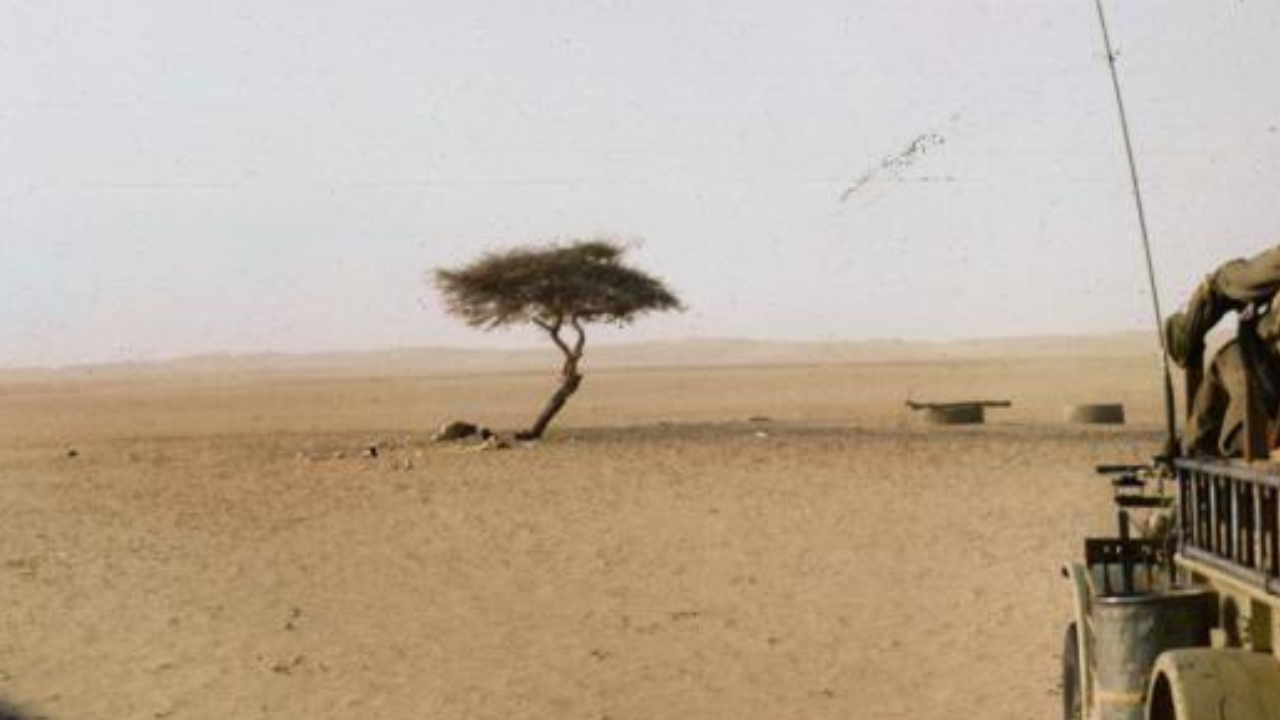
The survival and ultimate destruction of the Tree of Ténéré (L'Arbre du Ténéré) is not merely a tragic historical anecdote; it is a profound case study in extreme biophysical adaptation, spatial probability anomalies, and the systemic fragility of non-redundant assets. For over three centuries, this solitary acacia (Acacia tortilis) persisted as the only tree within a 400-kilometer radius in the Nigerien Sahara, only to be obliterated in 1973 by a motorist.
Analyzing this event requires moving past superficial irony. By dissecting the ecological mechanics that allowed the organism to thrive in complete isolation and deconstructing the mathematical inevitability of its destruction, we uncover critical principles of risk management, physical security, and systemic vulnerability.
The Biophysical Mechanics of Hyper Arid Survival
The ability of a single organism to persist in the Ténéré region—where annual rainfall averages less than 2.5 millimeters and temperatures routinely exceed 45°C—defies standard vegetative models. The survival of the tree relied on a highly specialized physiological adaptation: phreatophytism.
[Atmosphere: Extreme Vapor Pressure Deficit]
                    ▲
                    │ (Transpirational Pull: Xylem Tension > 2.0 MPa)
              [Tree Canopy]
                    ▲
                    │ (35-Meter Vertical Conduit)
             [Deep Taproot]
                    ▲
                    │ (Hydrostatic Pressure Gradient)
[Groundwater Table: Bilma Aquifer (33-36m Depth)]
Deep Aquifer Integration
Unlike shallow-rooted desert plants that rely on ephemeral surface moisture, the Tree of Ténéré utilized an aggressive taproot system designed for deep-vein exploitation. When a well was dug near the tree in 1939, engineers discovered that the root system penetrated the hyper-arid overburden to reach the water table at a depth of 33 to 36 meters.
This deep-water access connected the tree to the Bilma aquifer, a vast subterranean reservoir. This hydrological link decoupled the tree's survival from local meteorological conditions, transforming its primary environmental threat from lack of rainfall to water table depletion.
Extreme Xylem Tension and Cavitation Resistance
Lifting water across a vertical gradient of over 30 meters through dry soil requires immense negative pressure. According to the cohesion-tension theory, the water columns in the tree's xylem vessels were under continuous tension.
To prevent cavitation—the formation of vapor bubbles that rupture the water column and cause systemic hydraulic failure—the cellular structure of Acacia tortilis possesses incredibly narrow vessel diameters and highly reinforced cell walls. The mechanical strain of maintaining this hydrostatic gradient represents a significant metabolic investment, forcing the tree to limit its canopy growth to minimize transpirational water loss.
The Energy Partitioning Strategy
The tree managed a highly asymmetrical biomass distribution. It prioritized root elongation over shoot expansion, resulting in a structural architecture where over 80% of the total organic mass was subterranean.
┌──────────────────────────────────────────────────────────┐
│ Subterranean Biomass (Taproot System)              ~80%  │
├──────────────────────────────────────────────────────────┤
│ Aerial Biomass (Trunk and Sparse Canopy)           ~20%  │
└──────────────────────────────────────────────────────────┘
This ratio reduced the wind profile of the canopy and minimized the surface area vulnerable to solar radiation, securing long-term survival at the cost of reproductive output and growth speed.
Quantifying the Spatial Isolation
The Tree of Ténéré was classified as the most isolated tree on Earth. Defining this isolation mathematically reveals the unique spatial dynamics of the southern Sahara.
The tree sat at the center of an ecological exclusion zone with a radius ($r$) of approximately 400 kilometers. The area ($A$) of this absolute vegetative vacuum can be calculated using the standard area of a circle:
$$A = \pi r^2$$
$$A = \pi \times 400^2 \approx 502,654 \text{ km}^2$$
This calculated area is roughly equivalent to the entire landmass of Spain. Within this half-million square kilometer zone, the Tree of Ténéré was the sole macroscopic autotroph.
This extreme isolation had two critical ecological consequences:
- Genetic Desynchronization: With no conspecifics within pollinator range, the tree was entirely cut off from gene flow. Any reproductive cycles depended on self-fertilization, leading to extreme genetic bottlenecks and rendering any produced seeds highly vulnerable to localized inbreeding depression.
- Microclimatic Singularity: Lacking a surrounding canopy to break wind speeds or trap localized transpiration, the tree was exposed to the full kinetic force of the Harmattan winds. The tree existed as an ecological island, absorbing the entire environmental stress of its territory without any protective microclimate.
The Mathematics of the Unlikely Collision
The destruction of the tree in 1973 by a commercial truck driver is often dismissed as a freak accident. However, analyzing the event through spatial probability and human factors engineering reveals a predictable systemic failure.
To understand how a vehicle managed to strike a single target within a 502,654 square kilometer area, we must examine the intersection of physical constraints and behavioral feedback loops.
[Wide Desert Void: Low Risk]
            │
            ▼ (Logistical Corridors Funnel Traffic)
[The Tree: Used as a Visual Navigation Benchmark]
            │
            ▼ (Vehicles Actively Guided Toward Node)
[High-Density Risk Zone: Target Fixation & Collision Point]
The Fallacy of Uniform Probability
If the truck's path across the Sahara were truly random, the probability ($P$) of hitting the tree trunk (estimated diameter of 1 meter) within the exclusion zone would approach zero. However, traffic in the desert does not follow a uniform spatial distribution.
Logistical corridors in hyper-arid regions are constrained by terrain, fuel efficiency, and the location of water sources. The Tree of Ténéré was co-located with a historic well along a vital trans-Saharan trade and military route. The physical path of travel was highly canalized, compressing a seemingly infinite desert into a narrow, high-density transit corridor.
Navigational Attractor States
In a featureless environment, any prominent physical object acts as a visual and psychological anchor. Caravan leaders and truck drivers actively steered toward the tree to verify their navigation.
This practice created a feedback loop: the tree was highly vulnerable precisely because it was the only point of interest in the region. Rather than navigating to avoid it, drivers treated the tree as a destination point, concentrating traffic directly within its immediate vicinity.
Target Fixation and Human Error
During night driving or periods of fatigue, operators experience target fixation—a phenomenon where an individual becomes so focused on an object that they inadvertently steer directly toward it.
When a driver is impaired by fatigue or alcohol, as was reported in the 1973 collision, their ability to calculate depth perception and closure rates drops sharply. The driver does not see the tree as an obstacle to avoid, but rather as a visual target, holding the steering wheel steady until impact occurs.
The Failure of Structural Redundancy
The loss of the Tree of Ténéré highlights a fundamental rule of systems engineering: any system that relies on a single, non-redundant node for critical functions is doomed to eventual failure.
The Tree as Infrastructure
For centuries, the tree served two infrastructure roles:
- Geographical Marker: It was a critical, non-cryptographic positioning node for trans-Saharan commerce.
- Social Anchor: It served as an assembly point and cultural sanctuary where Tuareg nomads respected its presence, leaving its branches untouched for firewood despite desperate resource scarcity.
Because these functions relied entirely on a single biological asset, the system possessed a single point of failure (SPOF). There was no backup beacon, no secondary well marker, and no physical barrier to protect the asset from kinetic impact.
Post-Incident Hardening
Following the destruction of the tree, its remains were moved to the Niger National Museum in Niamey. To maintain the geographical utility of the site, Nigerien authorities installed a metallic monument in its place.
               ▲
              / \
             /   \
            /     \
           /[Steel]\
          / [Shaft] \
         /    │      \
────────┴─────┴──────┴────────
   [Reinforced Concrete Base]
This replacement highlights a vital transition from biological vulnerability to industrial resilience:
- Static Durability: The steel and concrete monument resists kinetic impacts that would easily destroy living timber.
- Decoupled Maintenance: The monument requires no water table access, neutralizing the long-term risk of regional desertification.
- Reduced Cultural Value: While functional as a geographic marker, the artificial structure lacks the sacred cultural protection of the original tree, shifting the site from a living sanctuary to an inert logistical checkpoint.
Protecting irreplaceable natural or cultural assets in high-risk zones requires moving past simple symbolic value. True preservation demands active physical barriers, such as reinforced concrete bollards or perimeter fencing, designed to absorb kinetic energy before it reaches the vulnerable asset. Relying on the vastness of an empty landscape or the respect of passersby is a failed security strategy. Physical protection must always match the absolute value of the asset.