Light travels at roughly 186,000 miles per second. Falsehoods travel faster. They do not require the friction of nuance, the weight of verified reporting, or the quiet, grinding labor of judicial investigation. They move on electricity and raw human fury, slipping into the bloodstream of the internet before the truth has even laced its boots.
Consider a crisp autumn afternoon on the asphalt of a European street. Sirens wail in the distance. Glass shatters against pavement. Smoke curls upward from a makeshift barricade, catching
The Anatomy of a Phantom Flame
news
Static hums in the dark. A thumb swipes across a screen, and suddenly, a quiet Tuesday night in a living room transforms into an arena of screaming sirens, shattered glass, and roaring fire.
We have all been there. Your eyes lock onto a looping video on social media. A figure stumbles. Smoke billows. A headline flashes in stark, capital letters, claiming to capture a horrifying moment of urban decay, a localized war zone, or an escalation of hatred so profound that it short-circuits your breath. Your pulse quickens. Your thumb twitches toward the share button. You want to warn people. You want to scream into the digital void that the world is breaking apart.
Pause.
Take a breath.
Before that righteous anger hardens into cement, let us look closer at the machinery of modern panic. Let us examine how a ghost story is manufactured, distributed, and consumed before breakfast.
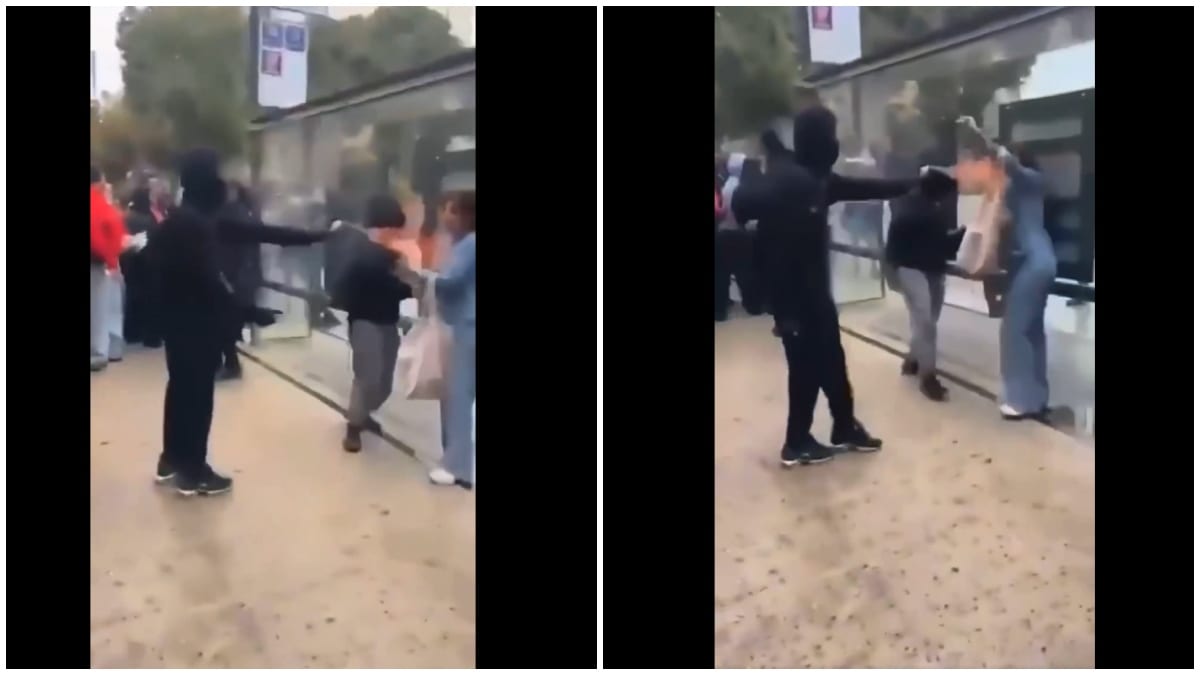
Consider the anatomy of a viral outrage. It rarely arrives with a citation or a balanced historical overview. It arrives as an explosion. In late 2023 and continuing through subsequent cycles of digital turbulence, clips surged across platforms like X and TikTok, purportedly showing a horrific scene in France. The caption—tight, aggressive, and engineered for maximum adrenaline—claimed to show a migrant setting a woman's face on fire during a supposed anti-white riot.
The internet did what the internet does best. It caught fire. Millions of views accumulated in the span of hours. Accounts with blue checkmarks, hyper-partisan commentators, and automated bots wove the clip into a grander narrative about civilizational collapse, border failures, and imminent doom. The video was presented as undeniable proof.
Except it was a lie. Or, more accurately, a jigsaw puzzle of falsehoods assembled with malicious intent.
When fact-checkers and investigative journalists finally unraveled the footage, the truth was startlingly mundane compared to the apocalyptic narrative, yet infinitely more depressing in its intent. The video had nothing to do with anti-white riots. It was not a recent event. The geographic markers were entirely wrong, and the context of the violence was violently ripped away from its original reality to serve a xenophobic geopolitical talking point.
Yet, by the time the truth arrived, wearing sensible shoes and carrying dry documentation, the lie had already circled the globe three times.
This is the invisible tax of our digital age. We are living through an epidemic of synthetic terror. Algorithms do not care about truth; they care about arousal. Anger is the highest-octane fuel available to the attention economy. When you feed a human brain a threat—real or fabricated—the amygdala hijacks the prefrontal cortex. Logic steps aside. Survival instinct takes the wheel.
Think about what happens to our collective psyche when every single day is punctuated by manufactured crises. We become hyper-vigilant, exhausted, and fundamentally untrusting of our neighbors. Every stranger on a metro platform becomes a potential assailant. Every distant city feels like a powder keg waiting for a match. We begin to inhabit a reality shaped not by what is happening outside our windows, but by what a server farm in another hemisphere decides will maximize our screen time.
The French video hoax is a textbook case study in weaponized digital media. It relied on a classic propaganda technique: the appeal to visceral disgust. By framing an isolated or entirely unrelated incident as part of an overwhelming, systemic invasion, the creators of the narrative bypassed critical thinking. They did not need you to investigate. They needed you to react.
When we strip away the noise, what are we left with? We are left with the cold, hard mechanics of verification. Real journalists spent hours cross-referencing metadata, analyzing dialect cues, tracking down original upload dates, and consulting local law enforcement archives. They did the unsexy, grinding labor of truth-seeking.
That labor matters. It is the invisible bulkhead holding back a tidal wave of manufactured chaos.
Yet, telling people the facts after the emotional blow has already been delivered is like trying to put smoke back into a chimney. The psychological imprint remains. Even when someone learns that a viral video was fake, the emotional residue lingers. The brain remembers the fear long after it forgets the correction.
We must become literate in our own emotional manipulation. The next time a video crosses your feed that makes your stomach drop, that makes your blood run hot with sudden, blinding fury, do not share it. Do not feed the beast. Treat that initial surge of emotion not as a call to action, but as a warning sign that someone is trying to pick your pocket—not of your money, but of your peace of mind.
The world is complicated enough without inventing monsters in the dark. The real challenge of our era is not just navigating the information before us, but maintaining our shared humanity in a system designed to make us hate one another from behind a glowing pane of glass.
Turn off the autoplay. Look up from the screen. The street outside is quiet, the air is real, and the phantom fires exist only in the code.