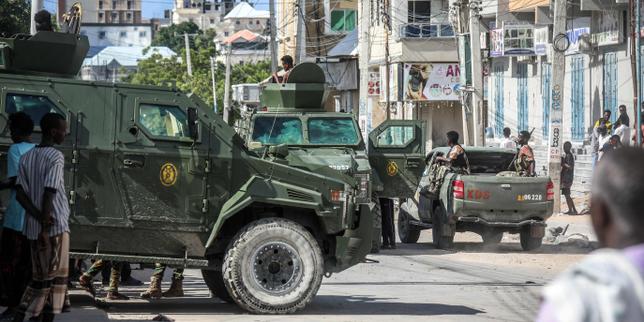
The outbreak of kinetic warfare in the streets of Mogadishu is neither an isolated security failure nor an unpredictable outburst of tribal friction. It is the mathematical consequence of an elite institutional design flaw: using constitutional engineering to alter electoral timelines mid-mandate without establishing a consensus-based enforcement mechanism.
When the Federal Government of Somalia unilaterally ratified a constitutional reform package that transitioned the legislative selection mechanism to universal suffrage while simultaneously extending executive and legislative terms from four to five years, it disrupted the delicate elite equilibrium. In highly fragmented political ecosystems, a mid-term rule change functions as an expropriation of political capital. The resulting clashes between federal security forces and opposition-aligned clan militias are not merely ideological disputes; they are rational tactical maneuvers within a zero-sum contest for state control. For another view, check out: this related article.
The Mechanics of Term Extension Dynamics
To understand why a legal modification to a constitutional text translates directly into mortar fire in residential districts like Howl Wadaag and Dabka, one must analyze the structural architecture of Somali political transitions. The core drivers of this escalation can be deconstructed into a three-part causal matrix.
The Mandate Extension Friction Point
The administration of President Hassan Sheikh Mohamud argues that transitioning from an indirect electoral model to a "one person, one vote" universal suffrage framework requires a transitional buffer period, legally justifying an automatic one-year mandate extension. Conversely, the opposition coalition—anchored by figures such as former Prime Minister Hassan Ali Khaire and former President Sharif Sheikh Ahmed—views this structural pivot as an artificial mechanism designed solely to prolong executive tenure. Further coverage regarding this has been shared by BBC News.
This dynamic mimics the 2021 constitutional crisis under former President Mohamed Abdullahi "Farmaajo". The structural variable remains constant: an incumbent administration leverages the rhetorical legitimacy of democratic modernization to unilaterally extend its operational runway, provoking an immediate defensive militarization by out-of-power elites who perceive a permanent lockout from state revenues.
Asymmetric Resource Mobilization
In a consolidated state, the government maintains a monopoly on the legitimate use of physical force. In Somalia, the security architecture is decentralized along clan lines, meaning that political capital is directly convertible into military capacity. The federal apparatus commands specialized, internationally trained components of the Somali National Army and federal police units.
However, opposition leaders retain immediate access to parallel clan-based mobilization networks. When the federal ministry of defense deploys state assets under the rubric of anti-militia clearance operations, the opposition perceives it as a targeted decapitation strike against rival political elites. The deployment of heavy weapons, including rocket-propelled grenades and mortars in dense urban corridors, reflects an equilibrium of force where neither side enjoys a decisive tactical advantage.
The Security Disruption Cost Function
The escalation of intra-elite conflict in the capital yields a direct negative externality: the degradation of the counter-insurgency campaign against Harakat al-Shabaab al-Mujahideen. The deployment of state security forces to secure urban sectors against opposition maneuvers creates an immediate tactical vacuum in peripheral zones. Al-Shabaab optimizes its operational strategy during these periods of elite fragmentation, leveraging the distraction to re-establish territorial control, extort commercial networks, and launch asymmetric strikes against a divided security apparatus.
Institutional Path Dependency and the Failure of Unilateral Reform
The structural flaw in the federal government’s transition strategy lies in the misapplication of institutional path dependency. Western-style constitutional adjustments assume that the legal text dictates political reality. In the Somali theater, the legal text is subordinate to the underlying elite bargain.
Unilateral Constitutional Change
  │
  ▼
Disruption of the Elite Bargain
  │
  ▼
Security Force Fragmentation (Clan Realignment)
  │
  ▼
Kinetic Escalation in Mogadishu
  │
  ▼
Counter-Insurgency Vacuum (Al-Shabaab Expansion)
  │
  ▼
Systemic Institutional Collapse
The primary constraint of the current administration's strategy is the assumption that universal suffrage can be organized under conditions of severe territorial fragmentation and active insurgency. Without federal control over rural hinterlands, a universal suffrage election cannot be comprehensive; it becomes an exclusionary exercise limited to secure urban enclaves. Consequently, the opposition’s resistance is rooted in a pragmatic calculus: an incomplete universal suffrage election run by an incumbent with extended powers is mathematically guaranteed to deliver an incumbent victory.
Structural Constraints of International Intervention
The international community—primarily the African Union, the United States, and the European Union—consistently responds to these flashpoints with calls for maximal restraint and a return to consensus-based dialogue. This diplomatic strategy suffers from two fundamental limitations.
First, foreign actors lack the leverage to enforce compliance because their own strategic priorities—chiefly the containment of transnational terrorism—require the continuous financial and logistical underwriting of the Somali state, regardless of its internal governance failures. This creates a moral hazard: the federal government can pursue high-risk constitutional maneuvers knowing that international partners cannot afford to fully withdraw security assistance without risking a systemic collapse to Al-Shabaab.
Second, the structural reliance on external funding weakens domestic accountability. Because state elites derive their revenue from international geopolitical rents rather than domestic taxation, they are structurally incentivized to prioritize the consolidation of institutional power over the negotiation of a durable domestic social contract.
Tactical Playbook for Stability Re-Establishment
To de-escalate the current kinetic crisis and prevent a descent into protracted civil warfare, the political calculus must be fundamentally reordered. The resolution cannot be achieved through purely military or purely rhetorical means. It requires a structured, multi-phase political settlement.
- Immediate Freezing of the Constitutional Extension Mandate: The executive branch must suspend the operational implementation of the March constitutional amendments. This concession is required to remove the immediate existential threat perceived by the opposition, creating the necessary political space for disarmament.
- Re-Establishment of the National Consultative Council (NCC) Framework: The transition model must be extracted from the exclusive domain of the federal parliament and placed into an inclusive negotiation matrix featuring federal member state leaders, opposition coalitions, and key clan elders. History indicates that only a negotiated elite consensus can guarantee security during a Somali electoral cycle.
- Bifurcated Electoral Roadmap: The administration must abandon the mathematically unfeasible objective of full universal suffrage within the current calendar cycle. Instead, a hybrid model must be negotiated—one that introduces elements of direct democracy in highly secure urban centers while preserving a reformed, transparent indirect model in contested regions. This preserves the momentum of democratic reform without provoking an existential security crisis.
- Independent Delinking of the Security Command Structure: To restore operational integrity to the counter-insurgency mission, the command structures of specialized security units must be insulated from political decision-making. Joint security committees, featuring representation from both the federal government and the opposition, must oversee the policing of Mogadishu to prevent the instrumentalization of state force for factional political ends.
If the federal executive persists in treating constitutional law as a unilateral instrument to bypass the elite bargain, the conflict will scale beyond the boundaries of Mogadishu, fragmenting federal member states and fatally compromising the structural gains made against regional insurgencies over the past decade.
You can gain a deeper understanding of the socio-political dynamics underlying this crisis by watching this Africanews analysis of the Mogadishu clashes, which provides direct visual context and local reports on how these institutional tensions manifested as kinetic street battles.


