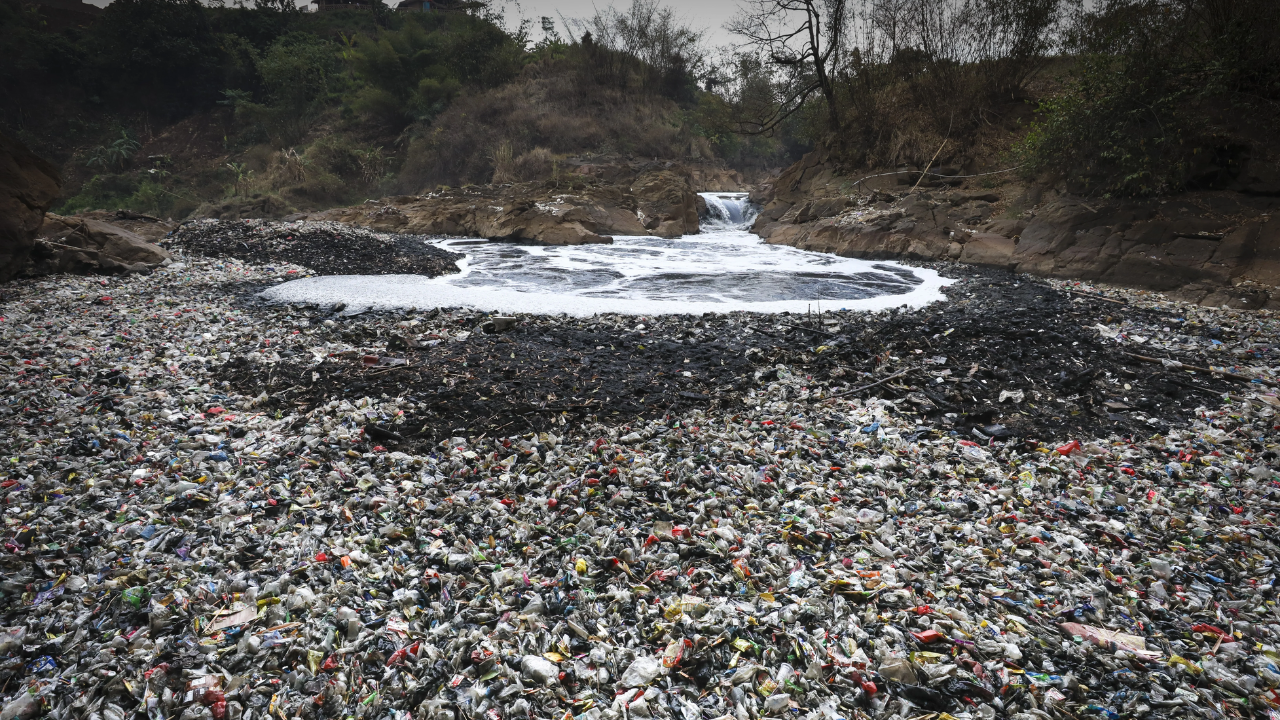
When a river's surface vanishes beneath an unbroken crust of single-use plastic, domestic waste, and industrial sludge to the extent that humans can physically walk across it without making direct contact with the water, the system has crossed the threshold from degradation into functional death. This phenomenon, frequently observed along sections of the Citarum River in West Java, Indonesia, is rarely a failure of localized waste management alone. It is the visible symptom of a systemic governance failure, an economic externality problem, and an infrastructure deficit operating simultaneously at scale. To understand why individuals can stride across a major waterway on a carpet of consumer packaging requires deconstructing the precise variables that convert a vital hydrological artery into a solid waste landfill.
The Economic Mechanics of Unregulated Pollutant Loading
The mass accumulation of debris capable of supporting human weight is driven by an economic cost function that heavily favors unmitigated dumping over compliant disposal. Upstream manufacturing centers, particularly textile production hubs in Bandung, operate within regulatory frameworks where the marginal cost of waste treatment exceeds the financial penalty of non-compliance.
The Cost Function of Waste Disposal
- Capital Expenditure: Constructing and maintaining effluent treatment plants requires substantial upfront capital.
- Operational Drag: Chemical neutralizing agents, sludge dewatering, and continuous monitoring consume recurring operational budgets.
- Enforcement Arbitrage: Weak municipal monitoring creates a near-zero probability of detection, driving the expected value of illegal dumping to zero.
When regional factories discharge untreated industrial effluents and municipal authorities fail to scale collection logistics alongside population growth, the riverbed acts as a low-cost conveyor belt. The convergence of residential trash from informal settlements lacking municipal collection and heavy industrial discharge creates a high-density matrix of organic and synthetic materials.
Hydrodynamic Traps and Obstruction Dynamics
Waterways do not accumulate mass uniformly. The physical geography of the Citarum basin includes reservoirs and narrow bends that act as hydrodynamic traps. When floating debris moves downstream, it encounters structural impediments such as the Saguling, Cirata, and Jatiluhur hydroelectric dams.
These massive engineering structures alter the natural velocity profile of the river. As water slows down behind dam walls, kinetic energy drops precipitously. The river loses its capacity to transport suspended and floating loads. Consequently, millions of tons of lightweight polyethylene terephthalate bottles, plastic bags, and discarded textiles compress against one another, forming dense, interlocking mats.
This process creates a feedback loop of structural blockage. As the surface layer thickens, it traps subsequent layers of sediment and organic matter. Over time, the trapped mass dewaters partially, grows vegetation roots, and achieves sufficient shear strength to support the weight of a person. What appears superficially as solid ground is actually an inverted density gradient of municipal refuse resting on stagnant, anoxic water.
Public Health and Epidemiological Cascades
The transition of a river into a solid waste pathway triggers severe downstream externalities, primarily concentrated in public health and agricultural safety. The dense crust prevents atmospheric oxygen transfer, pushing the underlying water column into absolute anoxia. Under these anaerobic conditions, heavy metals such as mercury, lead, and cadmium—dumped freely by textile dyeworks—bind to organic compounds and settle into the benthic sediment.
Local agricultural systems rely directly on Citarum water for paddy irrigation. As rice fields absorb heavy-metal-laced irrigation water, bioaccumulation occurs systematically through the food chain. The economic savings realized by polluting factories are thus instantly offset by steep increases in regional healthcare costs, chronic renal failure, neurological disorders among children, and systemic productivity losses across the provincial labor force.
Evaluating Remediation Interventions
Efforts to reverse this degradation have shifted through various tactical frameworks, yielding mixed operational results. International interventions, including financial packages from the Asian Development Bank and military-led clean-up deployments mandated by the Indonesian government, demonstrate the limitations of surface-level mitigation.
Surface skimming and manual dredging remove mass from the water column temporarily, but they fail to alter the upstream inputs. Without rigorous enforcement of zero-discharge regulations at the factory level and the rapid expansion of door-to-door municipal solid waste collection in rural districts, any cleared channel returns to its saturated baseline state within a single monsoon cycle.
The remediation bottleneck is fundamentally structural rather than technical. Technologies for wastewater treatment and solid waste sorting are mature and globally accessible. The missing variable is the enforcement of strict liability frameworks that force industrial operators to internalize the full social cost of their waste output.
Strategic Execution for Basin Recovery
Reversing the trajectory of the Citarum basin requires shifting capital allocation from cosmetic cleanup operations to structural enforcement mechanisms. Municipalities must transition from reactive dredging to proactive source control.
- Deploy continuous real-time optical and chemical sensors at all industrial discharge points to eliminate enforcement arbitrage.
- Mandate extended producer responsibility legislation that penalizes consumer goods corporations for unrecovered packaging waste found within the river basin.
- Decouple local municipal budgets from industrial tax generation to eliminate perverse incentives that protect polluting factories.
- Scale decentralized waste-to-energy infrastructure directly adjacent to informal settlements to eliminate the economic rationale for riverine dumping.