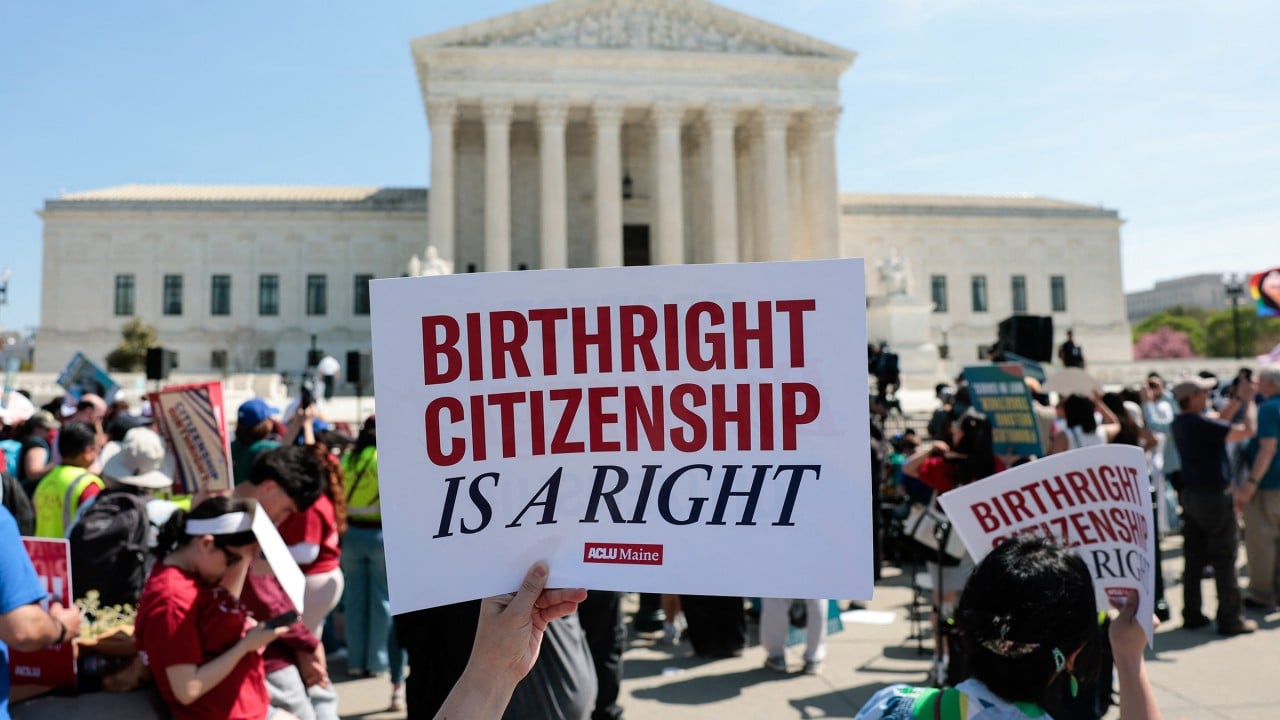
The conflict between executive immigration policy and the Fourteenth Amendment has reached its predictable structural bottleneck. Following the Supreme Court’s 6–3 decision in Trump v. Barbara, which struck down Executive Order 14160, the executive branch faces a closed constitutional pathway. The administration’s strategic pivot—publicly demanding a rehearing or alternative judicial avenues—fails to account for the rigid mechanisms of appellate finality and historical precedent.
To evaluate the stability of birthright citizenship, one must analyze the legal mechanisms, statutory interactions, and demographic feedback loops that dictate how the Citizenship Clause operates under judicial scrutiny.
The Two-Variable Calculus of the Citizenship Clause
The executive branch attempted to disrupt a 157-year legal equilibrium by decoupling the two explicit conditions found within Section 1 of the Fourteenth Amendment:
- The Territorial Condition: Birth or naturalization within the physical boundaries of the United States.
- The Jurisdictional Condition: Being subject to the jurisdiction of the United States at the moment of birth.
The administration's legal strategy relied on a revised definition of the Jurisdictional Condition. It posited that individuals unlawfully present or holding temporary visas do not owe full political allegiance to the United States, thereby exempting their offspring from automatic citizenship.
The structural flaw in this interpretation lies in a fundamental confusion between political allegiance and legal jurisdiction. Under the common law framework inherited from English jurisprudence—explicitly formalized in Calvin’s Case (1608) and affirmed by the Supreme Court in United States v. Wong Kim Ark (1898)—jurisdiction is territorial, not consensual.
The Carve-Out Framework
The historical record identifies only four strict exclusions to the territorial rule:
- Children of accredited foreign diplomats who possess sovereign immunity.
- Children born to hostile invading forces occupying U.S. territory.
- Births occurring aboard foreign sovereign vessels within territorial waters.
- Specific statutory exemptions regarding native populations under tribal sovereignty, later modified by the Indian Citizenship Act of 1924.
By attempting to insert a fifth category—undocumented immigrants and temporary visa holders—Executive Order 14160 operated outside the established common law exceptions. The majority opinion in Trump v. Barbara exposed this vulnerability, noting that the ratifiers of the Fourteenth Amendment did not contemplate a domicile or legal-status limitation on territorial jurisdiction.
The Statutory Bottleneck and Justice Kavanaugh's Concurrence
The legal vulnerability of the administration’s strategy is split into constitutional and statutory dimensions. While a 5–4 majority of the Court ruled on purely constitutional grounds that the Fourteenth Amendment guarantees birthright citizenship regardless of parental legal status, Justice Brett Kavanaugh's concurrence established a separate, statutory barrier.
This statutory bottleneck exists within Title 8 of the United States Code, specifically 8 U.S.C. § 1401(a), which codifies that any person born in the United States and subject to its jurisdiction is a citizen at birth.
[Fourteenth Amendment] ---> Codified in ---> [8 U.S.C. § 1401(a)]
                                                     ^
                                                     |
                                        [Executive Order 14160]
                                        (Attempted Reinterpretation)
Because Congress has tracked the broad common law definition of jurisdiction within the text of the Immigration and Nationality Act (INA), an executive order cannot override the clear text of a federal statute. The executive branch possesses delegated authority to enforce immigration laws, but it lacks the authority to alter the criteria for statutory citizenship. The concurrence clarified that any structural modification to the birthright citizenship framework requires direct legislative action from Congress, rather than executive reinterpretation.
Demographic Feedback Loops and the Cost Function of Exclusion
The operational implications of ending birthright citizenship extend beyond judicial theory. Joint projections from the Migration Policy Institute and Pennsylvania State University’s Population Research Institute quantify the systemic friction of changing this policy.
An estimated 250,000 children are born annually in the United States to parents who lack legal permanent residency or citizenship. Of this cohort, roughly 150,000 are born to undocumented parents.
If the executive branch were to successfully deny documentation to this group, it would trigger an immediate compounding effect on the unauthorized population.
The Population Accumulation Model
Denying citizenship does not incentivize immediate self-deportation; instead, it shifts individuals into a legally stagnant tier. The compounding arithmetic indicates that blocking birthright citizenship would expand the domestic unauthorized population by an estimated 2.7 million individuals by 2045.
This creates severe structural strain across multiple operational vectors:
- Administrative Backlogs: U.S. Citizenship and Immigration Services (USCIS) would be forced to develop complex verification systems to audit the legal status of mothers at the exact time of birth, increasing processing times and operational costs.
- Labor Market Distortions: A growing segment of the population would enter adulthood without legal work authorization, expanding the informal economy and reducing federal and state tax collection.
- Litigation Inefficiencies: Fragmented legal challenges would continue to emerge from state-level implementations, creating a patchwork of documentation standards across different jurisdictions.
The Illusions of the Rehearing Strategy
The administration’s stated objective to petition the Supreme Court for a rehearing in Trump v. Barbara faces near-impossible procedural hurdles. Under Supreme Court Rule 44, petitions for rehearing of a decision on the merits are rarely granted, requiring an extraordinary shift in circumstances or a clear demonstration that the Court overlooked a dispositive legal point.
The 194-page decision issued by the Court represents an exhaustive exploration of the historical, textual, and structural elements of the Citizenship Clause. The dissents, led by Justice Clarence Thomas, attempted to introduce an alternative originalist interpretation centered around a "domicile" requirement. The majority explicitly rejected this view, noting that citizenship and domicile are distinct legal concepts that cannot be conflated to restrict a clear constitutional mandate.
The executive branch cannot use a petition for rehearing to relitigate arguments that have already been comprehensively weighed and dismissed. The strategy functions more as political signaling than a viable path toward changing the law.
The only remaining structural mechanism to alter birthright citizenship is a constitutional amendment under Article V. This path requires a two-thirds majority in both houses of Congress or a constitutional convention called by two-thirds of the states, followed by ratification from three-fourths of the states. Given current levels of political polarization, achieving these thresholds is mathematically improbable. The judicial pathway is effectively closed, and the statutory framework remains firmly anchored in the territorial principle of common law.