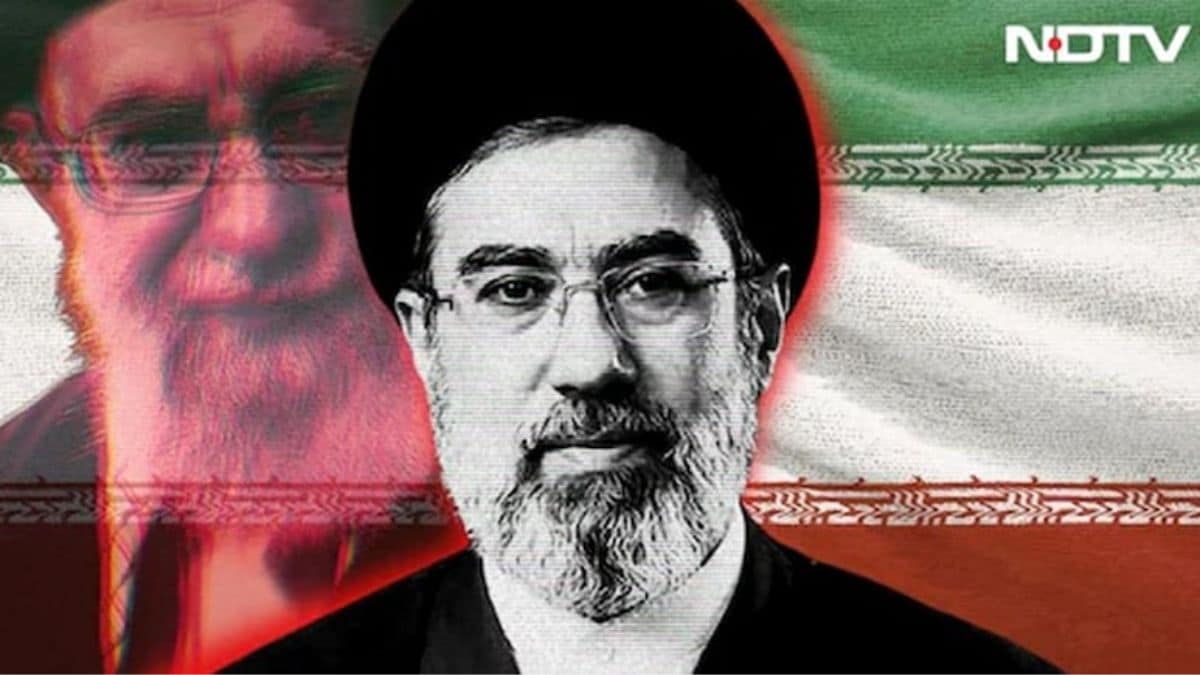
The institutional mechanism driving Iranian state survival operates independently of personal charisma. When Supreme Leader Mojtaba Khamenei issued a written declaration pledging to avenge his father’s assassination, the statement signaled a deliberate shift from a personalized autocracy to a highly decentralized, asymmetric deterrence framework. By explicitly stating that the mandate for retribution "does not depend on the existence of me or other officials," the clerical regime formalized a decentralized command structure meant to signal survival to external adversaries.
The primary strategic challenge for the Islamic Republic following the February 28 airstrikes was preventing total institutional collapse under decapitation pressure. Traditional autocratic states suffer from systemic vulnerabilities when top-tier leadership is eliminated. Iran's response utilizes a multi-layered mobilization strategy designed to counter maximum military pressure through three distinct vectors: symbolic public capital, operational decentralization, and localized economic endurance.
The Tri-Border Mobilization Engine
The regime structured the six-day funeral ceremonies across Tehran, Qom, Najaf, Karbala, and Mashhad not merely as a mourning ritual, but as an optimization of regional logistics. This multi-city layout represents an intentional deployment of transnational soft power across the Iran-Iraq Shia corridor.
- The Geopolitical Grid: Moving the late leader’s remains through Iraqi holy centers (Najaf and Karbala) before final burial in Mashhad reinforces the structural integration of the Axis of Resistance. It explicitly demonstrates to Western intelligence that despite high-value decapitation strikes, the operational access and cross-border mobility of Iranian state apparatuses remain intact.
- Mass Public Capital: The mobilization of millions of participants serves a clear quantifiable purpose: altering the cost-benefit calculations of foreign planners. By demonstrating a high baseline of domestic ideological alignment, the state projects a high probability of widespread civil resistance and asymmetric retaliation in the event of an outright ground invasion or further escalation.
The Decentralization of Vengeance
The core structural shift in the new leader's doctrine is the formal externalization of state-sanctioned violence. In classical deterrence theory, a state must demonstrate both capability and intent. When Mojtaba Khamenei frames the mission as a decentralized task for "every free person around the world," the state deliberately shifts the operational burden away from official state organs like the Islamic Revolutionary Guard Corps (IRGC).
This shift creates a profound intelligence bottleneck for adversaries. If retaliation is state-directed, it can be anticipated via electronic intercepts, military movements, and institutional command structures. Conversely, if retaliation is decentralized to ideologically aligned global actors, the target area expands exponentially while the attribution mechanism blurs. The threat shifts from a predictable ballistic or state-level naval engagement to unpredictable, low-signature asymmetric operations targeting individuals, diplomatic infrastructure, or commercial nodes globally.
The Cost Function of Total Mobilization
An analysis of the state funeral’s logistics reveals a heavy reallocation of public resources designed to simulate wartime endurance. The economic footprint of the multi-day shutdown indicates how the state plans to manage severe friction points under total war conditions.
Total Funeral Direct Cost Estimate: +$800 Million USD
├── Logistical Allocation (50M Loaves of Bread, 24-Hour Retail Mandate)
├── Critical Infrastructure Outlays (Free Fiber-Optic Grid Deployment)
└── Domestic Commercial Closures (Tehran Grand Bazaar, Regional Closures)
This massive deployment of civic infrastructure is not an emotional excess; it is a live stress test of municipal resilience. Ordering the Tehran Grand Bazaar and key regional businesses to close while mandating grocery chains to operate on 24-hour shifts functions as a deliberate exercise in emergency resource distribution. The distribution of millions of food rations and the rapid deployment of dedicated telecommunications infrastructure demonstrate the regime's capability to pivot from a civilian market economy to a centralized command economy within a 72-hour window.
The primary risk to this strategy lies in its sustainability. Forcing economic stagnation through mandatory closures while burning through currency reserves to subsidize mass movement creates an unsustainable fiscal burn rate. While effective as a short-term display of ideological force, repeating such mobilization cycles under sustained kinetic pressure introduces severe risks of domestic economic instability.
Strategic Forecast
The fraying of the 60-day ceasefire and the collapse of maritime security in the Strait of Hormuz point toward a protracted, non-linear escalation cycle. Expect Iran to lean heavily on the doctrinal blueprint laid out during the mourning ceremonies: formalizing its decentralization policy while using localized, high-impact disruptions along critical global shipping lanes to extract leverage in back-channel talks. The new supreme leadership is signaling that any future attempts at systemic decapitation will simply default command to an unmapped, hyper-fragmented network of global proxies, rendering traditional state-level deterrence formulas obsolete.

.webp)