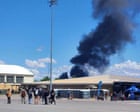
The midair collision of two United States Navy EA-18G Growler electronic warfare aircraft during the Gunfighter Skies Air Show at Mountain Home Air Force Base in Idaho exposes the tight operational tolerances and compounding risks inherent in close-formation demonstration flights. The incident, which occurred approximately two miles northwest of the installation, resulted in the total hull loss of both airframes—valued at approximately $67 million per unit—but achieved a 100% survival rate for the four crew members via successful low-altitude ejections. Analyzing this event requires evaluating three distinct phases: the aerodynamics of close-formation failure, the mechanics of modern emergency egress systems, and the structural execution of military installation containment protocols.
While standard media reporting focuses heavily on the visual spectacle of the crash, the true utility for defense analysts and aviation safety professionals lies in diagnosing the systemic pressures that govern these events. Air show maneuvers remove the safety buffers typically maintained during routine combat training, operating at the absolute margin of human reaction time and aerodynamic stability.
The Mechanics of Close-Formation Aerodynamic Interference
Close-formation flight relies on minimizing the spatial separation between multiple high-performance aircraft, frequently reducing the lateral and vertical clearance to less than one wingspan. In this flight regime, aircraft do not operate in isolation; instead, they interact with the localized atmospheric disturbances generated by adjacent airframes.
The primary aerodynamic hazard in close-formation maneuvers is wake turbulence, specifically wingtip vortices. The lift generation process creates a high-pressure zone beneath the wing and a low-pressure zone above it, forcing air to roll outward around the wingtips. This creates a pair of counter-rotating vortices extending behind the aircraft.
[Leading Jet] ---> Generates Wingtip Vortices (High-Velocity Downwash)
                          |
                          v
[Following Jet] ---> Enters Vortex Stream ---> Loss of Lift / Uncommanded Roll
                          |
                          v
                  [Midair Collision]
When a trailing or adjacent aircraft infiltrates this high-velocity downwash, the aerodynamic consequences are immediate:
- Uncommanded Roll Moments: The velocity vector of the vortex induces an asymmetrical lift distribution across the wings of the trailing aircraft, causing a rapid, uncommanded roll that can exceed the roll-rate capabilities of the flight control surfaces.
- Induced Induced Drag and Lift Deficit: Entering the core of a vortex severely degrades the local angle of attack, causing a sudden loss of lift over the affected wing section.
- Pilot-Induced Oscillations (PIO): In a high-stress, low-altitude demonstration environment, a pilot's manual correction to a sudden vortex-induced deviation can lag behind the aircraft's physical movement, creating a resonant feedback loop that exacerbates the erratic flight path.
Because the EA-18G Growler is a variant of the F/A-18F Super Hornet optimized for airborne electronic attack, it retains the heavy twin-engine geometry and flight control software of the strike fighter. When two of these heavy platforms operate in tight physical proximity at lower airspeeds—typical for crowd-facing maneuvers—the strength of the wingtip vortices increases proportionally with the higher angle of attack required to maintain altitude. Witness footage indicating that the jets became entangled during close-formation maneuvers points directly to a breakdown in spatial separation, likely precipitated by an environmental gradient or a micro-second control divergence that pulled one airframe into the aerodynamic wake of the other.
Egress Architecture and Survival Dynamics under High Dynamic Loading
The survival of all four aircrew members from Electronic Attack Squadron 129 (VAQ-129) highlights the efficacy of modern automated escape systems under extreme envelope constraints. The EA-18G utilizes the Martin-Baker MK14 Navy Common Ejection Seat (NACES), a highly automated system designed to operate from zero speed and zero altitude (0/0 capability) up to speeds of 600 knots and altitudes of 50,000 feet.
The timeline of a dual-seat ejection sequence is controlled by a digital sequencer to prevent midair collisions between the departing crew members and the components of the aircraft.
[Ejection Command Initiated]
          |
          +---> T = 0.00s: Canopy Fractures / Rear Seat Rockets Ignite
          |
          +---> T = 0.40s: Front Seat Rockets Ignite (Divergent Trajectory)
          |
          +---> T = 1.50s: Drogue Parachutes Deploy (Stabilization)
          |
          +---> T = 2.50s: Main Parachutes Deploy / Seat Separation
The sequence operates via strict incremental delays:
- Initiation and Canopy Clearance: Pulling the ejection handle triggers an underwater battery-powered or gas-driven system that either blows the canopy clear or shatters it using miniature detonation cords embedded in the acrylic.
- Rear Seat First Deployment: The rear crew member (Electronic Warfare Officer) is ejected first to clear the path for the front pilot. The solid-propellant rocket motor ignites, subjecting the occupant to an acceleration force of 15g to 18g to clear the vertical stabilizer of the collapsing airframe.
- Front Seat Delayed Deployment: After a calibrated delay of approximately 0.4 seconds, the front seat ignites. The trajectory of the front seat is pneumatically tilted via lateral thrust nozzles to create a divergent flight path away from the rear seat's trajectory.
- Stabilization and Parachute Deployment: A drogue chute deploys instantly to stabilize the seat and prevent high-speed tumbling. Once the sensor package detects that airspeed and altitude are within safe deployment parameters, the main canopy opens, and the seat separates from the occupant.
In the Mountain Home incident, the ejections occurred while the aircraft were spiraling toward the ground after making structural contact. The successful extraction of all four personnel confirms that the ejections occurred within the survivable window of the MK14 envelope, meaning the aircraft maintained sufficient altitude relative to their sink rate to allow the parachutes to fully blossom before ground impact.
Post-Mishap Installation Containment and Hazard Mitigation Protocols
The immediate implementation of a total base lockdown at Mountain Home Air Force Base following the crash represents a standardized military emergency response function rather than an indicator of a hostile threat. The activation of these protocols addresses specific logistical and safety variables unique to military aviation mishaps.
Hazardous Material Containment
The EA-18G Growler carries a highly toxic combination of fluids and materials that pose severe health risks upon combustion. The crash site immediately generates a hazardous materials (HAZMAT) perimeter due to:
- Composite Carbon Fiber Degradation: Modern military airframes use significant amounts of carbon-fiber epoxy composites. When subjected to aviation fuel fires, these composites fracture into microscopic, airborne fibers that mimic the respiratory hazards of asbestos.
- Hydrazine and Hydraulic Fluid Volatilization: Military hydraulic systems operate under extreme pressures (up to 5,000 psi) using synthetic fluids that release highly toxic gasses when burned.
- Fuel Unload and Fire Suppression: Air show aircraft often carry thousands of pounds of JP-8 fuel. A midair collision resulting in a ground explosion requires localized containment to prevent the runoff of toxic firefighting foams (AFFF) into the local water table.
Evidence Preservation and Forensic Integrity
The Air Force and Navy conduct concurrent safety and accident investigations (Class A Mishap Investigations). The initial lockdown serves to freeze the scene:
- Debris Field Mapping: Components of the aircraft can be thrown over a radius of several miles depending on the altitude and airspeed at the time of the collision. Securing the base perimeter prevents spectators or civilians from disturbing components critical to structural failure analysis.
- Flight Data Recorder Extraction: Securing the physical wreckage immediately protects the memory modules of the solid-state flight data recorders and deployable flight data systems before thermal damage or exposure degrades the digital evidence.
Spectator Control and Egress Logistics
Hosting the Gunfighter Skies Air Show brought thousands of civilian vehicles onto the military installation. The immediate cancellation of the remainder of the event required transitioning the base from an open-house configuration back to a secure environment. The lockdown prevented civilian vehicular gridlock on adjacent routes, ensuring that off-base civilian emergency services and military rescue vehicles had uninhibited access to the impact zones located two miles northwest of the flight line.
The Strategic Balance of Public Engagement and Operational Readiness
The cancellation of the Gunfighter Skies event—the first hosted at the base in eight years—stresses an ongoing tension within the Department of Defense regarding public flight demonstrations. Air shows serve as primary levers for public relations, recruitment, and community integration, matching the face of the military to taxpayers and potential recruits. However, these events introduce non-combat operational risks that directly impact combat readiness.
The loss of two EA-18G airframes removes vital specialized electronic warfare assets from the active inventory. Because the Growler production line is no longer operating at peak capacity, replacing these platforms requires either drawing down existing carrier air wing complements or accelerating structural upgrades on older blocks to bridge the capability gap.
The subsequent investigation will utilize the recovered flight data recorders, pilot telemetry, radar tracking, and high-resolution spectator footage to isolate the root cause. Investigators will map the exact positioning of the flight control surfaces leading up to the impact to differentiate between a mechanical flight control malfunction, an uncommanded aerodynamic upset from vortex interaction, or human error under high-g maneuvers. The definitive findings will ultimately dictate whether fleet-wide tactical changes are integrated into standard close-formation flight manuals across both the Navy and Air Force demonstration wings.