Dark matter makes up most of the universe. We can't see it. We can't touch it. We barely know how to look for it. To catch a glimpse of the invisible stuff holding galaxies together, scientists had to move nearly a mile underground.
They picked an abandoned gold mine in Lead, South Dakota.
The Sanford Underground Research Facility sits 4,850 feet beneath the surface. It's loud, wet, and pitch black. It's also one of the quietest places on Earth when it comes to particle physics. Surface laboratories deal with a constant shower of cosmic rays from space. These stray particles ruin sensitive physics experiments. Drop a detector deep into the earth, and the solid rock overhead acts as a massive shield.
Physics needs dirt. Lots of it.
The Journey From Extraction to Exploration
Gold miners didn't build the Homestake Mine to study the origins of the cosmos. They dug it to pull precious metal out of the earth starting in the late 1870s. Over the next century, workers hauled millions of ounces of gold out of the black rock.
Economics changed. Mining stopped. The tunnels started filling with water.
Most people assumed the infrastructure would rust away. Instead, physicists saw an empty vault. Converting a dangerous industrial hazard into a premier scientific facility required years of pumping out millions of gallons of water and securing miles of unstable tunnels.
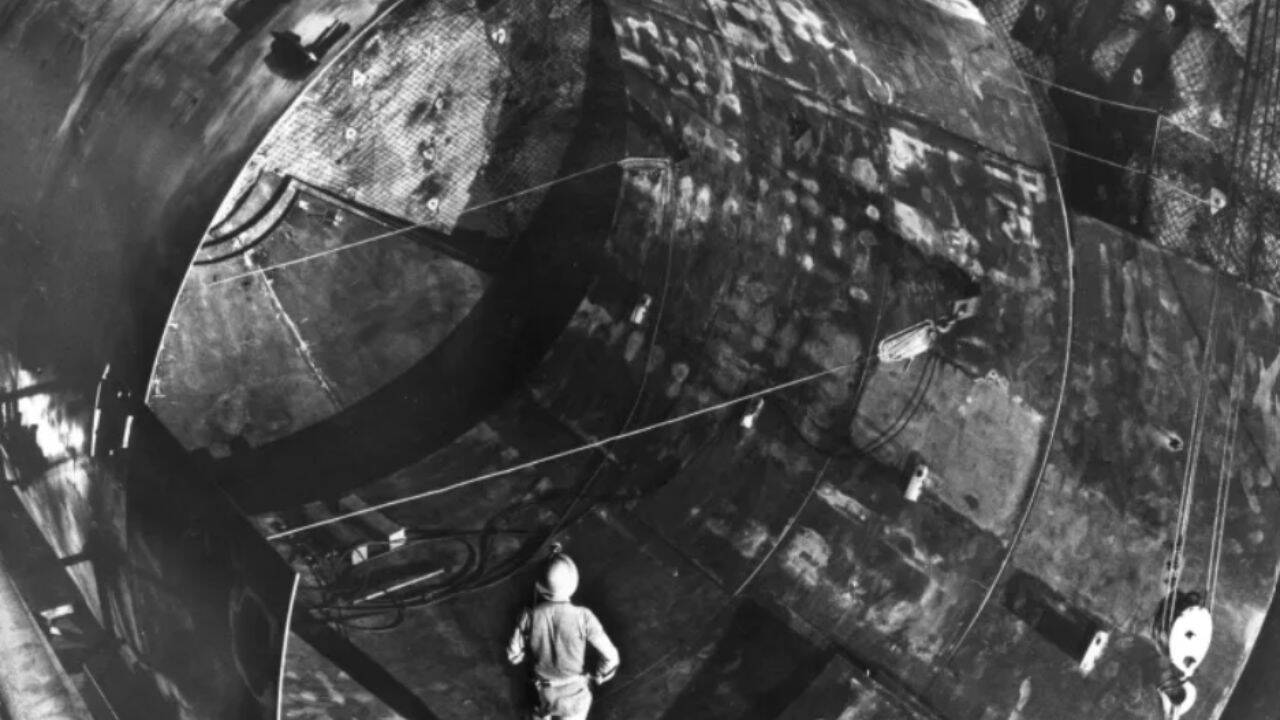
You don't just walk down into a 4,800-foot hole. You ride a rickety cage elevator that drops faster than a freight elevator in a skyscraper. The air down there is warm and carries the sharp smell of ancient rock and machinery. It feels claustrophobic at first. Then you realize you're standing in a massive cavern carved out of the earth, housing stainless steel tanks filled with ultra-pure liquid xenon.
Scientists don't work in isolation here. They work in a subterranean city where every speck of dust matters.
Why You Need a Mile of Rock to Find Nothing
The primary goal of these deep underground experiments is direct detection of dark matter, specifically Weakly Interacting Massive Particles, or WIMPs.
These hypothetical particles rarely interact with normal matter. Billions of them pass through your body every second without leaving a trace. Detectors have to be monstrously sensitive to catch even a single collision.
If you put a dark matter detector on the surface, cosmic rays slam into the sensors millions of times per day. That background noise completely drowns out the faint signal of a WIMP bouncing off a xenon atom. By burying the detector under 4,850 feet of rock, the cosmic ray rate drops by a factor of roughly ten million.
The rock blocks the noise. But the lab itself creates new challenges.
Normal rocks contain tiny amounts of radioactive elements like uranium and thorium. These elements decay and emit gamma rays and neutrons. A stray neutron looks identical to the signal a dark matter particle would leave. Physicists fight this by surrounding their detectors with water shields, ultra-clean copper, and ancient lead salvaged from sunken Roman ships.
Radiation is everywhere. Beating it takes obsession.
Inside the Majorana Demonstrator and LUX-ZEPLIN
The Sanford lab hosts multiple distinct detectors. Each one targets a different mystery in modern physics.
The LUX-ZEPLIN experiment stands as a prime example. It uses a massive tank of liquid xenon monitored by powerful photomultiplier tubes. When a particle hits a xenon atom, it produces a tiny flash of light and a cascade of free electrons. Researchers analyze these signals to figure out what kind of particle caused the interaction.
Neutrinoless double-beta decay is another major focus. The Majorana Demonstrator project looks at whether neutrinos are their own antiparticles. Answering this question could explain why the universe has more matter than antimatter today. Without that imbalance, stars and planets wouldn't exist.
Everything down there is hyper-engineered. Cleanrooms require full-body bunny suits just to keep skin cells and stray dust out of the sensitive assembly areas. Workers scrub equipment with acid and ultrasonic baths.
The Engineering Nightmare of Subterranean Science
Running a lab a mile underground creates logistical headaches most researchers never think about.
Power grids fail. Sumps need constant maintenance to prevent flooding from underground springs. Heavy equipment has to fit through narrow mine cages originally designed for mining carts and drill rigs.
Ventilation is another massive hurdle. Pushing fresh air down thousands of feet requires enormous surface fans running around the clock. Without them, heat from the surrounding rock would push temperatures up to uncomfortable levels.
Scientists spend hours just getting to work. You suit up, check your safety gear, step into the hoist, and drop into the dark for ten full minutes.
It strips away your ego. You realize how fragile human life is compared to the vast, heavy crush of the earth overhead.
What This Means for the Rest of Us
Funding pure science always draws criticism. People ask why we spend millions of dollars looking for invisible particles when roads need fixing and hospitals need supplies.
The answer is simple. Fundamental physics drives technological leaps.
The technology developed to detect faint particles underground often finds its way into medical imaging devices, security scanners, and data security. Liquid xenon purification techniques improve industrial manufacturing. Ultra-sensitive radiation detectors help monitor nuclear non-proliferation.
We invest in the deep underground because curiosity isn't a luxury. It's the engine of progress.
Take a moment to look up at the night sky tonight. Remember that thousands of feet beneath the soil in South Dakota, massive tanks of liquid xenon are sitting in the dark, waiting for a whisper from the very fabric of the cosmos.
Check your local science museum schedules, read up on the latest particle physics data releases, or follow open-access updates from the research facility to track how close we are to solving the universe's biggest mystery.