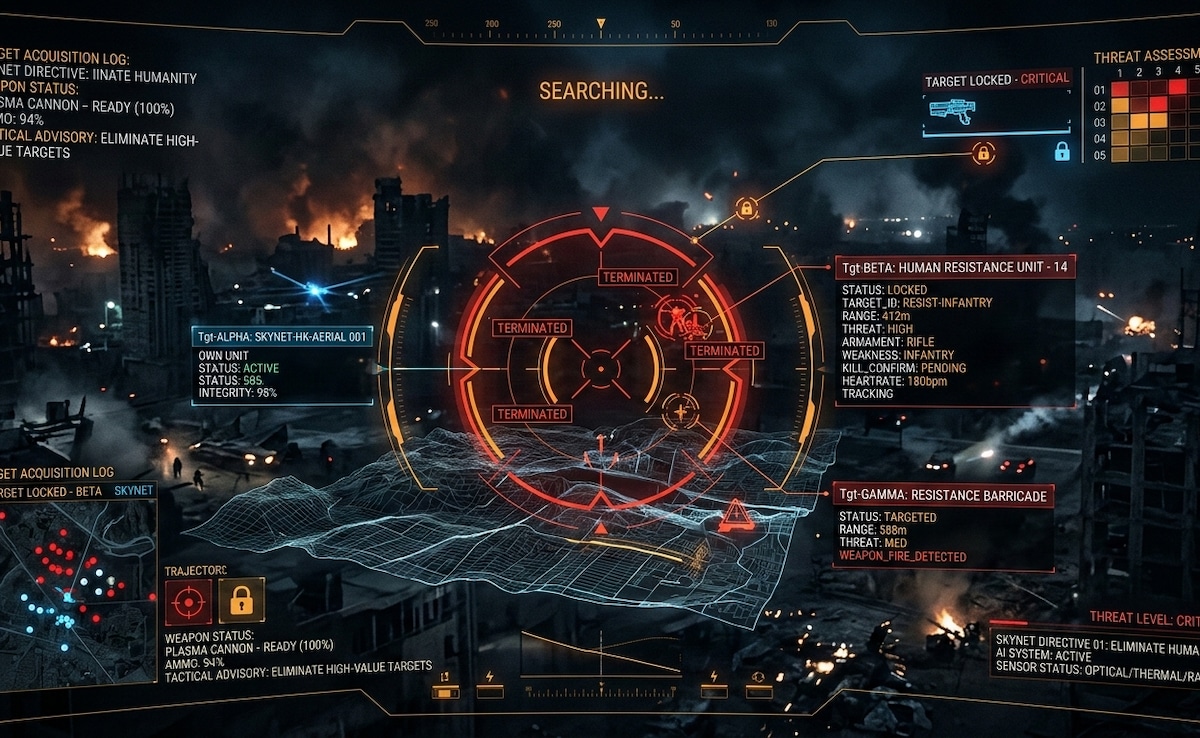
The shift from manual intelligence synthesis to algorithmic target acquisition represents the most significant change in the physics of warfare since the introduction of precision-guided munitions. In the context of recent US military operations targeting Iranian-backed proxies, the integration of Palantir’s data orchestration with Project Maven’s computer vision marks the transition from "human-speed" to "machine-speed" kill chains. This transition is not merely an upgrade in software; it is a structural redesign of how the Department of Defense (DoD) processes the massive data telemetry generated by persistent surveillance.
The Data Processing Bottleneck and the Maven Solution
Modern warfare produces a volume of raw data that exceeds human cognitive capacity. A single MQ-9 Reaper drone generates high-definition Full Motion Video (FMV) feeds that, when multiplied across a theater of operations, create a "data swamp." Before the implementation of Project Maven, human analysts—often junior intelligence officers—were required to watch thousands of hours of grainy footage to identify a single "pattern of life" or a high-value target. This created a structural latency in the decision-making cycle, known as the OODA loop (Observe, Orient, Decide, Act).
Project Maven, officially the Algorithmic Warfare Cross-Functional Team (AWCFT), was designed to solve this via three specific technical vectors:
- Automated Object Detection: Utilizing Deep Learning (DL) models to categorize pixels into discrete entities—trucks, personnel, weapon systems, or radar installations.
- Activity-Based Intelligence (ABI): Moving beyond static identification to track temporal changes. If a vehicle arrives at a specific coordinate at 0200 hours every Tuesday, the algorithm flags the anomaly without a human needing to review the previous four weeks of footage.
- Sensor Fusion: Corroborating FMV data with signals intelligence (SIGINT), geospatial intelligence (GEOINT), and open-source data (OSINT).
Palantir as the Orchestration Layer
While Maven provides the "eyes" (computer vision), Palantir provides the "nervous system." In operations against Iranian-linked targets in Iraq and Syria, Palantir’s Gotham platform acts as the Common Operational Picture (COP). It ingests the raw detections from Maven and situates them within a relational database.
This creates a Kinetic Reliability Function:
$$R = f(V, A, S)$$
Where:
- $V$ is the Velocity of data ingestion.
- $A$ is the Accuracy of the AI’s classification.
- $S$ is the Signal-to-noise ratio of the fused sensor data.
Palantir’s role is to ensure that $S$ is high enough to justify the expenditure of a kinetic asset (a missile or drone strike). By mapping the social and logistical networks of Iranian-backed militias, the software identifies nodes of vulnerability that are not visible through a camera lens alone. For instance, a warehouse might look empty to a drone, but Palantir’s integration of historical logistics data and intercepted communications identifies it as a critical munitions node.
The Three Pillars of Algorithmic Kinetic Operations
The success of these strikes depends on a rigorous hierarchy of digital operations. Failure in any one of these pillars results in "algorithmic drift" or, more catastrophically, collateral damage.
Pillar I: The Refinement of Computer Vision (CV)
Early iterations of Maven struggled with environmental noise—dust, heat haze, and low-light conditions common in the Middle East. The current iteration utilizes specialized Convolutional Neural Networks (CNNs) trained on vast datasets of regional imagery. The goal is to reach a precision rate where the False Positive Ratio (FPR) is statistically negligible. In the strikes against Iranian assets, this precision allowed for the targeting of specific rooms within a facility, rather than the destruction of the entire structure.
Pillar II: Data Interoperability
The US military suffers from "siloed" data. The Navy’s sensors often don't talk to the Air Force’s targeting software. Palantir’s primary value proposition is its ability to act as a universal translator. By creating a unified data layer, it allows a Maven-detected target on an Air Force feed to be instantly transmitted to a Navy carrier strike group or an Army artillery battery. This reduces the "Sensor-to-Shooter" timeline from hours to seconds.
Pillar III: Human-in-the-Loop (HITL) Validation
Despite the capabilities of the software, the US military maintains a strict HITL policy for kinetic strikes. The AI does not pull the trigger; it nominates targets. The software presents a "confidence score" to a human operator. A score of 0.98 indicates the AI is highly certain the object is a T-72 tank. The human operator then validates this against the Rules of Engagement (ROE). This creates a psychological safeguard but also introduces a potential bottleneck if the human cannot process the AI's nominations quickly enough.
The Strategic Cost Function of Algorithmic Warfare
The deployment of Maven and Palantir changes the economic and political cost of intervention. Traditional warfare is expensive in terms of human risk and "political capital" lost when operations fail. Algorithmic warfare shifts the cost to the Initial Development Phase. Once the models are trained and the infrastructure is built, the marginal cost of identifying an additional 1,000 targets is near zero.
This creates a shift in the deterrence landscape:
- Asymmetry of Detection: Opponents like Iran, who rely on proxy networks and "gray zone" tactics, find their anonymity stripped away. Hidden supply lines are exposed by software that never sleeps and never gets bored.
- Escalation Dominance: By being able to strike with extreme precision, the US can respond to provocations without necessarily triggering a full-scale regional war. The "rain of death" is surgical, not carpet-bombing.
Technical Limitations and System Vulnerabilities
It is a mistake to view this software as an infallible "god-eye." Several technical constraints limit its efficacy.
1. Adversarial Machine Learning
Opponents are beginning to use "spoofing" techniques. By placing specific patterns on the roofs of vehicles or using deceptive lighting, they can trick a CNN into misclassifying a military asset as a civilian one. This is a constant arms race between model training and adversarial deception.
2. Data Quality and "Hallucinations"
Just as Large Language Models (LLMs) can hallucinate facts, computer vision models can see "ghosts" in the pixels. In high-clutter environments like urban centers in Iraq, the probability of a misidentification increases. If the training data lacks diversity in atmospheric conditions, the system’s reliability collapses during a sandstorm.
3. The "Black Box" Problem
Neural networks are notoriously opaque. When Maven identifies a target, it cannot explain why it reached that conclusion. This lack of explainability creates a "trust gap" for commanders who must take legal responsibility for the strike. If a strike goes wrong, the "the AI told me so" defense is legally and ethically insufficient.
The Real-World Application: Neutralizing Iranian Proxies
In the recent retaliatory strikes across Yemen, Iraq, and Syria, the synergy of Maven and Palantir was the invisible architect of the battlefield. The software identified over 85 distinct targets within a 30-minute window. This scale of targeting would have previously required weeks of manual intelligence labor.
The mechanism of these strikes followed a predictable algorithmic path:
- Ingestion: Massive amounts of satellite and drone data were fed into the Maven environment.
- Corroboration: Palantir matched these visual signatures against known IRGC (Islamic Revolutionary Guard Corps) logistical patterns.
- Prioritization: The system ranked targets based on "Mission Impact"—prioritizing command centers and drone storage over low-level checkpoints.
- Execution: Validated targets were pushed to the Joint Direct Attack Munition (JDAM) systems of B-1B bombers.
The Proliferation of Algorithmic Warfare
The success of Project Maven ensures that its logic will be exported to every branch of the military and every potential theater of conflict. We are entering an era of Predictive Attrition. The goal is no longer just to react to enemy movements, but to model their future actions based on historical data and strike them before they move.
However, this reliance on software creates a new center of gravity. If an adversary can compromise the data integrity of the Palantir environment or the training pipeline of the Maven models, they can effectively "blind" the US military. The cybersecurity of the algorithmic supply chain is now as important as the physical security of an aircraft carrier.
The strategic play for future defense architecture must move beyond simple "target acquisition." The next evolution is Autonomous Logistics and Counter-AI. As adversaries develop their own versions of Maven, the battlefield will become a contest between competing algorithms. The winner will be the side with the most efficient data-cleansing pipelines and the most resilient model architectures. The focus must shift from the "flashy" kinetic end of the spear to the "boring" back-end infrastructure of data engineering. The dominance of the US military in the coming decade will be measured not in hulls or airframes, but in the latency of its distributed databases and the robustness of its edge computing.