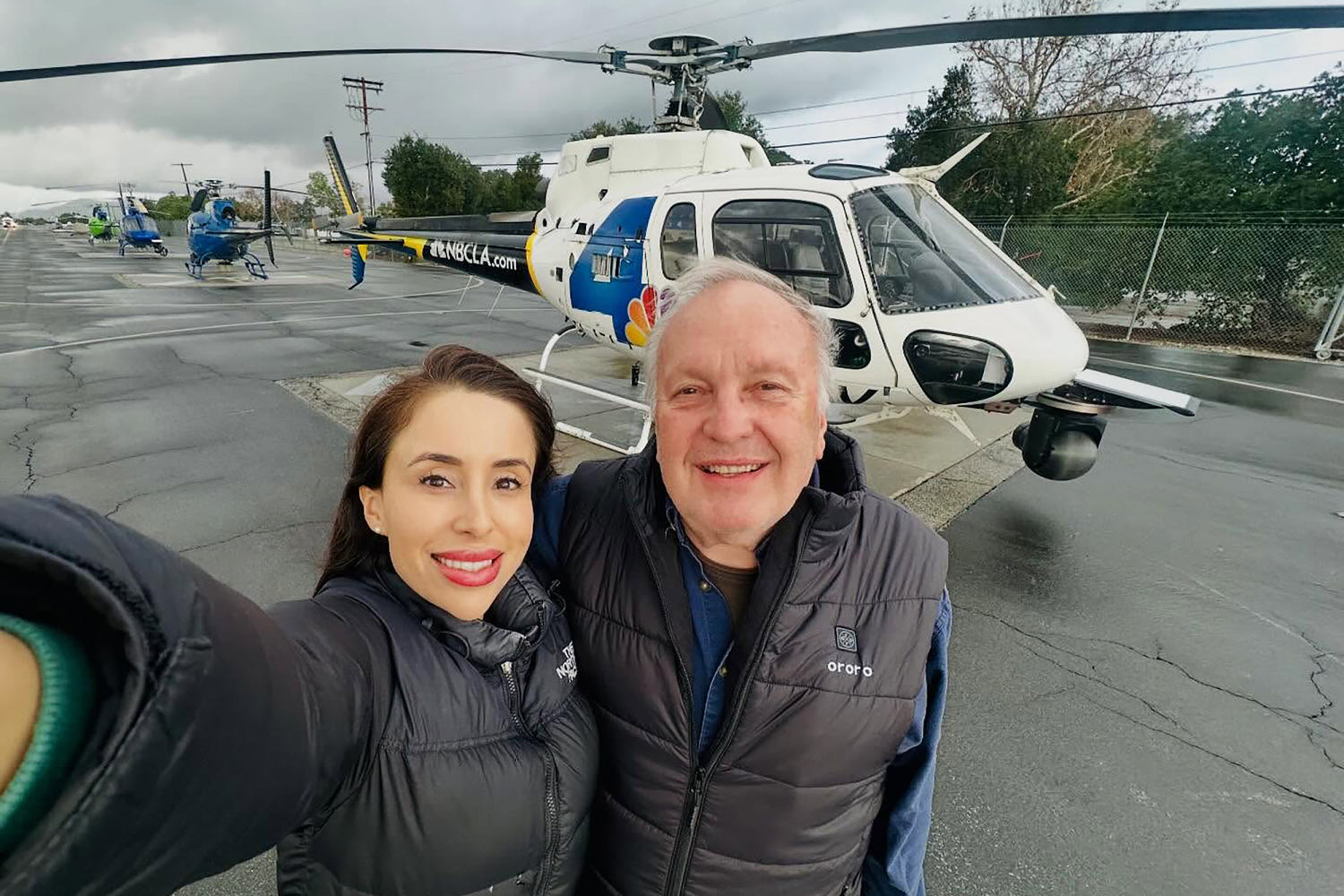
Low altitude broadcast journalism operates within an unforgiving operational envelope where margins for error are measured in fractions of seconds. The crash of the NBC Los Angeles news helicopter in the San Fernando Valley, which resulted in the fatalities of reporter Eliana Moreno, pilot George Marciniw, and a ground pedestrian, forces a technical re-examination of the systemic pressures governing electronic news gathering operations. Media flight tracking requires a delicate balance between public information velocity and aviation risk mitigation. Understanding the mechanics of this tragedy demands an evaluation of operational constraints, human factors, and the cost functions inherent to live aerial reporting.
The Operational Cost Function of Live Broadcast Aviation
Electronic news gathering aviation differs fundamentally from corporate transport or utility flying. Aircraft in this sector are subjected to a distinct set of operational variables that elevate baseline risk profiles.
- Low Altitude Loitering: Helicopters assigned to breaking news must maintain station-keeping maneuvers, often hovering or orbiting tightly over dynamic incident scenes such as traffic collisions or fires. This profile restricts translational lift, increases power demands, and narrows the height velocity diagram safety margins.
- Cognitive Multitasking Pressures: Flight crews are not merely navigating an aircraft; they are managing gyro-stabilized camera optics, scanning ground activity, communicating with newsrooms via multiple audio channels, and factoring live broadcast windows into spatial decisions.
- Dynamic Environmental Hazards: Urban environments present severe localized wind shears, thermal updrafts from fires or asphalt, and a proliferation of vertical obstructions including power lines, communication towers, and high-rise structures.
When these variables intersect with high-stress breaking news environments, the operational buffer thins rapidly. The operational imperative to deliver immediate visual data creates a structural bias toward risk acceptance.
Human Factors and Crew Resource Management
The partnership between veteran pilots and aerial reporters forms a complex socio-technical system. In the instance of the Chatsworth accident, initial audio transcripts indicate a sudden compression of time and space preceding the descent. Effective Crew Resource Management in a news helicopter requires explicit task sharing and uncompromised challenge-and-response protocols.
The division of labor inside the cockpit dictates that the pilot maintains absolute authority over flight trajectory while monitoring engine parameters and airspace. However, the external pull of the news story—driven by ground events like the primary bus collision being covered—can introduce implicit mission creep. When a reporter or assignment desk requests a tighter angle or a lower orbit to capture crucial details, the pilot faces subtle psychological pressure to compress safety margins.
The Regulatory and Technological Evolution of Electronic News Gathering
The recurrence of broadcast aviation incidents highlights structural gaps in how media organizations manage airborne assets. As stations increasingly pivot toward automated ground robotics, drone integration, and optimized remote sensing, crewed helicopters remain uniquely vulnerable due to aging legacy fleets and the pressures of real-time linear television.
Modern safety engineering points toward several structural adjustments to mitigate these hazards:
- Mandatory Geofencing and Altitude Floors: Automated flight management systems that restrict low-speed loitering below designated altitude thresholds unless specific emergency exemptions are met.
- Decoupling Editorial Direction from Flight Profiles: Enforcing strict operational separation where ground producers have zero direct audio routing to pilots during critical phase maneuvers like takeoff, landing, and low-altitude station-keeping.
- Fleet Modernization and Sensor Offloading: Shifting capital expenditure away from crewed helicopters toward advanced multi-rotor unmanned aerial systems equipped with high-definition optical zoom packages, which eliminate human onboard exposure for high-risk urban tracking.
Strategic Restructuring of Air Support Operations
Media organizations must transition from reactive safety reviews to predictive risk modeling. The financial and human toll of aviation accidents demonstrates that traditional hazard logs are insufficient for modern urban airspaces. Broadcasters need to calculate the actual return on investment of live helicopter deployment against the catastrophic tail risk of hull loss and loss of life.
The operational path forward requires institutionalizing a zero-compromise policy regarding weather, airspace congestion, and mechanical redundancy. If the news value of a live aerial shot cannot be captured from a safe, stabilized orbital altitude, the deployment must be canceled or substituted with static ground-based assets. Operational survival in broadcast aviation depends entirely on prioritizing structural safety over the fleeting demands of live news delivery.