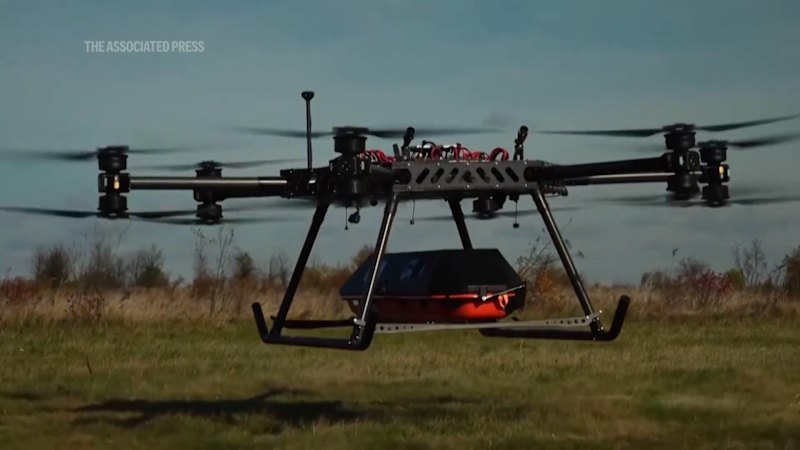
Standard reporting on the StarGate drone treats casualty evacuation as a simple novelty: a heavy unmanned aircraft carrying a wounded soldier off the battlefield. That framing misses the structural collapse of conventional battlefield rescue. Across modern front lines saturated with reconnaissance and strike unmanned aerial vehicles, the contested strip known as the kill zone has widened to several kilometers, turning wheeled ambulances, armored personnel carriers, and slow ground robots into high-probability targets.
Developed by SkyFall at the request of assault units such as CODE 9.2, StarGate is built around a specific operational trade-off: trading heavy ground payload capacity for velocity, obstacle avoidance, and rapid transit across blocked terrain. Known specifications place the platform at up to 150 kilograms of payload capacity, top speeds near 105 km/h, a range of roughly 30 kilometers, and a unit cost around $50,000, pairing a covered medical stretcher module with command links and autonomous routing under electronic warfare.
Evaluating this capability requires moving past human-interest snapshots to examine the physics of survival time, the mechanics of unmanned ground versus aerial transit, the electronics of contested airspace, and the industrial math of scaling a specialized rescue fleet.
Why Conventional Evacuation Fails in Saturated Kill Zones
Traditional casualty evacuation rests on a simple premise: reach the wounded soldier quickly enough to stop catastrophic hemorrhage and deliver surgical care before shock becomes irreversible. Dense loitering munitions, artillery spotting, and first-person-view strike drones break that timeline at two points simultaneously. First, movement draws immediate fire, pinning down medics and ground vehicles before pickup even begins. Second, even when a route is open on paper, mined roads, cratered tracks, water barriers, and rubble turn a short straight-line distance into a slow, winding crawl.
Unmanned ground vehicles emerged as a rational response to protect human crews from direct fire during logistics and rescue runs. Ground robots can haul heavy loads and have logged tens of thousands of logistics and evacuation missions. Yet their physics impose severe constraints on time-critical trauma care:
- Velocity ceiling: Ground platforms frequently move around 10 km/h over rough ground, stretching a ten-kilometer round trip or complex extraction into hours of exposure.
- Terrain coupling: Every ditch, minefield, wire obstacle, river, or marsh forces either a detour or a mechanical stop, increasing both mission duration and predictability along likely paths.
- Signature persistence: Moving slowly along ground corridors gives observers and strike operators prolonged tracking windows to line up munitions.
A flying evacuation drone changes the geometry of transit. Instead of negotiating every obstacle on the surface, it flies a more direct vector above ground hazards at roughly ten times the pace of a slow ground robot. Shorter exposure time in contested airspace directly reduces the integral of hazard over the mission—provided the aircraft itself does not advertise its presence or lose navigation control along the way.
The Cost Function of Unmanned Casualty Evacuation
Comparing unmanned ground vehicles, heavy multirotor evacuation platforms, and legacy manned rescue requires looking at the full cost function rather than sticker price alone. A $50,000 airframe looks inexpensive next to a crewed helicopter or a multi-ton armored vehicle, yet unit price is only one term in the equation.
Capital Cost Versus Loss Probability
Expected mission cost rises sharply whenever an asset has a high chance of being destroyed or captured. A low-cost platform that survives a single high-risk extraction from an otherwise unreachable pocket can deliver immense value even if its airframe is expended. Conversely, an expensive platform that takes hours on a slow ground route faces compounding exposure over time. The relevant metric is not purchase price in isolation, but expected cost per successful stabilization handoff.
Payload Limits and Patient Readiness
Moving from cargo or munitions to a human passenger tightens engineering tolerances without room for error. A 150-kilogram payload limit must cover the wounded soldier, body armor or gear if not shed, medical stabilization items, and any restraint or protective enclosure integrated into the stretcher module. Unlike a crate of ammunition, a trauma patient cannot tolerate hard landings, severe vibration, or prolonged exposure without clinical deterioration.
Equally important is the pre-flight bottleneck at the pickup point. An aerial drone cannot simply hover over an open field and scoop up an immobilized casualty without ground support. Getting a severely injured soldier into or onto the evacuation module still requires local assistance, self-loading capability, or pre-positioned gear. The aircraft solves long-distance transit out of the danger zone; the last few meters of loading remain a human and procedural bottleneck.
Navigation, Signatures, and Electronic Warfare Trade-Offs
Putting a person inside a heavy drone introduces an acute control problem: the link cannot simply fail safely into the ground like a strike munition. Reported StarGate operations highlight two technical pillars that keep the aircraft on course when signals are contested—comm links such as Starlink and SkyFall's L-Link system, alongside artificial intelligence route plotting during electronic warfare exposure.
Each layer brings a distinct vulnerability:
- Satellite and radio links: High-bandwidth links support remote monitoring and command, yet jamming, spoofing, or signal degradation can sever or degrade external control in dense electronic warfare zones.
- Onboard autonomy: Local route computation allows the aircraft to continue toward a safe recovery point when external links are jammed, but autonomous navigation depends on sensor accuracy, terrain awareness, and clean waypoints.
- Acoustic and thermal presence: Heavy lift aircraft generate substantial motor noise and visual or thermal signatures. Operating at night and pairing extraction flights with coordinated diversionary drone activity helps mask the rescue aircraft from enemy spotters and interceptors.
These trade-offs explain why aerial evacuation operates best as a specialized complement rather than a wholesale replacement for ground robotics. Where terrain is passable and time permits, ground robots still carry heavier loads and handle the bulk of routine logistics and evacuations. Where mines, fire, water, or time-critical trauma close off ground corridors, speed and altitude become decisive.
From Isolated Rescues to Repeatable Medical Operations
Early combat evacuations via StarGate—numbering in the single digits in initial reports—prove technical feasibility under real fire, not yet full-scale medical doctrine. Moving from a handful of high-profile rescues to a dependable force-wide capability requires industrializing four operational layers:
- Manufacturing throughput: Scaling production toward hundreds or a thousand units per month only translates into frontline readiness if spare parts, stretcher modules, batteries, and repair pipelines keep pace with attrition and flight hours.
- Pilot specialization: Flying a heavy drone with a wounded human aboard demands stricter discipline, smoother flight profiles, and higher risk awareness than flying supply or strike missions.
- Medical integration: A drone is a transport leg, not a mobile intensive care unit. Survival gains depend on rapid handoff to stabilization teams and clear triage rules over which casualties fly first.
- Coordinated airspace deconfliction: Rescue aircraft share crowded skies with reconnaissance, resupply, and strike drones, making route timing and airspace coordination essential to prevent mid-air interference or friendly fire.
Limitations and Strategic Forecast
Aerial casualty evacuation is no silver bullet. Weather, air defense coverage, severe electronic jamming, payload ceilings, and the difficulty of loading critically injured troops under fire will continue to restrict when and where these aircraft can fly. In many scenarios, ground robots will remain the primary workhorse for frontline supply and routine extraction.
Over the next twelve to twenty-four months, the decisive shift will not be the invention of flying stretchers, which already exists in prototype and early combat use. The real advantage will go to the force that treats unmanned medical aviation as a disciplined system—pairing jam-resilient autonomy, standardized stretcher modules, dedicated flight crews, and synchronized drone decoys to turn rare miracle rescues into a repeatable survival corridor out of the kill zone.


