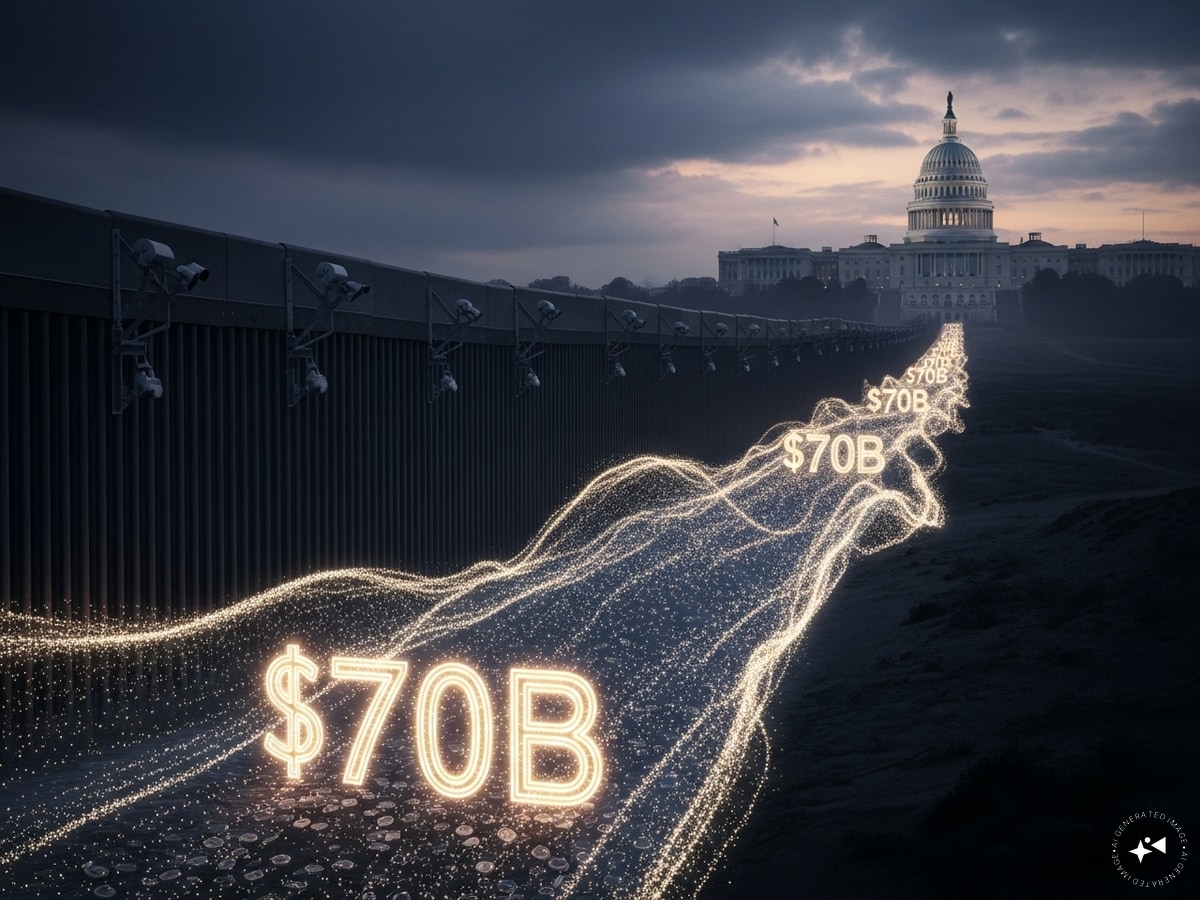
The Senate just greenlit a $70 billion immigration enforcement package. Predictably, the media is obsessing over the lack of checks on executive power. They are fixated on the "unmonitored settlement fund" and shouting about how a sitting president could use it as a political war chest.
They are missing the entire point.
The real story isn’t that the executive branch has too much leeway with the money. The real story is that spending $70 billion to scale up traditional border enforcement is a fundamentally broken strategy that treats an economic supply-and-demand problem as a pure police action.
For two decades, I have analyzed capital allocation and regulatory policy. If a private enterprise burned cash on a broken operational model the way Washington does on border enforcement, the board would fire the executive team by lunchtime.
This bill doesn't fix a broken system. It subsidizes an obsolete one.
The Open Spigot: Why Enforcement Spending Fails Basic Economics
The conventional wisdom on Capital Hill is simple: more money equals tighter borders. If you deploy more sensors, build more detention beds, and hire more agents, you stop the flow.
It sounds logical. It is completely wrong.
Border migration is driven by an unyielding macroeconomic reality. On one side, you have severe labor shortages in critical American sectors like agriculture, construction, and hospitality. On the other side, you have a massive, motivated labor supply.
When a structural wage gap between two regions exceeds 300%, no amount of physical or bureaucratic friction stops the flow. It merely raises the price of entry.
[Wage Gap/Economic Pull] ──> [Traditional Border Barriers] ──> [Higher Cartel Fees/Black Market Growth]
By pouring $70 billion into the traditional enforcement apparatus without reforming the legal pathways for labor, the Senate isn't stopping illegal immigration. It is inadvertently guaranteeing the business model of human smuggling cartels.
When you increase the risk of crossing without altering the underlying economic incentive, you don't reduce the demand. You simply allow cartels to charge higher premiums. Security spending acts as an artificial price support for the illicit market.
Dismantling the Unchecked Settlement Fund Panic
The loudest critiques of the bill focus on the Trump settlement fund—a pool of capital left intentionally flexible. The mainstream consensus screams that this is an unprecedented threat to the separation of powers.
Let's look at the mechanics honestly.
In any fast-moving operational theater, rigid line-item budgeting is a recipe for disaster. If the agency heads have to wait for a congressional appropriation cycle every time migration patterns shift from the Rio Grande Valley to the Arizona desert, the response will always be six months too late.
The problem isn't that the fund is flexible. The problem is what the fund is legally allowed to buy.
Under the current framework, the money is locked into a reactive posture: detention, deportation, and physical barriers. True operational flexibility would allow these funds to be deployed for rapid guest-worker processing, regional stabilization initiatives, and technological infrastructure that expedites legal entry to relieve pressure on the physical border.
Imagine a scenario where a logistics giant sees a massive bottleneck at its primary distribution hub. It doesn't solve the crisis by hiring five thousand security guards to stand at the gates and block incoming trucks. It solves it by expanding the loading docks and automating the manifests.
Washington is spending billions on guards while the loading docks are crumbling.
People Also Ask: The Premise is Completely Rotten
The public discourse around this bill is shaped by fundamentally flawed questions. Let's dismantle the main assumptions dominating the debate.
Doesn't increasing border technology stop the flow?
No. Technology like automated surveillance towers, ground sensors, and aerial drones merely increases the detection rate. It does not alter the processing capacity or the legal framework. Identifying ten times as many individuals does nothing if your immigration courts have a backlog of over three million cases. You have simply built a more expensive window to watch a systemic failure occur in real time.
Why not just use these billions to deport everyone who enters illegally?
Because the math doesn't work. The average cost to apprehend, detain, process, and deport a single individual runs into thousands of dollars. Multiplying that by millions of people requires an infrastructure expenditure that would dwarf the entire current defense budget. More importantly, it ignores the labor void it creates. Removing millions of workers from the construction and agricultural sectors would trigger immediate, massive inflationary shocks across the American economy.
Will this bill at least stabilize the legal ports of entry?
It won't, because it treats ports of entry as security checkpoints rather than trade corridors. Our ports of entry handle hundreds of billions of dollars in legitimate commerce annually. When you saturate these corridors with security mandates without upgrading the digital infrastructure to process commercial goods and legal travelers simultaneously, you choke off economic growth.
The Hard Truth: Legal Labor Pipelines are the Only True Enforcement
If you want to secure the border, you must make it economically irrelevant to cross illegally.
The vast majority of people crossing the southern border are not looking to game the system; they are looking for work that American employers are desperately trying to fill. The most effective enforcement mechanism ever devised isn't a wall or a drone—it's a functional, scalable guest-worker visa program.
- Drying Up the Market: If an individual can apply for a legal seasonal work visa from their home country, pass a background check, and board a commercial flight to a guaranteed job, they will not pay $10,000 to a cartel to walk through a deadly desert.
- Redirecting Resources: By shifting the bulk of economic migrants into a transparent, regulated legal pipeline, border enforcement agencies can focus 100% of their resources on actual security threats: drug trafficking, weapons smuggling, and criminal networks.
Current Reality:   [90% Economic Migrants + 10% Criminal Elements] ──> Overwhelmed Border Infrastructure
Rational Strategy: [90% Sorted via Legal Work Pipelines]         ──> Targeted Enforcement on the 10%
The obvious downside to this contrarian approach is political. It requires both parties to abandon their favorite talking points. Democrats would have to accept strict enforcement for those who bypass the legal system, and Republicans would have to accept a massive expansion of legal immigration numbers.
Stop Funding the Theater
This $70 billion bill is an exercise in political theater designed to give lawmakers a talking point for the next election cycle. It allows one side to claim they are "tough on the border" while allowing the other side to fundraise off the threat of unchecked executive power.
Meanwhile, the underlying economic engine remains completely untouched.
As long as the American economy demands labor and the immigration system refuses to provide a legal, regulated pathway to supply it, the border will remain chaotic. No amount of razor wire, detention centers, or unmonitored settlement funds will change that basic law of economics.
Stop throwing good money after bad strategy. Stop treating a labor market reality as a military siege. Until the policy shifts from brute force to market design, that $70 billion is just an expensive band-aid on a self-inflicted wound.