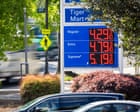
Stop whining about the pump.
Every time the national average ticks toward $4.15, the media cycle devolves into a predictable, low-IQ panic. We see the same grainy footage of SUVs idling at Exxon stations and hear the same "expert" platitudes about the "crushing weight" on the American consumer. It is a lazy narrative built on a fundamental misunderstanding of energy economics.
High gas prices are not a crisis. They are a corrective mechanism.
The obsession with $2.00 or $3.00 gasoline is a longing for an era of systemic inefficiency and subsidized waste. When energy is cheap, we make stupid decisions. We build sprawling suburbs forty miles from job centers. We buy three-ton trucks to haul groceries. We ignore the decaying infrastructure of our power grids because it's easier to just keep burning cheap fossils.
The $4.15 gallon isn't the enemy. It is the only thing standing between the United States and a total stagnation of innovation.
The Myth of the "Crushing" Fuel Cost
Let’s look at the math that the evening news refuses to touch.
In 1980, the average price of gas was roughly $1.19. Adjusted for inflation, that is well over $4.50 in today’s money. Yet, in 1980, the average car got about 16 miles per gallon. Today’s fleet average is closer to 26 mpg, with many modern hybrids pushing 50.
Your "pain at the pump" is a psychological artifact, not a mathematical reality. You are paying more per unit, but you are using far fewer units to travel the same distance. The actual percentage of household income spent on gasoline has remained remarkably stable over the last four decades, hovering between 2% and 4% for the vast majority of Americans.
The outcry isn't about math. It’s about the loss of the perceived right to be inefficient.
Demand Destruction is the Market’s Only Honest Teacher
Economists love to talk about "inelastic demand"—the idea that people have to drive, so they will pay whatever the price is. This is a half-truth. Demand is only inelastic in the short term. In the long term, high prices are the only force powerful enough to change human behavior.
When gas hit record highs in 2008, it didn't just "hurt" people. It killed the Hummer. It forced Detroit to stop building rolling bricks and start competing with Japanese fuel efficiency. It accelerated the adoption of logistics software that optimizes trucking routes, saving billions of gallons of fuel.
Without the "surge" to $4.15, we wouldn't have the momentum for the current energy transition. If gas stayed at $2.00, nobody would buy an EV. No venture capitalist would fund a next-generation battery startup. We would be stuck in a feedback loop of 20th-century technology.
High prices are the signal the market needs to move on. They are the friction that creates fire.
The Inflation Scapegoat
Politicians love to blame gas prices for the broader inflation of consumer goods. It’s an easy sell. "Diesel costs more, so your milk costs more."
While fuel is a component of transport costs, it is rarely the primary driver of the price hikes you see at the grocery store. Labor, packaging, and corporate margin expansion play far larger roles. But you can't point at a "Labor Price" sign on every street corner. You can see the gas sign from a mile away. It becomes the visible proxy for a complex economic malaise that has nothing to do with crude oil.
I have sat in boardrooms where executives decided to raise prices by 10% while blaming a 5% increase in fuel costs. They use the gas station marquee as a shield. If you want to find the real source of your shrinking paycheck, stop looking at the pump and start looking at the debasement of the currency and the consolidation of retail monopolies.
The Strategic Petroleum Reserve Obsession
The moment prices spike, the public screams for a release from the Strategic Petroleum Reserve (SPR). This is peak short-term thinking.
The SPR was designed for supply disruptions—wars, hurricanes, embargoes. Using it to shave fifteen cents off a gallon of regular so a politician can survive a midterm election is a misuse of a national security asset. It’s like eating your emergency rations because you didn’t feel like going to the grocery store.
Artificially lowering the price through SPR releases actually prolongs the agony. It blunts the price signal. It tells consumers, "Don't worry, keep driving that 12-mpg beast, the government will subsidize your habits." It delays the necessary shift toward efficiency.
The Geography of Choice
The people most "harmed" by gas prices are those who have built lives predicated on the permanence of cheap oil.
If you live in an exurb where you have to drive 25 miles to buy a loaf of bread, you have made a massive, leveraged bet on the price of Brent Crude. You are a commodity speculator, whether you realize it or not.
The American dream of the 1950s—the white picket fence in a car-dependent vacuum—was a temporary glitch fueled by post-war abundance. It was never a sustainable model for a global economy. High gas prices are simply the bill coming due for decades of poor urban planning.
We need $4.50 gas to make walkability, transit, and density economically viable. We need it to make the "15-minute city" more than just a conspiracy theory or a fringe urbanist pipe dream.
Why Low Prices are the Real Danger
Imagine a scenario where gas drops to $1.50 tomorrow.
The immediate reaction would be a consumer spending spree. But the long-term result would be a disaster. Capital investment in renewable energy would evaporate overnight. Public transit projects would be defunded. We would revert to our most wasteful impulses, leaving us even more vulnerable when the inevitable supply shock hits three years later.
Cheap oil is an addictive drug that makes us weak and technologically stagnant.
The Actionable Truth
If you want to "beat" gas prices, stop looking for a cheaper station.
- Downsize the vehicle, not the lifestyle. Most Americans drive 90% of their miles alone in a vehicle designed to carry six people and a trailer. That is a massive capital misallocation.
- Hedge your own life. If you are sensitive to gas prices, your biggest risk factor is your commute. Shorten it or electrify it.
- Ignore the headlines. The "highest level in four years" is a meaningless metric when the dollar has lost 20% of its value in that same window. In real terms, gas is currently a bargain.
The media wants you to feel like a victim of the global oil market. You aren't. You are a participant in a transition that is long overdue.
Stop asking the government to fix the price. Start asking why you’re still so dependent on a fluid pulled from the ground halfway across the world.
The high price is the cure. Pay it and move on.