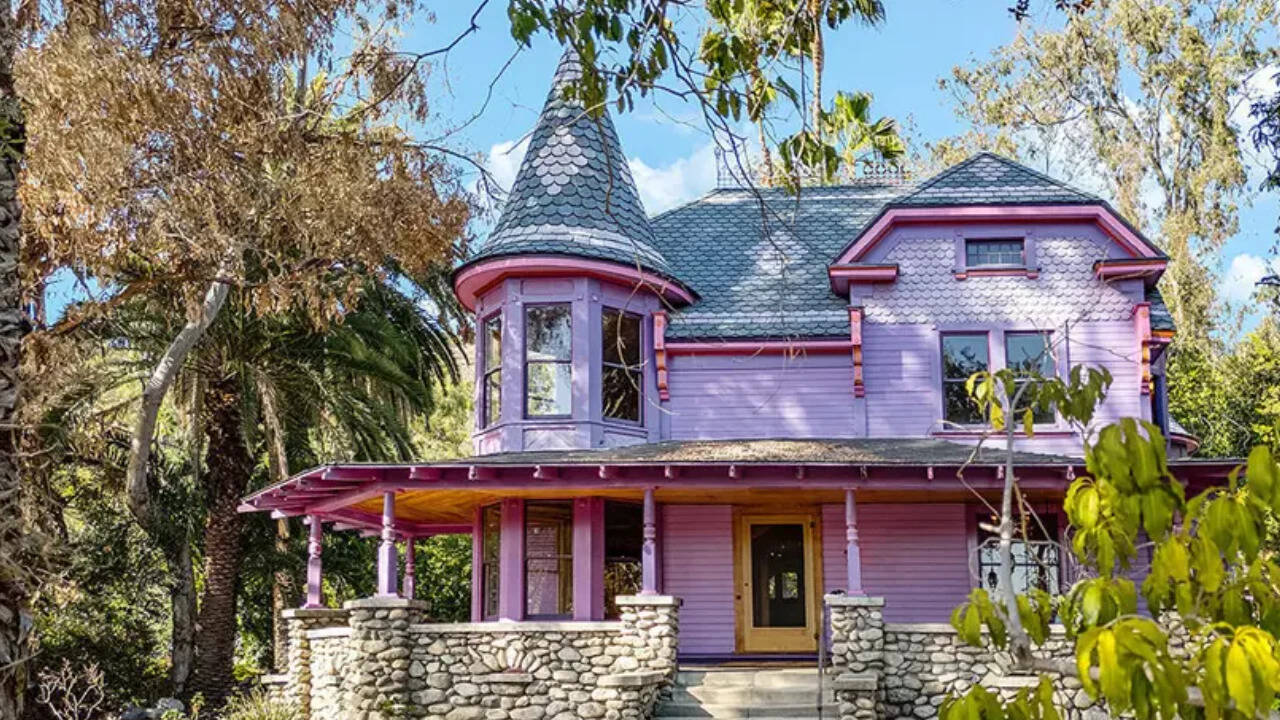
Every time a historic home hits the Los Angeles market with a seven-figure price tag, the internet reacts with predictable outrage. You see the viral headlines. You read the breathless commentary about an 1888 purple Victorian asking $2 million, framed as another absurd symptom of California real estate madness.
They are looking at the wrong numbers.
Real estate journalists love rage-bait. Show a colorful, 138-year-old house, slap a $2 million price tag in the headline, and watch the clicks roll in from people who equate square footage with value. That lazy consensus completely ignores land economics, replacement costs, and the brutal mechanics of Los Angeles zoning. If you look at the underlying asset rather than the lavender siding, a $2 million historic Victorian in central LA isn't a sign of an overpriced bubble. In many cases, it is one of the few remaining ways to buy irreplaceable urban land below replacement cost.
The Myth of the "Overpriced" Historic Home
Most buyers and commentators evaluate residential real estate using a suburban rubric. They take the asking price, divide it by the square footage, compare it to a tract home built in 1998, and declare the historic house a rip-off.
That math fails completely in a supply-constrained metropolis like Los Angeles.
When you buy an 1888 Victorian in neighborhoods like Angelino Heights, West Adams, or Boyle Heights, you are not paying $2 million for an aging wooden box with drafty windows and questionable plumbing. You are buying three distinct assets bundled together:
- Infill Land Scarcity: The parcel sits minutes from Downtown LA, major transit corridors, and cultural hubs. They stopped making dirt near the city center a century ago.
- Replacement Cost Arbitrage: Try building a 3,000-square-foot home from scratch in Los Angeles today with old-growth redwood framing, 12-foot ceilings, hand-milled gingerbread trim, and wrap-around porches. Between city permitting delays, union labor rates, material costs, and architectural fees, new construction in LA routinely exceeds $600 to $800 per square foot before you even buy the dirt.
- Architectural Monopoly: Modern developers build boxy stucco cubes because maximizing floor-to-ceiling ratios drives profit. Nobody builds Queen Anne Victorians anymore. You are buying a non-reproducible artifact.
I have watched institutional investors and seasoned developers walk away from historic properties because the initial inspection report looked scary, only to spend three years and $3.5 million fighting the Los Angeles Department of Building and Safety to build a soulless modern duplex two blocks away. They choked on a $2 million sticker price and ended up spending 75% more for half the charm.
What Everyone Gets Wrong About Buying Old Houses in LA
The standard real estate advice tells buyers to avoid century-old homes unless they have an unlimited renovation budget. That is half-true, which makes it dangerous. The real financial trap isn't the age of the wood; it is the regulatory maze surrounding historic preservation.
Before touching a single paintbrush on an 1888 Victorian, you must distinguish between three very different legal designations in Los Angeles:
- Historic-Cultural Monument (HCM): Designated by the city's Cultural Heritage Commission. Exterior alterations require strict review, and demolition is virtually impossible.
- Historic Preservation Overlay Zone (HPOZ): Neighborhood-level zoning (such as Angelino Heights, LA's first HPOZ). Even changing a porch railing or paint palette requires approval from a local preservation board.
- Unprotected Historic Structure: A house built in 1888 that sits outside an HPOZ and lacks monument status. This gives the owner massive flexibility, though it still triggers California Environmental Quality Act (CEQA) review if you try to tear it down.
People assume historic status is a financial anchor. They see government oversight and run for the hills.
They miss the Mills Act.
The Tax Loophole Nobody Mentions
Enacted in 1972, California's Mills Act is the single most powerful wealth-preservation tool in residential real estate, yet viral articles about expensive Victorians almost never mention it.
Under a Mills Act contract, the owner of a qualified historic property agrees to restore and maintain the structure according to the Secretary of the Interior's Standards. In exchange, the county assessor calculates property taxes not on the $2 million purchase price, but on an income-based valuation formula.
Let's run the actual math.
On a standard $2 million purchase in Los Angeles County, your base property tax (roughly 1.25% including local assessments) starts at $25,000 per year. With a Mills Act contract in place, property tax reductions routinely hit 40% to 60%. Suddenly, your annual tax bill drops to $10,000 or $12,000.
Over a ten-year hold, that single contract saves you $130,000 to $150,000 in cash flow. That isn't theoretical equity; that is tax-free money staying in your bank account every single year, effectively subsidizing the exact roof repairs and foundation bolting that terrify amateur buyers.
The Structural Reality of 1888 Construction
Let's dismantle another lazy assumption: the idea that an 1888 house is inherently fragile compared to modern construction.
In the late 19th century, Southern California builders framed homes using old-growth coastal redwood and Douglas fir. Trees harvested in the 1880s had tight, dense growth rings that make modern farmed pine look like balsa wood. Old-growth redwood is naturally resistant to termites, rot, and fire. When preserved properly, it outlasts modern engineered lumber by decades.
Of course, 1888 builders knew nothing about seismic engineering. They often set timber framing directly onto unreinforced brick foundations or wooden mudsills without anchor bolts.
If you buy an unretrofitted Victorian in Los Angeles, the first major earthquake will slide the house right off its foundation. That is not a flaw to fear; it is a predictable line item to price into your offer.
- Foundation Bolting and Cripple Wall Bracing: Usually costs between $15,000 and $40,000 depending on crawlspace access.
- Knob-and-Tube Rewiring: Upgrading an entire 19th-century electrical system to a modern 200-amp panel runs $20,000 to $35,000.
- Galvanized Pipe Replacement: Swapping corroded steel water lines for PEX or copper adds another $12,000 to $20,000.
Add those up. Even if a $2 million Victorian needs a full seismic retrofit, complete rewiring, and all new plumbing, you are looking at roughly $75,000 to $95,000 in heavy infrastructure work. On a $2 million asset, that is less than 5% of the purchase price. People routinely spend more than that remodeling a single kitchen in Beverly Hills.
The "Purple Paint" Distraction
Why did the original listing grab headlines? Because the house is painted purple.
Media outlets treat eccentric exterior paint on a Victorian as a quirky novelty, or worse, a reason to discount the property. In reality, bold polychrome color schemes—deep purples, teals, ochres, and rust reds—are historically accurate for late-19th-century Queen Anne architecture. The "Painted Ladies" aesthetic pioneered in San Francisco during the 1960s colorist movement was explicitly designed to highlight complex Victorian millwork, fish-scale shingles, and spindle friezes that disappear under boring monochromatic beige.
More importantly, cosmetic paint is the cheapest variable in real estate. Repainting a multi-story Victorian with proper lead-safe containment and elastomeric exterior coatings costs $18,000 to $30,000. Yet buyers routinely pass on structurally sound, well-located properties because they cannot see past a seller's bold color palette.
If a purple exterior scares away 60% of the buyer pool, you don't complain about the paint. You use the lack of competing offers to negotiate $100,000 off the asking price, close escrow, and buy whatever paint you want.
The Brutal Downsides Nobody Admits
I am not here to sell you a romantic fantasy about living in a museum. Owning a 19th-century home in Los Angeles carries serious friction that ruins unprepared buyers.
First, insurance is a nightmare. California's property insurance market is already strained, and standard carriers hate insuring homes built before 1920. You will get rejected by mainstream algorithms because of the age of the structure, forcing you into surplus lines carriers or the California FAIR Plan paired with a Difference in Conditions (DIC) policy. Expect to pay double or triple what you would insure a 2010 build for, until you prove the roof, electrical, and plumbing have been fully updated.
Second, artisans are scarce. You cannot call a standard big-box handyman to repair curved glass sash windows, plaster medallions, or custom-turned redwood balusters. You have to hunt down specialized restoration carpenters, and they charge accordingly.
Third, energy efficiency is terrible. Single-pane wavy glass windows and uninsulated balloon-framed walls leak conditioned air like a sieve. In an HPOZ, you generally cannot rip out original wood windows to install modern double-pane vinyl. You have to rely on interior storm windows, heavy drapery, and high-efficiency heat pumps to keep summer cooling bills from hitting four figures a month.
How to Actually Underwrite a Historic LA Property
If you are looking at a $2 million Victorian in Los Angeles and trying to decide whether it is a trap or a generational asset, stop scrolling through the listing photos. Ignore the staged mid-century furniture and the purple siding. Run this four-step audit instead:
- Check ZIMAS Immediately: Pull up the City of Los Angeles Zone Information and Map Access System (ZIMAS). Check the parcel's exact zoning, HPOZ status, and whether an active Mills Act contract already transfers with the title.
- Inspect the Crawlspace Before the Kitchen: Bring a structural engineer, not just a general home inspector. Look at the mudsills, floor joists, and foundation perimeter. If the redwood framing is dry and bolted to modern concrete, the hardest part of your life is already done.
- Price the Hidden Systems: Subtract the exact cost of rewiring, repiping, and roof replacement from your target valuation. Never pay turnkey prices for a house running on 1920s knob-and-tube wiring.
- Analyze Lot Utilization: Many 1880s LA parcels sit on deep lots zoned R2 or RD1.5. Even if the main house is protected, you may have the legal right to build a detached Accessory Dwelling Unit (ADU) at the rear of the property, generating $3,000 to $4,500 a month in rental income to offset your mortgage.
Stop Confusing Price With Value
The internet wants you to believe that a $2 million purple Victorian in Los Angeles is proof that the housing market has lost its mind. That narrative is comforting if you are sitting on the sidelines waiting for a crash that never comes.
Look at the actual numbers. In a city where median single-family home prices regularly breach $1.2 million for unremarkable 1,400-square-foot stucco boxes on tiny lots, paying $2 million for irreplaceable 1888 craftsmanship, prime urban land, potential ADU income, and a 50% property tax discount isn't crazy.
The crazy move is paying the exact same price for a disposable modern box with zero soul and a full tax bill.



