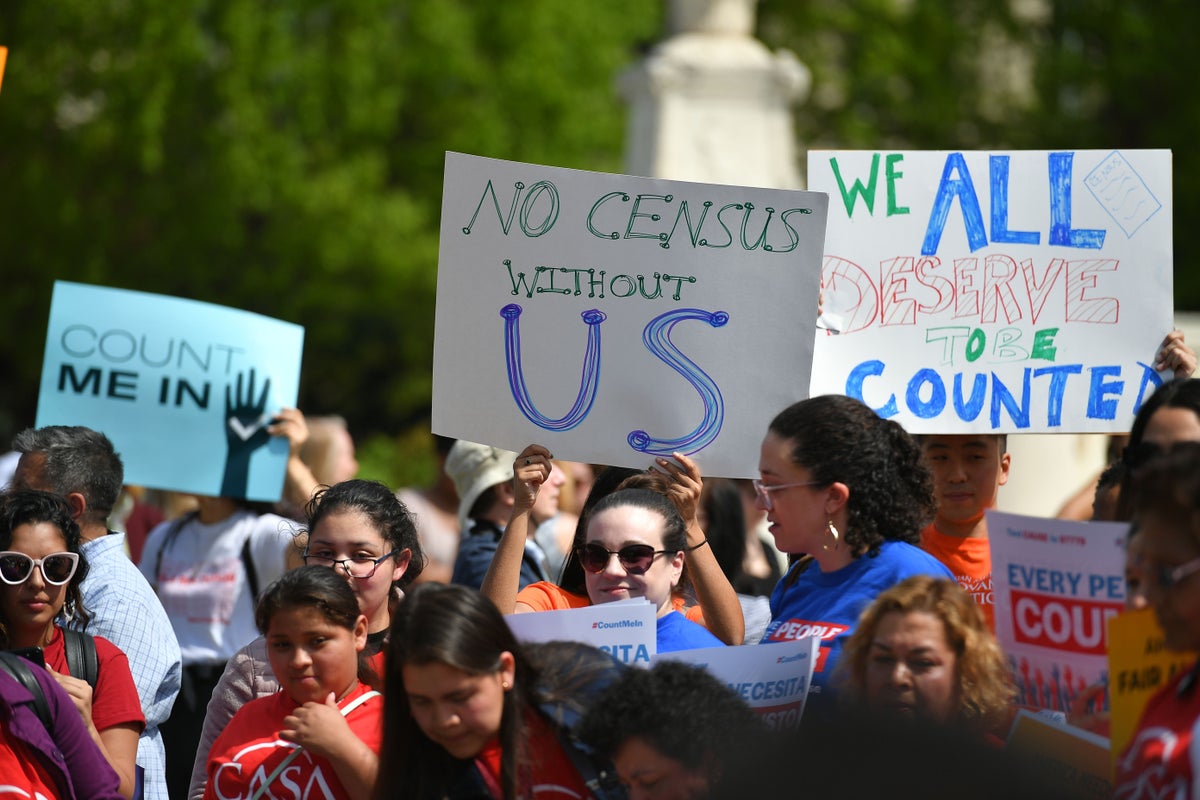
The federal government is setting the machinery in motion to alter how millions of people are counted, or left out, in the upcoming 2030 national head count. President Donald Trump’s administration has advanced proposals that would inject a citizenship question into census testing and ultimately strip non-citizens without green cards from crucial apportionment totals. This mechanism targets the foundational data used to distribute congressional seats and Electoral College votes. For decades, the decennial census has operated under a strict interpretation of the Fourteenth Amendment, which mandates counting the "whole number of persons in each state". Discarding that interpretation threatens to upend the political geography of the United States.
The Mechanics of Exclusion
Bureaucratic inertia rarely shifts overnight. Yet the Department of Commerce has begun reshaping preparation for the next decennial count by integrating survey methods that explicitly probe citizenship status. Bureau researchers have long warned that asking about legal status on a mandatory national survey causes a chilling effect. Participation plummets in immigrant communities and mixed-status households. Households that fail to respond skew federal resource allocation, local funding models, and congressional representation.
The strategy extends far beyond mere data collection. Political strategists aligned with the administration recognize that altering the baseline population numbers shifts power away from dense, diverse urban centers. When millions of non-citizens are erased from apportionment calculations, states with large immigrant populations stand to lose seats in the House of Representatives. Those seats migrate elsewhere, redistributing national political influence to whiter, more rural districts.
Historical Precedent and Constitutional Walls
Every census since 1790 has attempted to tally every resident physically present within US borders, regardless of legal standing. Enslaved people and Native Americans faced specific, tragic constitutional exclusions in early iterations, but the framework never hinged on modern immigration classifications. Attempting to introduce a blanket exclusion now runs directly into constitutional text.
The Fourteenth Amendment leaves little room for ambiguity regarding the apportionment base. It specifies persons, not citizens. During his first term, Trump pursued a similar objective, which culminated in a Supreme Court rebuke when justices found the administration's stated rationale "contrived". The current iteration of the policy aims to bypass those judicial roadblocks by testing methodologies years in advance and embedding the questions within routine federal surveys like the American Community Survey.
Legal challenges are already drafted. Civil rights organizations and Democratic lawmakers are preparing for a protracted multi-year courtroom battle. They argue that weaponizing the statistical agency compromises the integrity of federal data used by economists, epidemiologists, and city planners. A broken census does not just affect congressional maps; it blinds local governments trying to build roads, hospitals, and emergency services for the actual population living on their streets.
The Battlegrounds of Data
Field tests for the 2030 count have already shrunk in scale and shifted in geography, reflecting the political friction surrounding the process. By narrowing test locations and utilizing controversial survey instruments, the administration is stress-testing a system built for neutrality.
The stakes involve more than abstract constitutional theory. Consider a hypothetical state legislature controlled by a single party that gains access to block-level citizenship data. Armed with that granularity, mapmakers can construct voting districts based strictly on the voting-age citizen population rather than total inhabitants. Millions of children and non-citizens vanish from the denominator. The resulting maps concentrate legislative power permanently, insulating incumbents from demographic shifts.
Opponents face a shifting timeline. Even if the current administration pushes the policy forward, subsequent political shifts or congressional action before 2029 could dismantle the changes before final printing. Yet the damage to public trust may already be permanent. When government statisticians are viewed as extension officers of immigration enforcement, the foundational cooperation required to count a nation of 330 million people dissolves into fear and silence.
Trump pushes for 'new' census that excludes non-citizens
This archival footage captures President Trump announcing directives to modify data collection standards, shedding light on the ongoing push to reshape federal population counts.