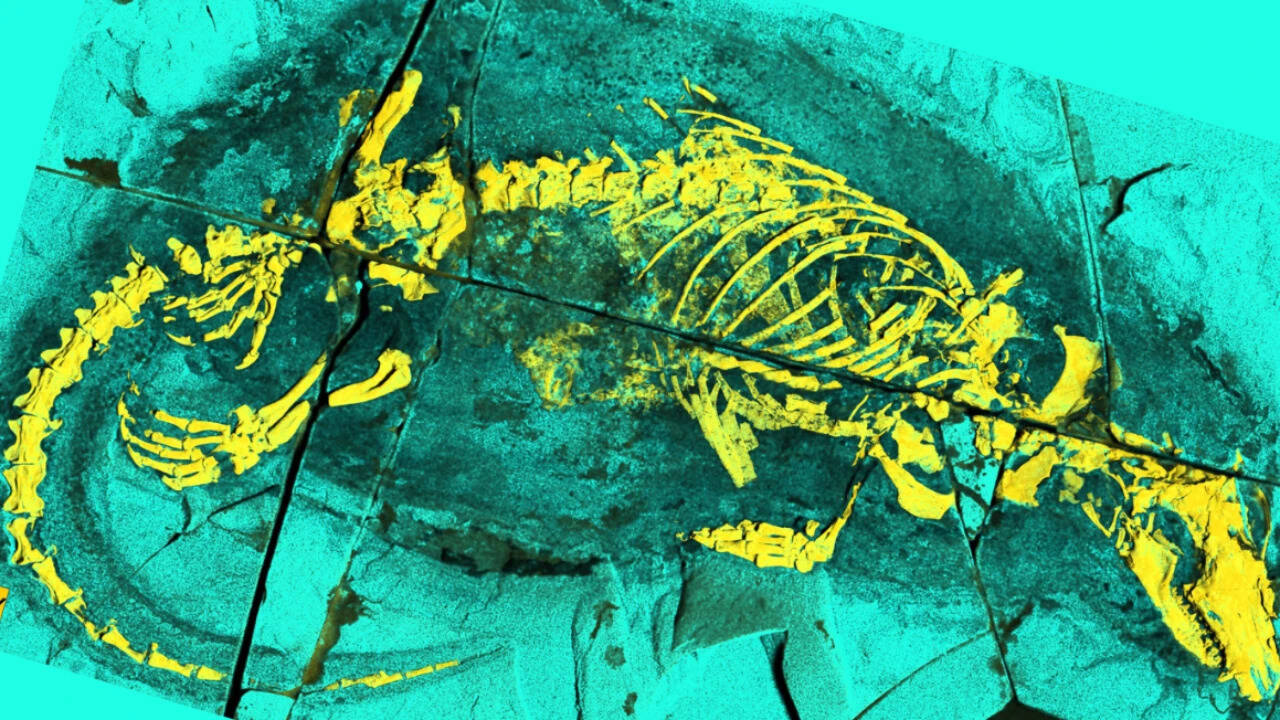
Evolution hides its best secrets in mud. Deep in the fossil beds of China, researchers pulled a specimen from the rock that completely changes how we picture early mammals. This isn't just another broken jawbone or a lonely tooth. We are talking about a remarkably preserved creature that lived 165 million years ago during the Jurassic period, and it was doing things we assumed only modern aquatic beasts had figured out.
Forget the tired trope of tiny, shivering shrews hiding under ferns while dinosaurs ruled the earth. This extinct animal, named Castorocauda lutresimilis, weighed around a pound and looked strikingly like a modern otter or platypus. More importantly, its fossilized skeleton preserved fur, soft tissue, and specialized bone structures that prove it swam like a fish and swallowed like a modern mammal long before dinosaurs breathed their last.
Paleontologists missed the bigger picture for decades by assuming all Mesozoic mammals were generic, nocturnal insect-eaters. That assumption is dead wrong. Let's look at what this fossil actually tells us about our ancient ancestors and why it forces us to rewrite the mammalian family tree.
The Jurassic Otter That Shocked Paleontologists
When scientists first unearth a new fossil, they look for clues about how the creature lived. With Castorocauda, the evidence was glaring. It had a wide, scaly tail shaped much like a beaver's, designed for propulsion in murky Jurassic lakes. Its limb bones were flattened and robust, built for paddling against strong currents rather than scampering through leaf litter.
You can picture it clearly. While massive theropods stalked the fern prairies, this half-kilogram beast slipped into freshwater rivers to hunt fish with needle-sharp teeth. It occupied an ecological niche we thought was empty for another hundred million years.
People always ask how a fossil can preserve soft tissue like hair and scales. It takes a very specific type of quiet, oxygen-depleted sediment to bury a carcass before scavengers tear it apart. The Jehol Biota and related fossil beds in China provided that exact environment. The mud acted like a vault, locking in microscopic details of pelage and skin that usually rot away within days.
How Swallowing Changed Everything
Swimming is impressive, but the real anatomical breakthrough lies in the skull and throat. To understand why scientists got so excited about this discovery, you have to look at how animals eat.
Reptiles and amphibians basically gulp their food whole or tear chunks off and swallow them with minimal chewing. Mammals do something entirely different. We chew our food thoroughly, mix it with saliva, and use a specialized muscular tongue to push it back while breathing through a separated nasal passage.
Castorocauda possessed the dental specialization to process fish efficiently. Its teeth were distinctively heterododont, meaning it had incisors, canines, premolars, and molars meant for gripping slippery prey and shearing flesh. This specialized dentition proves that the evolutionary leap toward complex chewing happened much earlier than textbooks taught ten years ago.
When you chew your food before swallowing, you speed up digestion. That metabolic shift was the secret weapon that allowed early mammals to generate their own internal heat. Endothermy wasn't just a nice upgrade. It was the survival mechanism that let our ancestors stay active at night and survive whatever ecological shocks came their way.
Why The Mesozoic Wasnt Just Dinosaur TV
Popular culture loves to frame the Mesozoic era as a two-hour documentary starring angry T-Rexes and grazing sauropods. Mammals are usually relegated to tiny extras scurrying underfoot.
That narrative is pure fiction. By the middle of the Jurassic, mammalian lineage was already exploding into weird, wonderful, and highly specialized forms. We had gliders that looked like modern flying squirrels, burrowers with shovels for hands, and swimmers like our Chinese friend.
+-------------------------------------------------------+
|          Mesozoic Mammalian Diversification           |
+-------------------+-----------------------------------+
| Ecological Niche  | Representative Fossil Type        |
+-------------------+-----------------------------------+
| Arboreal / Glider | Volaticotherium (flying squirrel) |
| Aquatic / Swimmer | Castorocauda (otter-like)         |
| Fossorial / Digging| Repenomamus (badger-like predator)|
+-------------------+-----------------------------------+
These creatures weren't waiting around for an asteroid to clear the stage. They were already winning the evolutionary arms race in the shadows, perfecting traits like lactation, specialized hearing bones, and high-efficiency metabolisms that would eventually let them inherit the planet.
What This Means For Modern Mammal Origins
Every time a fossil like this turns up, evolutionary biologists have to redraw their trees. The presence of specialized semi-aquatic traits 165 million years ago means that mammalian divergence happened at a blistering pace.
It also reminds us how much we still have to learn. Most of the fossil record is microscopic dust or shattered fragments. Complete skeletons with hair impressions are the lottery tickets of paleontology. When one hits, it shatters decades of consensus in a single afternoon.
Stop thinking of early mammals as timid, uniform mice. They were daring, diverse, and surprisingly adaptable innovators that conquered rivers, trees, and burrows while the dinosaurs still ruled the canopy. The next time you watch an otter slide down a muddy riverbank, remember that its blueprint was already winning in the rivers of Jurassic China.