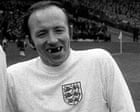
In 1966, a short-sighted, gap-toothed kid from Manchester danced on the Wembley turf. Norbert "Nobby" Stiles had just helped England win the World Cup. He held the Jules Rimet trophy in one hand, his false teeth in the other, leaping in a spontaneous jig of pure, unadulterated joy. It is one of the most famous images in British sporting history. It represents the pinnacle of human achievement, of a boy who conquered the world through sheer grit and a willingness to throw his body into harm's way.
Decades later, that same man sat in a quiet room, swallowed by a heavy, terrifying silence. The teeth were still missing. But so was the memory of the dance.
The man who had conquered Wembley spent his final years in a care home, bedbound, struggling to recognize the family who loved him. When he was in his late fifties, his family noticed the first cracks in the armor. He began forgetting small details. He repeated questions. Eventually, a dark, creeping sense of doom settled over their household—a quiet, unnamed monster that they could feel approaching but could not stop. By 2010, the disease had advanced so ruthlessly that Nobby had to sell his World Cup winner's medal just to pay for his own care.
When he died in 2020 at the age of 78, his family did not let the story end in the quiet graveyard. They wanted to know what had stolen the father they loved.
Now, a coroner's court in Stockport has provided the final, devastating answer.
The Weight of the Rain
At Manchester United's Old Trafford training ground in the late 1950s and 1960s, there was a training contraption that seemed entirely harmless. It was a standard leather football hanging from the ceiling on a string.
Young players, eager to please the legendary manager Matt Busby, were encouraged to stand beneath it and practice their headers. Hit it. Watch it swing back. Hit it again.
No one forced them. It was simply what you did to survive in the professional game.
To understand what Nobby Stiles' brain went through, we must discard our modern understanding of football. Today's balls are synthetic, light, and engineered to repel water. The ball Nobby headed was a heavy, 16-ounce leather casing laced together with thick seams. On a dry day, it felt like a brick. On a wet, rainy Tuesday in Manchester, that leather casing acted like a sponge. It absorbed the mud and the water, swelling in weight and density.
Every time Nobby met that wet leather ball with his forehead, his brain was subjected to an impact equivalent to 80 percent of a professional boxer's punch.
Imagine taking a fraction of a heavyweight punch to the skull. Now imagine doing it forty times a day. Every day. Five days a week. For seventeen years.
Medical experts at the inquest calculated a conservative estimate of the toll: Nobby Stiles headed a football approximately 140,000 times during his career.
The Invisible Scar
When Nobby's family donated his brain to medical research, neuropathology expert Dr. Daniel Du Plessis examined the tissue. What he found was a brain ravaged by two distinct enemies. The first was Alzheimer’s disease, a tragic but common affliction of old age.
The second enemy, however, was entirely man-made: Chronic Traumatic Encephalopathy (CTE).
CTE is not a natural disease of aging. It is a progressive, degenerative brain condition caused by repeated blows to the head. It is the signature injury of American football players and boxers.
When Senior Coroner Alison Mutch asked Dr. Du Plessis to be entirely clear, she did not mince words: "You are saying repeated heading of the ball is the cause of his CTE?"
"Yes," the expert replied.
The coroner's final ruling was historic, clinical, and tragic. She ruled that while Alzheimer’s was present, Nobby’s severe dementia was directly contributed to by "high stage" CTE. And that CTE was caused by the requirement to repeatedly head a football during his career.
The very skill that made Nobby a legend, the bravery that earned him the love of a nation, was the very thing that slowly, systematically dismantled his mind.
But the real problem lies elsewhere. Nobby Stiles is not an isolated tragedy.
The Growing Roll Call
Consider what happens next when a sport refuses to look at its own reflection.
Only months before Nobby's ruling, another inquest concluded that Gordon McQueen—the towering Scotland and Manchester United defender who died at 70—also had his brain destroyed by CTE. His daughter, television presenter Hayley McQueen, remarked with devastating simplicity that England's iconic 1966 World Cup-winning squad has been "pretty much wiped out" by neurodegenerative disease.
Behind every name on that team sheet is a family that watched a giant shrink into a shadow.
The governing bodies of football find themselves in a defensive crouch. In the High Court, lawyers for the Football Association (FA) have argued that it has "not been established by science" that heading a ball leads to permanent brain damage.
But the families of these players are tired of waiting for the science to be neat enough for a legal brief.
They point to a landmark 2019 study, co-funded by the FA itself, which revealed a terrifying statistic: professional footballers are three and a half times more likely to die of neurodegenerative diseases than the general public.
Some progress is finally creeping into the modern game. The FA has begun phasing out all heading in youth football up to the under-11 level. But for the generation who played on the muddy pitches of the twentieth century, these changes are decades too late.
Leaving the Football at the Door
For all his legendary status on the pitch, Nobby's son, John Stiles, remembers a man who was entirely different once he crossed his own threshold.
"If you went into his house, you would never know he was a footballer," John told the inquest. "He never talked, he never bragged. Football was left at the door."
He was just a father. A husband. A quiet, humble man from Manchester who loved his family above all else. He did not keep his medals on display; indeed, those medals had to be sold to ensure he could be cared for with dignity when his mind began to slip away.
The tragedy of Nobby Stiles is not just that he died of a brain disease. It is that the sport he adored, the game he gave his youth and his health to, has been so slow to acknowledge the cost of its own entertainment.
As John Stiles stood outside the court, he made an appeal that bypassed the dry legal debates and went straight to the heart of the matter. We do not need more decades of slow, agonizing research to prove what is happening to these men. We need to help the families who are watching their heroes fade away in expensive care homes today.
The image of Nobby dancing at Wembley will live forever in the archives of English sport. But we can no longer look at that joyful dance without remembering the quiet, devastating price he paid for it.