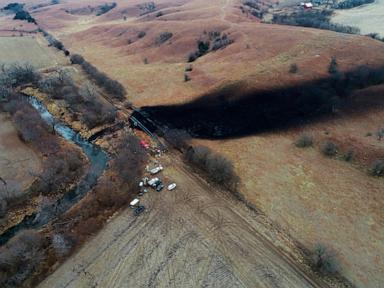
On a freezing December night in 2022, a profound silence enveloped the rolling hills of Washington County, Kansas. In this stretch of the American heartland, the rhythms of life are dictated by the wind, the condition of the soil, and the steady flow of Mill Creek. But beneath the frozen grass, buried under layers of earth, a different kind of pulse was racing.
Inside a 36-inch steel artery belonging to the Keystone Pipeline system, thick, heavy Canadian tar sands oil was rushing southward toward refineries in Texas. Then, at approximately 9:30 p.m., the pressure dropped.
It was not a gradual leak. It was an instantaneous rupture.
A section of the high-pressure pipeline tore open near a bend, sending a geyser of suffocating, black crude exploding through the soil. The force stained the hillside black and sent nearly 543,000 gallons of thick oil surging overland. Within hours, a waterway that had sustained local wildlife and cattle for generations was buried under a blanket of sludge an inch thick, stretching bank-to-bank for more than three miles.
The corporate press reported the incident through the cold lens of mathematics and regulatory jargon. They spoke of "barrels," "compliance," and "civil penalties." But to understand what actually happened in Washington County, you have to look past the spreadsheets. You have to look at the invisible stakes of a landscape disrupted, and the immense human effort required to piece a shattered ecosystem back together.
The Weight of the Sludge
To understand why this specific spill was so devastating, consider the nature of the substance traveling through the pipe. This was not light, buoyant crude oil that floats easily on top of water, waiting to be skimmed away. This was bitumen from the Canadian tar sands—a substance so dense and heavy it must be diluted with liquid chemicals just to force it through a pipe.
When bitumen hits a cold, moving stream like Mill Creek, it undergoes a terrifying transformation. The volatile chemicals carrying it evaporate into the air, leaving behind a thick, tar-like substance that sinks. It wraps around rocks. It buries itself in the sediment. It smothers the creek bed, choking out the microscopic life that forms the very foundation of the river's ecosystem.
The immediate aftermath was catastrophic. The Kansas Department of Health and Environment was forced to issue an emergency stream advisory, warning farmers that their cattle could no longer drink from the water, and telling families to keep their children and pets far away. The creek, suddenly, was a dead zone.
Imagine being a local landowner walking out to your pasture the next morning, expecting the crisp, clean air of a Kansas winter, only to be met by the stinging, chemical stench of a refinery. The federal government later documented that more than 2,700 animals—birds, fish, amphibians, and mammals—were caught in the black tide. Among the silent casualties was the long-eared bat, an endangered species already fighting a desperate battle for survival.
The waterway was rendered entirely lifeless.
A Ghost in the Machinery
The question that haunted the community, and federal investigators, was simple: How does a modern, multi-billion-dollar piece of infrastructure just break?
The answer, it turned out, lay buried in the past.
Imagine building a house on a foundation of shifting sand, knowing that a single corner is under immense, unnatural stress. According to a subsequent engineering investigation, the specific bend in the pipeline that ruptured had been "overstressed" since the day it was installed in December 2010. The very construction activity meant to secure the pipe had altered the land around it.
Worse, the soil beneath the heavy steel tube had been improperly compacted. The pipe was essentially suspended in a state of physical anxiety, carrying immense pressure while resting on unstable ground. Though the operator re-excavated the site in 2013, they left the strained section of pipe in place. It was a ticking clock. For twelve years, the metal endured the microscopic flexing of thermal expansion and intense pressure until a faulty weld finally gave way under the bending stress.
In the years following the disaster, the corporate structure behind the pipeline shifted. The original builder, TC Energy, spun off its crude oil pipeline business into a new entity called South Bow. But changing the name on the corporate letterhead does not erase the physical reality of a scarred landscape.
The Human Cost of Cleanliness
What followed the disaster was a monumental, grueling battle against time and chemistry. While the public's attention quickly shifted to other news cycles, an army of human beings descended on Washington County.
For months, federal and state environmental workers, alongside cleanup crews, lived in a grueling reality. To get to the oil that had sunk to the bottom of Mill Creek, engineers had to perform a massive feat of temporary terraforming. They built underflow dams, constructed giant diversion systems, and literally dewatered miles of the creek, pumping the water out to expose the contaminated mud beneath.
Crew members spent more than 6,000 hours in frozen mud, using vacuum trucks, skimmers, and their own hands to scrape the poison out of the earth. They excavated approximately 200,000 tons of oil-impacted soil and debris, hauling it away in an endless caravan of trucks. They treated and discharged more than 54 million gallons of contaminated surface water, filtering it repeatedly until it was safe to return to the natural flow.
It was an exhausting, multi-million-dollar exercise in undoing a mistake that should have been prevented a decade prior.
The Balance Sheet of Accountability
Now, nearly four years after the rupture, the final financial reckoning has arrived. Under a federal settlement filed in July 2026 by the U.S. Environmental Protection Agency, the Department of Justice, and the State of Kansas, South Bow has agreed to pay a heavy price for the negligence inherited from the pipeline's past.
The numbers are staggering on paper. The company will pay a civil penalty of $26.9 million for violating the Clean Water Act. It will hand over another $3 million to the state of Kansas for natural resource restoration. But perhaps the most telling figure is the $40 million the company is now legally mandated to spend on pipeline integrity and maintenance projects designed to ensure this never happens again.
This settlement represents a rare moment where the government draws a hard line in the dirt, demanding that the companies crossing the American heartland treat the soil with the same reverence as the people who live on it.
The money will fund future restoration, and the company has already completed dozens of "integrity digs" along thousands of miles of pipe to check for other hidden flaws. But a check written to the federal treasury cannot instantly heal a wounded ecosystem.
Today, if you visit Washington County, the heavy machinery is gone. The dams have been dismantled. The water has been returned to its natural course, and Mill Creek is flowing once more. To a passing driver, the prairie looks healed, the grass green, the water clear.
But beneath the surface, the memory remains. The land remembers the oil, just as the people remember the night the heartland fractured. The true cost of our energy independence is not measured in the dollars paid at a pump, or the millions paid in a federal courtroom, but in the fragile, quiet spaces where a creek tries to forget the taste of tar.

