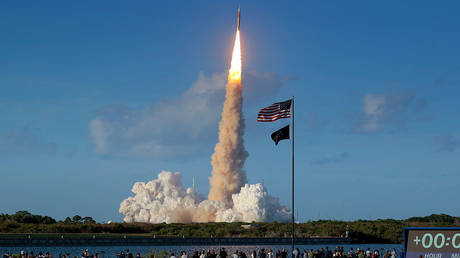
On April 1, 2026, a 322-foot pillar of fire lifted four human beings off a Florida launchpad and toward a destination we haven’t touched in over five decades. Artemis II is not just a sequel to the Apollo era; it is the most expensive, high-stakes infrastructure project in human history. While the public sees a triumphant return to the stars, the reality is a desperate scramble for orbital dominance, a pivot to a privatized space economy, and a cold-blooded geopolitical necessity to beat China to the lunar south pole.
The mission is currently in its critical first phase. As of today, the Orion spacecraft is loitering in high Earth orbit, completing a 24-hour gauntlet of systems checks. This isn't a victory lap. The crew—Reid Wiseman, Victor Glover, Christina Koch, and Jeremy Hansen—are essentially test pilots for a $100 billion architecture that has suffered years of delays and billions in cost overruns. If the life support systems or the manual piloting demonstrations fail now, the entire American strategy for deep space collapses.
The Myth of Scientific Discovery
We are told we are going back for "science." That is a half-truth designed for press releases. While the scientific community is eager to study lunar volatiles and the history of the solar system, the primary driver for Artemis II is strategic preeminence.
In 1972, we left the moon because we had "won." The Soviet Union was no longer a threat in the lunar theater, and the massive $25 billion price tag (in 1960s dollars) was no longer justifiable to a public weary of the Vietnam War. Today, the map has changed. China plans to land taikonauts on the moon by 2030 and is already building a "networked" lunar infrastructure.
If the United States does not establish the rules of the road now, we risk being locked out of the most valuable real estate in the solar system. The moon's south pole contains water ice in permanently shadowed craters. This isn't just for drinking; it is the "oil" of the 21st century. By breaking water ($H_2O$) into hydrogen and oxygen, the moon becomes a gas station for the rest of the solar system. Whoever controls that ice controls the economics of deep space.
A Brutal Financial Reality
The Artemis program is an astronomical departure from the NASA of the 1960s. Apollo was a government-run monolith. Artemis is a fragile marriage between legacy bureaucracy and Silicon Valley ego.
NASA is spending roughly $4.1 billion per launch on the Space Launch System (SLS). For perspective, that single mission cost dwarfs the entire multi-year budget of India’s Chandrayaan program. The SLS is a "heritage" rocket, meaning it uses refurbished Space Shuttle engines and solid rocket boosters. It is expensive, non-reusable, and arguably obsolete before it even cleared the tower.
Why use it? Because of political geography. The components for the SLS are built in every single US state. It is a jobs program as much as a space program. This creates a "too big to fail" scenario where the mission must proceed regardless of the skyrocketing costs.
However, Artemis II marks the end of this era. For the upcoming Artemis III landing, NASA has been forced to outsource the actual lunar lander to SpaceX and Blue Origin. The agency can get the astronauts to the moon's neighborhood, but it no longer has the technical or financial capacity to land them there without Elon Musk or Jeff Bezos. This shift from "exploration" to "service procurement" is a fundamental change in how the US government operates.
The Apollo 13 Shadow
The flight path for Artemis II is a "free-return trajectory." This is the same safety-first maneuver used to bring the crippled Apollo 13 crew home. The spacecraft will fly approximately 4,700 miles beyond the far side of the moon, using lunar gravity to slingshot back toward Earth without needing a massive engine burn to return.
It sounds safe, but the risks are concentrated in two areas:
- The Heat Shield: During the uncrewed Artemis I mission, the Orion heat shield experienced "unexpected char loss." NASA spent over a year analyzing why pieces of the shield flaked off during reentry. If the shield fails during the Artemis II splashdown at 25,000 mph, the mission ends in disaster.
- Radiation: The crew will travel 250,000 miles from Earth, far beyond the protection of our planet's magnetic field. They will be exposed to high-energy cosmic rays and potential solar flares. This is the ultimate test of Orion’s shielding capabilities before we attempt a long-term lunar stay.
Diversity as a Strategic Asset
The selection of Victor Glover and Christina Koch is frequently framed as a social milestone—the first person of color and the first woman to head to the moon. While true, this is also a calculated move for long-term sustainability.
NASA learned a bitter lesson in the 1970s: if the public doesn't see themselves in the mission, they won't fund it. By ensuring the "Artemis Generation" is demographically representative, the agency is building a broader political base to shield its budget from the whims of changing administrations. It is a survival tactic. If you want a 30-year program, you need 30 years of public buy-in.
The Lunar Toll Road
Within the next decade, the moon will no longer be a barren wasteland for flags and footprints. It is being reimagined as a waystation.
The "Gateway"—a small space station planned for lunar orbit—will serve as a transit hub. The goal is to move the heavy lifting of space travel away from Earth's deep gravity well. If we can manufacture fuel on the moon and launch from its 1/6th gravity, the cost of reaching Mars drops by orders of magnitude.
But this vision relies entirely on the success of the next nine days. Artemis II is the stress test for the hardware that will eventually carry humans to the Red Planet. If Orion holds together, we have a bridgehead. If it doesn't, the dream of a multi-planetary species stays grounded for another fifty years.
The astronauts are currently 200,000 miles away, hurtling into the dark at speeds that would melt most machines. They aren't just there to take photos of the far side. They are there to prove that the United States can still execute at the edge of the impossible—and that the moon is worth the $100 billion price of admission.
The countdown to the Trans-Lunar Injection burn begins in less than twelve hours. We are about to find out if our reach finally matches our ambition.